Model Answer

Discuss the changing nature of kinship relations in the contemporary world.

Model Answers

Q: Discuss the changing nature of kinship relations in the contemporary world.

Question asked in UPSC Sociology 2021 Paper 1. Download our app for last 20 year question with model answers.

Model Answer:

Changing Nature of Kinship Relations

Robin Fox defines kinship as the study of what man does with the basic facts of life like mating and gestation. Traditionally viewed by A.R. Radcliffe-Brown as an ascribed system of social relations based on descent, contemporary kinship has shifted from structurally binding institutions to achieved, affective, and negotiated relationships.

Structural and Late-Modern Transformations

  • Functionalist Shift: Talcott Parsons noted that industrialization necessitated the “Isolated Nuclear Family” for geographic mobility, a trend supported by William J. Goode’s thesis on global family patterns.
  • Late-Modern Reflexivity: Anthony Giddens argues kinship is increasingly defined by the “Pure Relationship,” maintained for mutual satisfaction rather than structural obligation. Ulrich Beck highlights this transition from traditional fate to individual choice amidst modern individualization.

Pluralization, Technology, and Kinship Resilience

  • Families of Choice: Kath Weston (Families We Choose) illustrates how LGBTQ+ communities forge kinship based on solidarity and care rather than strict biological ties.
  • Fictive Kinship: Carol Stack demonstrated how the urban poor rely on non-relatives for survival, proving kinship adapts to economic constraints.
  • Impact of ART: Marilyn Strathern argues that Artificial Reproductive Technologies (IVF, surrogacy) fracture traditional descent by separating biological, gestational, and social parenthood.
  • Modified Extended Family: Challenging the narrative of kinship decline, Eugene Litwak posits that modern communication allows geographically dispersed kin to maintain strong, active networks of financial and emotional support.

Globalization has birthed “Transnational Care Chains” (Arlie Hochschild), where migrant women from the Global South care for families in the North while remitting resources to their own kin, fundamentally altering spatial kinship dynamics. Furthermore, transnational surrogacy commercializes sacred lineage ties into legal contracts.

Conclusion

Kinship has not disappeared; it has dynamically evolved. Moving from rigid structures dictated by blood and lineage, it remains a highly adaptable, resilient social institution, manifesting today as fluid, reflexive networks of choice, care, and technology.

Discuss the changing nature of kinship relations in the contemporary world. Read More »

Discuss the challenges faced by the cooperative movements in India. Suggest measures to strengthen the movement at the grass-roots level.

Model Answers

Q: Discuss the challenges faced by the cooperative movements in India. Suggest measures to strengthen the movement at the grass-roots level.

Question asked in UPSC Sociology 2023 Paper 2. Download our app for last 20 year question with model answers.

Model Answer:

Cooperative Movements in India

Sociologically, the cooperative movement is an institutionalized social movement envisioned for structural transformation and distributive justice. However, instead of realizing Gandhian egalitarianism, it has often become a site for reproducing deep-rooted rural inequalities.

Sociological Challenges of the Cooperative Movement

  • Elite Capture: B.S. Baviskar, in his study of Maharashtra’s sugar cooperatives, argued they are frequently hijacked by the Dominant Caste (e.g., Marathas), who use them as springboards for political power, creating patron-client relationships.
  • Caste-Class Nexus: Utilizing a Marxist framework, A.R. Desai highlighted that state-sponsored cooperatives primarily benefit the “rural bourgeoisie” (rich farmers), further marginalizing landless laborers and lower castes.
  • Gender Blindness: Despite women performing the bulk of grassroots agricultural and dairy labor, cooperative boards remain entrenched in systemic patriarchy.
  • Bureaucratization: Viewed through a Weberian lens, excessive state control has stripped cooperatives of their grassroots “social movement” character, reducing them to rigid, top-down bureaucratic apparatuses.

Measures for Grassroots Strengthening

  • Democratization: Strict enforcement of the 97th Constitutional Amendment Act (2011), which mandates board reservations for SCs, STs, and women, is essential to dismantle dominant caste monopolies.
  • Building Social Capital: Invoking Robert Putnam’s concept of “social capital,” grassroots solidarity must be rebuilt via homogenous self-help groups (SHGs) feeding into macro-cooperatives.
  • Institutional Support: The new Ministry of Cooperation’s vision of “Sahkar se Samriddhi” must actively prioritize bottom-up structural reforms over centralization.

SEWA (founded by Ela Bhatt) represents a highly successful subaltern, women-led cooperative integrating trade unionism. Similarly, the AMUL model demonstrates how economic interdependence can successfully transcend traditional caste barriers.

Conclusion

To reconcile Gandhi’s vision of cooperative self-reliance with B.R. Ambedkar’s skepticism of Indian villages as “dens of localism,” the movement must transition from being a “cooperative of the privileged” to a genuine “cooperative of the subaltern.”

Discuss the challenges faced by the cooperative movements in India. Suggest measures to strengthen the movement at the grass-roots level. Read More »

Critically examine Max Weber’s theory of Social Stratification.

Model Answers

Q: Critically examine Max Weber's theory of Social Stratification

Question asked in UPSC Sociology 2021 Paper 1. Download our app for last 20 year question with model answers.

Model Answer:

Max Weber theory of social stratification

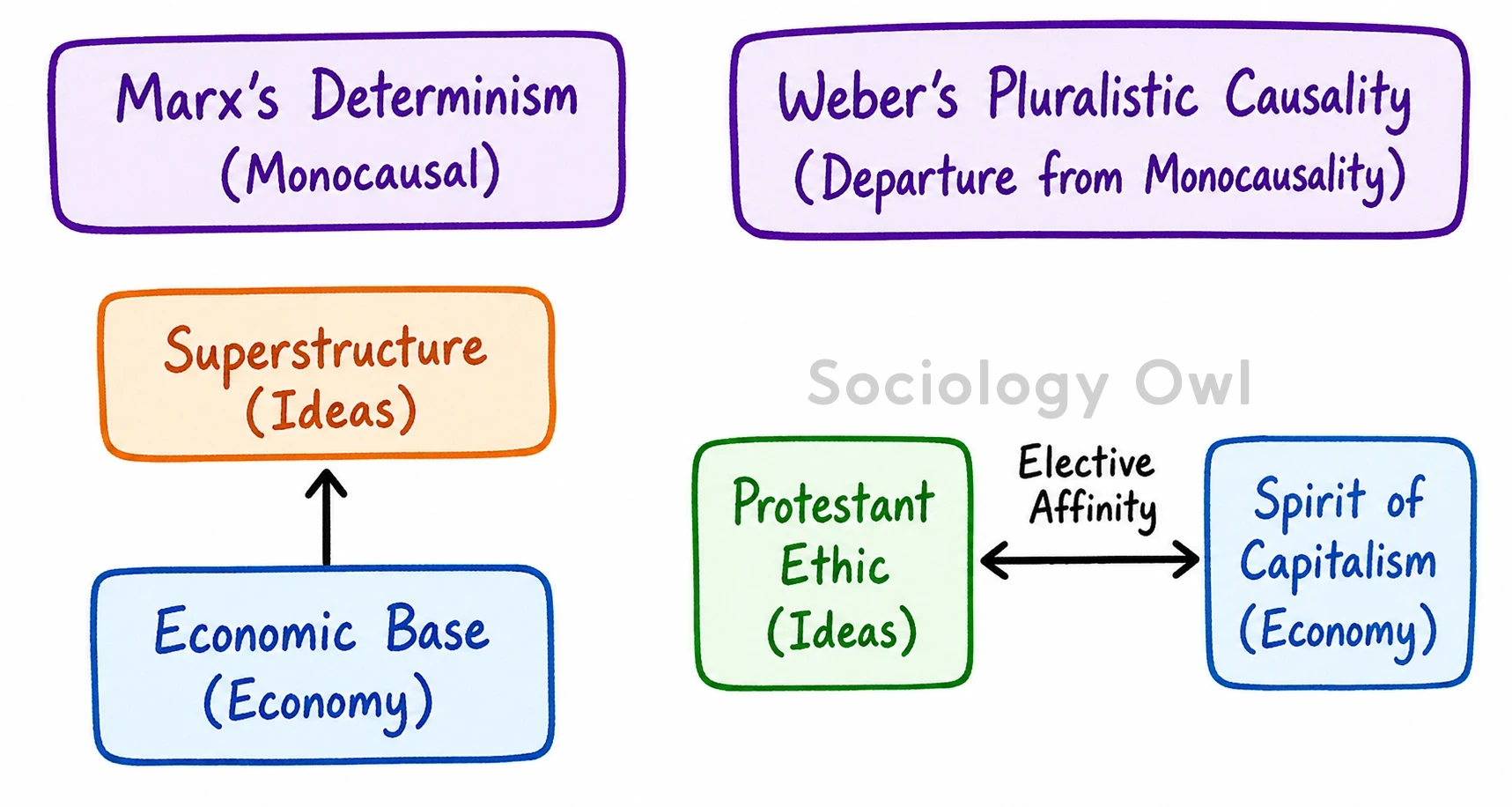
In “Economy and Society”, Max Weber rejected Marxist economic determinism, proposing a “Trinitarian model” of stratification that highlights the multidimensional nature of inequality.

The Trinitarian Model

  • Class: Driven by an individual’s “Market Situation” and “Life Chances”, not merely property ownership.
  • Status: Based on social honor and prestige. “Status Groups” often practice “Social Closure” to restrict outsider access to resources.
  • Party: Rational associations (e.g., political parties, trade unions) aimed at securing Power.

Critical Examination

  • Marxist Critique: Oliver Cox argues this pluralistic fragmentation obscures core capitalist exploitation and actively disrupts class consciousness.
  • Postmodernist Critique: Jean Baudrillard asserts that modern status is dictated by consumerism and lifestyle choices rather than traditional honor.
  • Feminist Critique: The theory largely ignores patriarchy as a primary, structural axis of stratification.

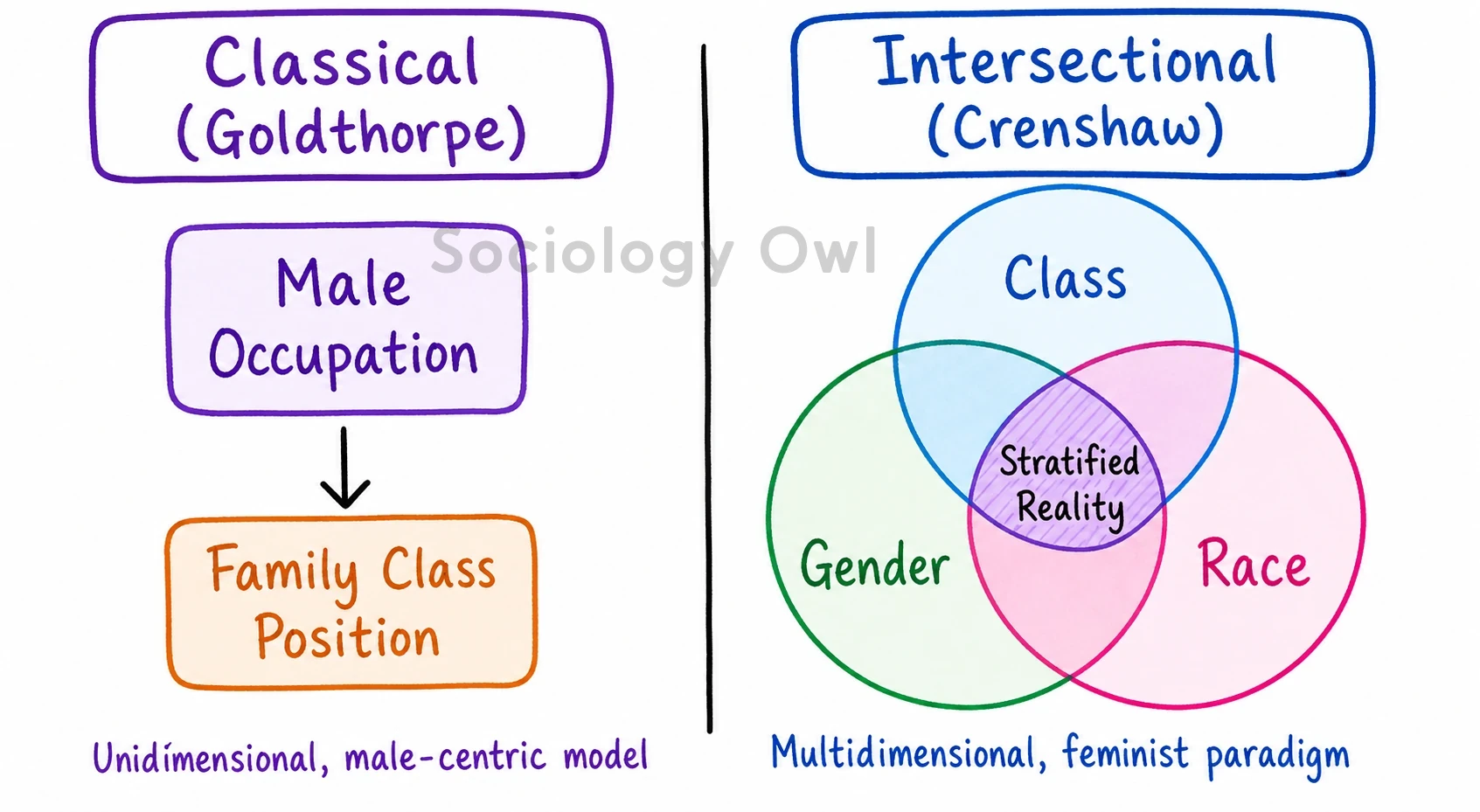
Neo-Weberian John Goldthorpe utilized market capacity to develop modern empirical class schemas. Furthermore, India’s caste system perfectly illustrates this model: a Brahmin priest might possess high Status but low Class (wealth), whereas a Dalit entrepreneur holds high Class but faces Status discrimination.

Conclusion

Despite critiques, Weber’s pluralistic approach remains foundational for empirical sociology, accurately capturing the complex, overlapping intersections of modern social hierarchies.

Critically examine Max Weber’s theory of Social Stratification. Read More »

Do you agree with Max Weber’s idea that bureaucracy has the potential to become an iron cage ? Justify your answer.

Model Answers

Q: Do you agree with Max Weber's idea that bureaucracy has the potential to become an iron cage ? Justify your answer.

Question asked in UPSC Sociology 2021 Paper 1. Download our app for last 20 year question with model answers.

Model Answer:

Max Weber and Iron Cage of Bureaucracy

Max Weber warned that elevating Formal Rationality (efficiency, rules) over Substantive Rationality (human values) creates a stahlhartes Gehäuse (translated by Talcott Parsons as the “Iron Cage”), trapping individuals in a soulless system of control.

Bureaucracy as an Iron Cage

  • Depersonalization: George Ritzer’s “McDonaldization of Society” illustrates modern hyper-rationality, where algorithmic management in gig economies acts as an inescapable digital iron cage.
  • Internal Dysfunctions: Robert Merton argued the cage breeds “Trained Incapacity” and Goal Displacement, while Michel Crozier highlighted how rigid rules create systemic paralysis.

Counter-Perspectives

  • Marxist Critique: Karl Marx viewed bureaucracy not as an inevitable cage of modernization, but as an instrument of bourgeois oppression destined to wither away.
  • Flexibility: Alvin Toffler’s “Adhocracy” and Burns and Stalker’s “Organic” structures demonstrate that organizations can dismantle rigid, mechanistic hierarchies.

Indian bureaucratic red-tapism during the initial COVID-19 pandemic exemplified the iron cage, where strict procedural adherence temporarily hindered rapid, life-saving public health interventions.

Conclusion

While Weber’s structural warning endures, modern institutions increasingly strive for a hybrid model, balancing formal efficiency with human-centric adaptability to prevent the iron cage from completely closing.

Do you agree with Max Weber’s idea that bureaucracy has the potential to become an iron cage ? Justify your answer. Read More »

Critically examine how Durkheim and Merton explicate Anomie.

Model Answers

Q: Critically examine how Durkheim and Merton explicate Anomie.

Question asked in UPSC Sociology 2022 Paper 1. Download our app for last 20 year question with model answers.

Model Answer:

Durkheim and Merton: Anomie Theory

Originating from the Greek anomos (without law), anomie denotes a breakdown of social norms. Émile Durkheim viewed it as a macro-level pathology emerging during Europe’s transition to industrial capitalism, whereas Robert K. Merton normalized it as a structural byproduct of stable, functioning societies.

In The Division of Labor in Society, Durkheim framed anomie as an “abnormal form” arising from uncoordinated specialized roles during rapid industrialization. In Suicide, he identified “anomic suicide,” which peaks during sudden economic booms or busts because society’s moral regulatory power over infinite individual desires temporarily fails, leading to meaninglessness.

Contextualized by the Great Depression, Merton’s Strain Theory shifted focus from psychological defects to structural flaws. He argued anomie arises from a disjuncture between culturally prescribed goals (the “American Dream”) and institutionalized legitimate means. Individuals navigate this strain via five adaptations: conformity, innovation (using illegitimate means for cultural goals), ritualism, retreatism, and rebellion.

Critical Examination

While foundational, both frameworks face significant sociological critiques:

  • Subcultural Critique: Albert Cohen argues Merton overly focuses on individual, utilitarian crime, ignoring non-utilitarian group deviance driven by Status Frustration.
  • Illegitimate Means: Cloward and Ohlin expand Merton’s theory by noting that not everyone has equal access to crime (Differential Illegitimate Opportunity).
  • Marxist Critique: In The New Criminology, Taylor, Walton, and Young criticize Merton for ignoring white-collar crime and the bourgeoisie’s power to dictate “cultural goals.”
  • Interactionist Critique: Howard Becker’s Labeling Theory contends both theorists accept official crime statistics unreflectively, ignoring how authorities socially construct deviance.

Durkheim’s anomie explains the psychological distress during the COVID-19 pandemic or Sri Lanka’s economic collapse, where sudden disruptions caused moral deregulation. Merton’s anomie explains modern Jamtara cybercrimes in India, where unemployed youth internalize global wealth goals but, lacking legitimate means, resort to criminal “innovation.”

Conclusion

While Durkheim sought to cure anomie via occupational guilds and Merton exposed it as capitalism’s structural strain, both revolutionized sociology. By establishing deviance not as an individual moral failing but as a systemic phenomenon, their frameworks remain indispensable for analyzing modern structural crises.

Critically examine how Durkheim and Merton explicate Anomie. Read More »

Explain Max Weber’s theory of social stratification. How does Weber’s idea of class differ from that of Marx?

Model Answers

Q: Explain Max Weber’s theory of social stratification. How does Weber’s idea of class differ from that of Marx?

Question asked in UPSC Sociology 2023 Paper 1. Download our app for last 20 year question with model answers. 

Model Answer:

In Economy and Society, Max Weber proposed the Trinitarian Model of stratification as a “posthumous dialogue with the ghost of Karl Marx.” Rejecting economic reductionism, Weber defined stratification as the unequal distribution of power.

Weber’s Trinitarian Model of Stratification

  • Class (Economic): Dictated by one’s “Market Situation” and “Life Chances” (skills, credentials). Weber identified four classes: propertied upper, property-less white-collar, petty bourgeoisie, and manual workers.
  • Status (Social): Rooted in prestige. Status groups share a distinct “Style of Life” and enforce social closure to restrict outsider entry.
  • Party (Political): Rational associations (e.g., trade unions, NGOs) seeking power, often independent of class or status.

Weber vs. Marx: Conceptual Divergences

  • Polarization vs. Pluralization: Marx predicted a Bourgeoisie-Proletariat polarization. Weber argued for class pluralization, noting the bureaucratic expansion of the middle class.
  • Subjective Consciousness: Marx believed objective economic positions inevitably lead to revolutionary consciousness (class-for-itself). Weber argued shared class situations rarely guarantee collective action; status groups are far more cohesive.
  • Base-Superstructure: Marx believed economics determines all social relations. Weber countered that social status can override economic class.
  • Critique: Neo-Marxist Oliver Cox argued Weber’s model is unnecessarily complex, asserting that status ultimately stems from capitalist economic relations.

Weber’s “Market Situation” accurately explains the global Gig Economy; workers lack Marxist property ownership but form fragmented classes based on skills. In India, a poor Brahmin priest holds high status but low class, validating Weber’s multidimensionality.

Conclusion

Though postmodernists like Zygmunt Bauman argue traditional stratification is dissolving into individualized lifestyles, Weber’s framework remains vital. Pierre Bourdieu brilliantly synthesized both thinkers, combining Marx’s economic capital with Weber’s cultural (Status) and social (Party) capital to decode modern inequality.

Explain Max Weber’s theory of social stratification. How does Weber’s idea of class differ from that of Marx? Read More »

Q. Discuss the dimensions of power in the construction and maintenance of social hierarchies in a society.

Q. Discuss the dimensions of power in the construction and maintenance of social hierarchies in a society.

UPSC Sociology 2024 Paper 1

Model Answer:

Dimensions of Power in Social Hierarchies

Defined by Max Weber as realizing one’s will despite resistance, power stratifies society. Steven Lukes identifies three core dimensions—decision-making, agenda-setting, and ideological control—that are central to constructing and maintaining social hierarchies.

Mechanisms of Social Hierarchy

  • Political Economy: Karl Marx ties power directly to owning the means of production, establishing baseline class hierarchies.
  • Ideological Control: Antonio Gramsci explains hierarchy maintenance through Cultural Hegemony, where ruling classes normalize their worldview as common sense.
  • Symbolic & Discursive Power: Pierre Bourdieu argues that Cultural Capital and Symbolic Violence legitimize and reproduce class privileges. Similarly, Michel Foucault highlights Disciplinary Power, which maintains hierarchy through surveillance and the Power/Knowledge nexus.
  • Intersectionality: Patricia Hill Collins describes a “Matrix of Domination” where overlapping identities (race, class, gender) compound social stratification.

  • Critique: Conversely, functionalist Talcott Parsons views power not as domination, but as a “variable-sum game” and a systemic resource for collective goals.

In India, English language fluency acts as Cultural Capital, reinforcing historic caste and class divides in corporate hiring. Globally, algorithmic management in the gig economy exemplifies modern Disciplinary Power.

Conclusion

Hierarchies are sustained through intertwined economic, ideological, and discursive dimensions of power. Yet, as Foucault observed, “where there is power, there is resistance,” ensuring that social stratification remains dynamic and continuously contested by subaltern groups.

Q. Discuss the dimensions of power in the construction and maintenance of social hierarchies in a society. Read More »

Write short note on Relevance of pattern variables in the study of social change.

Model Answers

Q: Write short note on Relevance of pattern variables in the study of social change.

Question asked in UPSC Sociology 2008 Paper 1. Download our app for last 20 year question with model answers.

Model Answer:

Pattern Variables and Social Change

The concept of Pattern Variables was introduced by the eminent American sociologist Talcott Parsons in his seminal work, The Social System (1951). Building upon the legacy of Ferdinand Tönnies (Gemeinschaft vs. Gesellschaft), Emile Durkheim (Mechanical vs. Organic Solidarity), and Max Weber (Traditional vs. Rational action), Parsons sought to create a grand theoretical framework to understand human action. Pattern variables are essentially five dichotomous dilemmas of choice that an actor must resolve before taking any social action. In the context of social change, these variables act as a structural-functional barometer to measure a society’s transition from traditional (expressive) to modern (instrumental) forms.

Framework of Pattern Variables in Social Change

To study social change, sociologists use Parsons’ five dichotomies to track how societal values evolve during the process of modernization and industrialization:

Pattern Variable DilemmaTraditional Society (Expressive Action)Modern Society (Instrumental Action)
Affectivity vs. Affective NeutralityHigh emotional involvement (e.g., joint family reliance)Emotional detachment (e.g., doctor-patient relationship)
Collectivity vs. Self-OrientationSacrificing for the group (e.g., tribal loyalty)Pursuit of individual goals (e.g., capitalist entrepreneurship)
Particularism vs. UniversalismJudging based on relationships (e.g., nepotism)Judging based on general rules (e.g., rule of law)
Ascription vs. AchievementStatus by birth (e.g., caste, royalty)Status by effort (e.g., merit-based civil services)
Diffuseness vs. SpecificityBroad, undefined obligations (e.g., patron-client ties)Narrow, contract-based obligations (e.g., gig economy worker)

Relevance in Analyzing Social Change

  • Measuring Economic Development: Sociologists like Bert F. Hoselitz and Neil Smelser applied pattern variables to study economic growth. They demonstrated that for a society to industrialize, its economic institutions must shift from ascription, particularism, and diffuseness towards achievement, universalism, and specificity.
  • Analyzing Institutional Differentiation: As societies change, institutions undergo structural differentiation. For example, education moves away from particularistic religious teachings (Gurukul system) to universalistic, standardized modern schooling.
  • Evaluating Role Expectations: Pattern variables map the increasing complexity of modern roles. The shift from a feudal serf (ascriptive, diffuse) to a modern factory worker (achievement-oriented, specific) highlights the macro-structural evolution of society.

The Indian Context: Application and Complexities (Paper 2 Integration)

In the Indian context, the application of pattern variables reveals that social change is rarely a linear shift from traditional to modern, but rather a complex synthesis.

  • Yogendra Singh on Modernization: In his book Modernization of Indian Tradition, Yogendra Singh uses a similar paradigm to show that India is experiencing a unique blend. While universalistic legal frameworks are adopted, particularistic structures like caste remain resilient by adapting to modern democracy (e.g., caste-based voting blocks).
  • M.N. Srinivas and Caste Resilience: Through concepts like Sanskritization and Westernization, M.N. Srinivas observed that while Indians adopt achievement-oriented modern professions, they often retain ascriptive and affective ties in private spheres (like marriage and family).
  • Dipankar Gupta’s “Mistaken Modernity”: Dipankar Gupta argues that India suffers from “mistaken modernity.” While we possess the superficial trappings of modern society (technology, consumerism), our underlying social relations remain heavily grounded in ascription and particularism rather than true universalism.
  • Lloyd and Susanne Rudolph: In The Modernity of Tradition, they argue that traditional structures (like caste associations) have become vehicles for modernization, blurring Parsons’ neat dichotomies. Traditional ascriptive identities are used to achieve modern political goals.

Contemporary Relevance in a Globalized World

In the 21st century, Parsons’ variables remain highly relevant for analyzing post-industrial and globalized societies. The rise of the Gig Economy represents extreme Specificity and Affective Neutrality, where human interactions are reduced to algorithmic contracts. Conversely, the concept of Glocalization (coined by Roland Robertson) shows how global corporations blend Universalism (global standard products) with Particularism (customizing menus for local tastes, like the McAloo Tikki in India). Furthermore, social media often blurs these boundaries, mixing specific professional networking with diffuse, affective personal sharing.

Conclusion

While critics like Jürgen Habermas and Anthony Giddens argue that Parsons’ structural-functionalism oversimplifies human agency and presents a Eurocentric view of modernization, the pattern variables remain an indispensable heuristic tool. As Talcott Parsons envisioned, they provide the necessary vocabulary to decode the DNA of social change. When adapted to specific historical and cultural realities—such as the resilient hybridity of Indian society—pattern variables allow sociologists to systematically measure the tensions, transitions, and trajectories of human civilization moving through time.

Write short note on Relevance of pattern variables in the study of social change. Read More »

Analyze critically David Morgan’s views on family practices.

Model Answers

Q: Analyze critically David Morgan’s views on family practices.​

Question asked in UPSC Sociology 2023 Paper 1. Download our app for last 20 year question with model answers. 

Model Answer:

David Morgan shifted sociology from viewing the family as a static structural institution (advanced by functionalists like Talcott Parsons) to an active, ongoing process. His concept of “Doing Family” emphasizes everyday routines and human agency over rigid institutional boundaries.

Deconstructing the Structural Family

  • Fluidity and Agency: Morgan focuses on routine activities (mealtimes, chores) where individuals actively negotiate roles, accommodating diverse late-modern family forms.
  • “Displaying Family”: Building on Morgan, Janet Finch argues that these active family practices must be socially recognized to hold meaning.

Critical Analysis

  • Structuralist Critique: Marxists argue his micro-focus on everyday practices ignores macro-structural inequalities (capitalism, poverty, state policies) that restrict a family’s agency.
  • Personal Life Perspective: Carol Smart contends Morgan remains unnecessarily tied to the traditional term “family.” She proposes the Personal Life perspective to include pets and non-biological friends.

Morgan’s framework elegantly explains transnational families “doing family” across borders via remittances and digital kinship (WhatsApp calls), or LGBTQ+ “chosen families” formed through shared caregiving.

Conclusion

Despite feminist and structural critiques, Morgan effectively bridges structure and social action, providing a vital sociological lens to understand the fluid, diverse kinship networks of late modernity.

Analyze critically David Morgan’s views on family practices. Read More »

What functions does religion perform in a pluralistic society?

Model Answers

Q: What functions does religion perform in a pluralistic society?​

Question asked in UPSC Sociology 2023 Paper 1. Download our app for last 20 year question with model answers. 

Model Answer:

In a pluralistic society, no single belief system holds a monopoly, reflecting Peter Berger’s concept in The Sacred Canopy regarding the “pluralization of lifeworlds.” Consequently, religion transitions from an overarching unifier to performing adaptive, specialized functions.

Functions in a Pluralistic Society

  • Identity Maintenance: Will Herberg argues that amidst structural assimilation, religion becomes the primary mechanism for minority and immigrant groups to preserve cultural boundaries.
  • Civil Religion: To prevent societal fragmentation, Robert Bellah notes that diverse societies develop overarching secular symbols (e.g., constitutional patriotism) that integrate disparate faiths.
  • Public Sphere Engagement: Through Jose Casanova’s concept of “Public Religions,” faiths leave the private sphere to offer collective ethical frameworks for modern secular crises.

Dysfunctions and Critiques

Using R.K. Merton’s concept of Dysfunctions, intense intra-group solidarity can generate inter-group hostility. Furthermore, Steve Bruce notes that pluralism can trigger Religious Fundamentalism as a defense mechanism against competing secular truths.

Global interfaith coalitions, such as diverse religious leaders uniting over climate change advocacy, demonstrate religion’s modern public function transcending dogmatic boundaries.

Conclusion

In diverse societies, religion operates as a dual force—it preserves distinct cultural identities while posing risks of polarization, necessitating robust secular frameworks to harmonize pluralistic coexistence.

What functions does religion perform in a pluralistic society? Read More »