Model Answer

Analyse the perspectives of Isolation, Assimilation and Integration in understanding the trajectories of Indian Tribal Development.

Model Answers

Q: Analyse the perspectives of Isolation, Assimilation and Integration in understanding the trajectories of Indian Tribal Development.

Question asked in UPSC Sociology 2023 Paper 2. Download our app for last 20 year question with model answers.

Model Answer:

The trajectory of Indian tribal development historically revolves around the “Elwin-Ghurye Debate.” Sociologist Surajit Sinha emphasizes that tribal identity is not static but shaped by varying degrees of colonial and post-colonial interactions with mainstream society.

Trajectories of Tribal Development

  • Isolation: Supported by colonial administrators like J.H. Hutton and initially by Verrier Elwin in his book The Baigas. Elwin proposed a “National Park Policy” to protect tribes from exploitation by Dikus (outsiders/moneylenders), though he later favored integration.
  • Assimilation: G.S. Ghurye categorized tribes as “backward Hindus,” advocating their absorption. N.K. Bose conceptualized the “Hindu Method of Tribal Absorption,” arguing that economic security within the caste system drove assimilation, a process often facilitated by what M.N. Srinivas termed Sanskritization.
  • Integration: A structural-functional middle path. Jawaharlal Nehru formulated the Tribal Panchsheel to ensure development without cultural erosion, backed by D.N. Majumdar’s sociological vision of “creative integration.”

The Subaltern Critique

Contemporary sociologist Virginius Xaxa critiques these frameworks as paternalistic, noting they were formulated entirely by non-tribals. He argues that structural “integration” often manifested as “asymmetric integration,” leading to forced assimilation, resource alienation, and displacement.

Tribal policy has shifted from state-led integration toward a “Rights-Based Approach.” The PESA Act (1996) and Forest Rights Act (2006) prioritize tribal autonomy. For instance, the Supreme Court upheld the rights of the Dongria Kondh tribe in Niyamgiri against Vedanta mining, illustrating indigenous resistance to coercive integration.

Conclusion

As highlighted by the Xaxa Committee Report (2014), tribal development must move beyond historical binaries. Modern sociological paradigms advocate for “Inclusion with Autonomy,” ensuring tribal communities remain active architects of their socio-economic and cultural destinies rather than mere objects of development.

Analyse the perspectives of Isolation, Assimilation and Integration in understanding the trajectories of Indian Tribal Development. Read More »

Examine the concept of ‘Cultural Pluralism’ in the context of India’s Unity in Diversity.

Model Answers

Q: Examine the concept of ‘Cultural Pluralism’ in the context of India’s Unity in Diversity.

Question asked in UPSC Sociology 2023 Paper 2. Download our app for last 20 year question with model answers.

Model Answer:

Cultural Pluralism in India’s Unity in Diversity

Cultural Pluralism allows diverse groups to retain distinct identities without total assimilation. T.K. Oommen notes that Indian pluralism is uniquely territorial (linguistic) and non-territorial (caste/religion), forming the bedrock of India’s Unity in Diversity.

Sociological Dimensions of Unity

  • Civilizational Unity: G.S. Ghurye highlighted cultural integration through sacred geography and ancient pilgrimage networks transcending regional boundaries.
  • Composite Culture: Yogendra Singh emphasized the synthesis of traditions, historically evolving into the syncretic Ganga-Jamuni Tehzeeb via Bhakti and Sufi movements.
  • Structural Integration: M.N. Srinivas demonstrated how Sanskritization provides a shared cultural idiom, alongside historic economic interdependence across diverse groups.

Critiques and Contestation

  • Marxist View: A.R. Desai argued the state’s “Unity in Diversity” narrative is ideological, utilized to mask underlying capitalist class inequalities.
  • Hierarchy over Difference: Dipankar Gupta cautions that Indian pluralism often morphs into hierarchy, where differences are coercively ranked rather than equally respected.

Contemporary sociopolitical assertions, such as tribals demanding a distinct Sarna religious code, reflect the active defense of plural identities against perceived majoritarian homogenization (e.g., Uniform Civil Code or ‘One Nation’ debates).

Conclusion

India’s cultural pluralism is not a static demographic given, but a dynamically negotiated democratic process that must continuously balance diverse cultural identities with overarching national cohesion.

Examine the concept of ‘Cultural Pluralism’ in the context of India’s Unity in Diversity. Read More »

In the context of changing Indian society, how do you view Andre Beteille’s conceptions of harmonic and disharmonic social structures ?

Model Answers

Q: In the context of changing Indian society, how do you view Andre Beteille’s conceptions of harmonic and disharmonic social structures ?

Question asked in UPSC Sociology 2022 Paper 2. Download our app for last 20 year question with model answers.

Model Answer:

Andre Beteille’s Harmonic and Disharmonic Social Structures

Andre Beteille analyzes social structures via the normative and existential orders. A harmonic system features inequality in norm and practice (e.g., traditional caste). A disharmonic system emerges when equality is the norm, but inequality persists in reality.

Transition to a Disharmonic Society

  • Constitutional Egalitarianism: The Indian Constitution mandated legal equality, thrusting traditional Indian society into a disharmonic phase.
  • Dispersed Inequalities: In Caste, Class, and Power, Beteille highlights the shift from traditional cumulative inequalities to modern dispersed inequalities, where caste, wealth, and political power no longer perfectly overlap.
  • Marxist Critique: Conversely, A.R. Desai argues that traditional hierarchies merely morphed into capitalist class exploitation, representing structural continuity rather than a disharmonic shift.

This disharmonic friction drives democratic churn. Demands for a Caste Census and dominant caste agitations (like the Marathas) reflect the tension between constitutional promises of equality and existential material deprivation.

Conclusion

Beteille views the disharmonic phase not as a systemic breakdown, but as the vital engine of social change. Until existential realities match constitutional ideals, Indian society will continue experiencing transformative democratic friction.

In the context of changing Indian society, how do you view Andre Beteille’s conceptions of harmonic and disharmonic social structures ? Read More »

Q. What is science? Do you think that the methods used in natural sciences can be applied to sociology? Give reasons for your answer.

Q. What is science? Do you think that the methods used in natural sciences can be applied to sociology? Give reasons for your answer.

UPSC Sociology 2025 Paper 1

Model Answer:

Science is a systematic enterprise producing empirical, objective knowledge. Sociologically, Robert Merton defined its ethos via CUDOS (Communism, Universalism, Disinterestedness, Organized Skepticism), while Karl Popper argued its hallmark is Falsifiability. The applicability of natural science methods to sociology remains heavily debated.

The Positivist and Anti-Positivist Debates

Positivists argue sociology can and must use natural science methods to uncover objective, universal laws.

  • Auguste Comte: Advocated for a rigorous “social physics” to discover deterministic laws of society.
  • Emile Durkheim: Argued sociology must study Social Facts as observable “things.” In his seminal work Suicide, he utilized rigorous statistical methods to prove that highly private acts have underlying, objective structural causes.

Interpretivists and critical theorists argue that human consciousness renders natural science methods fundamentally inadequate for sociology.

  • Max Weber: Posited that humans attach subjective meanings to actions, necessitating Verstehen (empathetic understanding) rather than mere external observation.
  • Harold Garfinkel: From an ethnomethodological perspective, argued that social reality is continuously constructed through interaction, resisting objective measurement due to reactivity (the Hawthorne Effect).
  • Jurgen Habermas: Critiqued the blind application of natural science methods as Scientism, arguing it reduces human emancipation to instrumental rationality and numbers.

The Realist Middle-Ground

  • Keat and Urry: Provide a bridge, arguing sociology is scientific. They distinguish between “Closed Systems” (physics laboratories) and “Open Systems” (meteorology, sociology). Like meteorologists studying atmospheric pressure, sociologists scientifically study complex, unobservable structures (e.g., patriarchy, class) in open environments.

Computational Sociology utilizes Big Data (e.g., social media analytics), reviving neo-positivism to track global human behavior quantitatively. However, qualitative methods remain vital alongside this to contextualize behaviors and expose issues like Algorithmic Bias.

Conclusion

While absolute prediction is impossible due to human consciousness, sociology maintains scientific rigor through Methodological Pluralism (triangulation). By combining quantitative data with qualitative depth, sociology operates not as an exact natural science, but as a robust, empirical social science.

Q. What is science? Do you think that the methods used in natural sciences can be applied to sociology? Give reasons for your answer. Read More »

Q. “Industrial class structure is a function of social structure of Indian society.” Do you agree with this statement? Analyze.

Q. “Industrial class structure is a function of social structure of Indian society.” Do you agree with this statement? Analyze.

UPSC Sociology 2025 Paper 2

Model Answer:

India’s transition to an industrial economy did not obliterate its traditional social structure—comprising caste, kinship, agrarian relations, and patriarchy—but adapted it. As A.R. Desai noted, the emerging capitalist class utilized traditional institutions to consolidate wealth, resulting in a superimposition of modern class lines upon traditional social hierarchies.

Traditional Structures Shaping Industrial Classes

  • Capital and Kinship: Harish Damodaran in India’s New Capitalists illustrates how traditional mercantile castes monopolized early industrial capital via kinship networks, while upper castes dominated managerial roles through inherited educational capital.
  • The Division of Labourers: B.R. Ambedkar famously critiqued that caste is not merely a division of labour, but a “division of labourers.” Consequently, Shudras and Dalits disproportionately occupy the unorganized manual workforce.
  • Agrarian-Industrial Nexus: Jan Breman highlights how agrarian distress within rural structures pushes marginalized castes into the urban industrial reserve army as precarious “footloose labour.”
  • Patriarchy and Class: Feminist scholars like Neetha N. demonstrate how patriarchal structures funnel women into the most exploitative, low-paid industrial tiers, such as garment manufacturing.

Transformations and Counter-Trends

  • Secularization of Work: Analyzing counter-trends, G.S. Ghurye observed that industrialization promotes occupational freedom. Richard Lambert, in his classic study of Poona factories, found that the internal shop-floor fostered a secular hierarchy, even if external social relations remained caste-bound.
  • Dalit Capitalism: Chandra Bhan Prasad highlights the rise of the Dalit Indian Chamber of Commerce and Industry (DICCI), demonstrating how modern capitalism and state support can fracture traditional caste-class monopolies.

In the modern IT sector, Carol Upadhya reveals that subtle caste networking still influences career progression. Furthermore, today’s gig economy often preys on a workforce made vulnerable by traditional agrarian and caste marginality. Acknowledging these structural impediments, state policies like Stand-Up India actively target SC/ST and women entrepreneurs to democratize industrial capital.

Conclusion

India’s industrial class structure remains a dynamic synthesis of modernization and tradition. While democratic capitalism, secular workspaces, and affirmative action challenge historical monopolies, the traditional structures of caste, agrarian ties, and patriarchy fundamentally continue to condition access to capital and labor markets.

Q. “Industrial class structure is a function of social structure of Indian society.” Do you agree with this statement? Analyze. Read More »

Is Weber’s idea of bureaucracy a product of the historical experiences of Europe?

Model Answers

Q: Is Weber’s idea of bureaucracy a product of the historical experiences of Europe?

Question asked in UPSC Sociology 2023 Paper 1. Download our app for last 20 year question with model answers. 

Model Answer:

Max Weber’s Theory of Bureaucracy

Max Weber’s bureaucracy is an Ideal Type rooted in the macro-historical Rationalization of Western society, reflecting Europe’s transition from traditional to Rational-Legal authority.

European Origins of the Model

  • Capitalist Calculability: The rise of Western capitalism demanded highly predictable and efficient administration based on Zweckrational (goal-oriented) action.
  • Institutional Legacy: Abstracting from the Prussian state and the codification of Roman Law, Weber emphasized structural hierarchy, specialization, and strict impersonality.

Beyond Europe and Critiques

While Weber used this heuristic tool to analyze ancient China and Egypt, his formulation is highly debated:

  • Eurocentric Bias: Post-colonial scholars argue that transplanting this European model to developing nations creates a “Prismatic Society” (Fred W. Riggs), where traditional loyalties bypass formal rules.
  • Internal Critiques: Robert Merton highlighted that rigid adherence to European-style rules induces Bureaucratic Dysfunction and goal displacement.

Today, rigid Weberian structures are being challenged globally by New Public Management (NPM) and algorithmic Digital Bureaucracy.

Conclusion

Though born from the specific historical womb of European capitalism, Weber’s conceptualization remains a foundational analytical tool for comparative organizational sociology globally.

Is Weber’s idea of bureaucracy a product of the historical experiences of Europe? Read More »

Write short note on Class-in-itself and class-for-itself.

Model Answers

Q: Write short note on Class-in-itself and class-for-itself.

Question asked in UPSC Sociology 2003 Paper 1. Download our app for last 20 year question with model answers.

Model Answer:

Class in itself and class for itself

The concepts of Class-in-itself (Klasse an sich) and Class-for-itself (Klasse für sich) were formalized by Karl Marx in his 1847 work, The Poverty of Philosophy. Emerging during the height of the Industrial Revolution, Marx observed that the transition from feudalism to capitalism had thrown masses of displaced peasants into urban factories. While these workers shared immense suffering and identical material conditions, they initially lacked the solidarity and organization required to challenge the capitalist system. Marx developed these concepts to explain the trajectory of the working class from a fragmented, exploited aggregate into a revolutionary political force.

Core Concepts: The Marxist Perspective

Class-in-itself (Objective Reality)

This represents the objective economic dimension of social class. A group forms a “class-in-itself” when its members share a common relationship to the means of production.

  • It is an aggregate of individuals who occupy the same structural position in the economic system (e.g., wage laborers who own no property and must sell their labor).
  • At this stage, workers are highly atomized, viewing each other as competitors in the labor market rather than comrades.
  • The existence of the class is an objective fact, completely independent of whether the individuals possess a subjective awareness of their shared exploitation.

Class-for-itself (Subjective Awareness)

This represents the subjective and political dimension of social class. It occurs when a “class-in-itself” develops Class Consciousness—a collective awareness of their shared exploitation and common structural interests.

  • It marks the transformation from a passive socio-economic category into an active, self-conscious political agent.
  • Workers overcome false consciousness (the adoption of bourgeois ideologies) and recognize the bourgeoisie as their systemic antagonist.
  • This stage is characterized by collective action, the formation of trade unions, and ultimately, political mobilization aimed at structural revolution.

Comparative Analysis

Basis of DifferenceClass-in-itselfClass-for-itself
NatureObjective and structural.Subjective and psychological/political.
AwarenessLack of shared class awareness; presence of false consciousness.High degree of true class consciousness.
Inter-personal RelationsWorkers view each other as competitors for wages.Workers view each other as comrades in a shared struggle.
ActionPassive existence; unorganized and atomized.Active resistance; organized into unions and political parties.
Historical RoleVictims of capitalist exploitation.The “Vanguard of the Revolution” leading to socialism.

Sociological Critiques and Extensions

  • Max Weber: Criticized Marx’s deterministic view that a class-in-itself inevitably becomes a class-for-itself. Weber argued that shared “market situations” do not automatically translate into communal action, as workers may be divided by status groups (religion, ethnicity).
  • Georg Lukács: In his book History and Class Consciousness, Lukács emphasized that class consciousness is not a natural byproduct of economic conditions but must be actively cultivated by a revolutionary party.
  • Ralf Dahrendorf: Argued that in post-capitalist societies, the institutionalization of class conflict (via collective bargaining and labor laws) prevents the working class from ever becoming a revolutionary class-for-itself.

The Indian Context (Paper 2 Integration)

Applying Marxian class theory to India requires immense theoretical nuance, as the traditional Marxist binary is heavily complicated by the pervasive reality of caste, religion, and regionalism.

  • A.R. Desai: In his Marxist analysis of Indian nationalism, Desai argued that British colonialism created new objective classes (a class-in-itself) such as the industrial bourgeoisie, modern proletariat, and impoverished peasantry. However, their transition to a class-for-itself was uniquely channeled through the anti-colonial freedom struggle rather than a pure socialist revolution.
  • Andre Beteille: In his study of agrarian relations in Tanjore (Caste, Class, and Power), Beteille notes that while objective economic classes exist in Indian villages (landlords, tenants, landless laborers), subjective class consciousness is severely fragmented. A landless laborer’s loyalty is often tied to their caste or patron (Jajmani relations) rather than their economic class, preventing the emergence of a true class-for-itself.
  • Dipankar Gupta: Highlights that in India, caste identities often override class solidarity. Political mobilization frequently occurs along caste lines (e.g., dominant castes demanding reservations) rather than pure economic class lines, demonstrating the presence of a “class-in-itself” but an aborted “class-for-itself.”
  • Kathleen Gough: Contrary to Beteille, Gough found that in parts of South India (like Kerala and Tanjore), extreme polarization did lead agricultural laborers to develop strong class consciousness, acting as a class-for-itself through communist peasant movements.

Contemporary Relevance

In the modern, globalized world, Marx’s distinction remains highly relevant, albeit in new forms:

  • The Gig Economy and The Precariat: Sociologist Guy Standing identifies a new emerging class called the Precariat (gig workers, freelancers, Uber drivers). Due to algorithms and spatial isolation, they clearly form a highly exploited class-in-itself. However, their physical separation and lack of traditional factory floors make it incredibly difficult for them to organize into a class-for-itself.
  • Neo-Marxist perspective on Mass Media: Thinkers of the Frankfurt School, particularly Herbert Marcuse in One-Dimensional Man, argue that advanced capitalism uses consumerism, mass media, and the welfare state to placate the working class. This perpetually traps them in a state of false consciousness, preventing the transition to a class-for-itself.

Conclusion

The conceptual dichotomy of class-in-itself and class-for-itself remains a foundational tool in sociology for analyzing the gap between objective inequality and subjective political mobilization. As British Marxist historian E.P. Thompson famously argued in The Making of the English Working Class, class is not a “thing” but a “historical relationship.” The transformation into a class-for-itself is not a mechanical inevitability, but a complex historical process forged through shared struggles, culture, and active human agency.

Write short note on Class-in-itself and class-for-itself. Read More »

Q. Who is said to be the pioneer of village studies in India? Illustratively describe contributions of some Indian sociologists on village studies. How their approaches are distinct from each other?

Q. Who is said to be the pioneer of village studies in India? Illustratively describe contributions of some Indian sociologists on village studies. How their approaches are distinct from each other?

UPSC Sociology 2025 Paper 2

Model Answer:

Countering Charles Metcalfe’s colonial myth of static “little republics,” the 1950s saw a boom in sociological village studies driven by post-independence nation-building. M.N. Srinivas is widely regarded as the pioneer of the “Field View” via participant observation, though S.C. Dube published the first full-length sociological study, Indian Village (1955).

Contributions to Village Studies

  • M.N. Srinivas: In The Remembered Village (Rampura study), he employed a structural-functionalist lens. He introduced concepts like Sanskritization and Dominant Caste, emphasizing “Village Solidarity” wherein the village acted cohesively despite internal caste hierarchies.
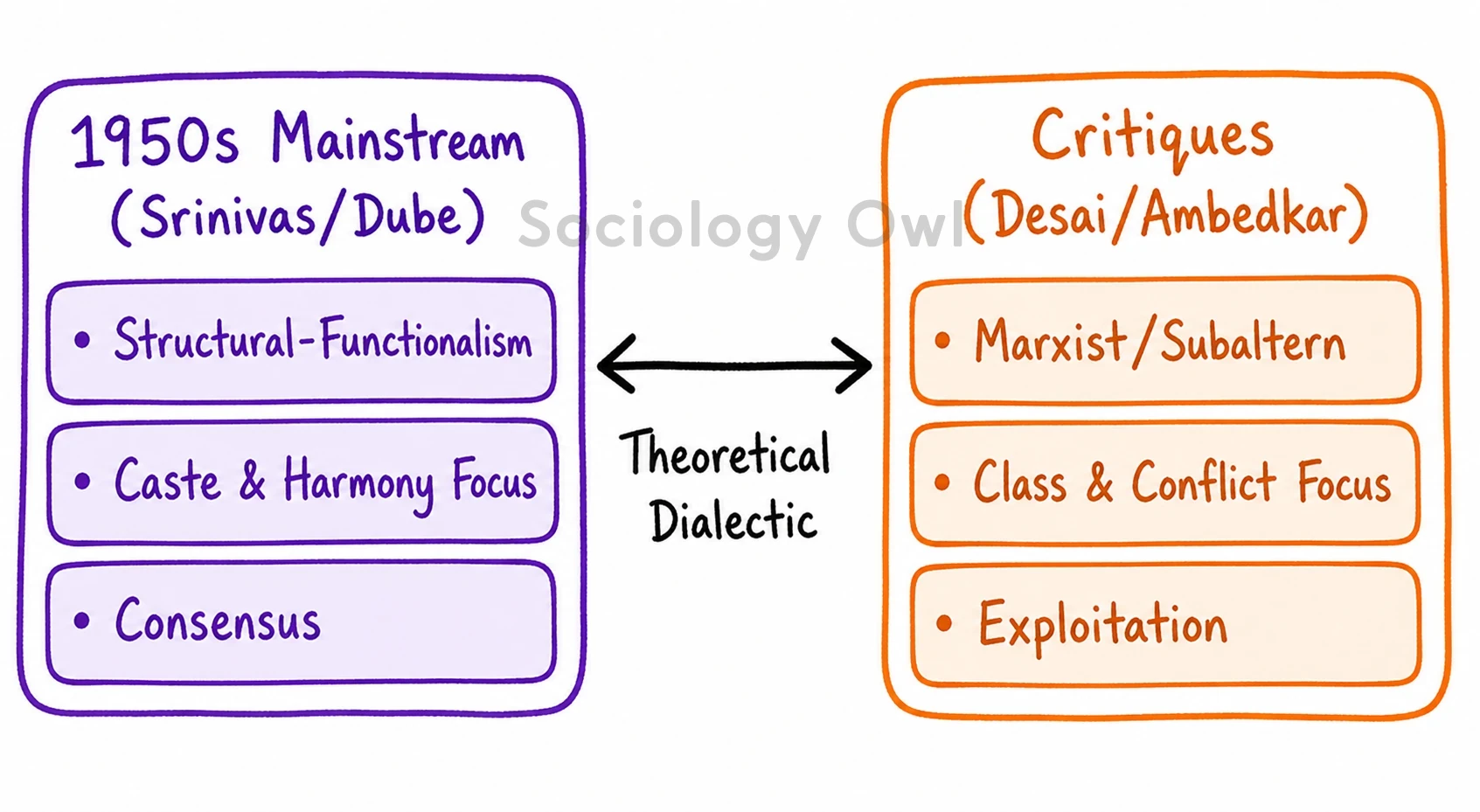
  • A.R. Desai: In Rural Sociology in India, Desai utilized a Marxist historical-dialectical approach. He rejected the harmonious village notion, analyzing it as a site of class conflict, land alienation, and peasant pauperization under colonial capitalism.
  • Andre Beteille: Using a Weberian framework in his Sripuram study, he mapped the shift from a closed to an open stratification system, noting how the traditional overlap between Caste, Class, and Power had fractured.
SociologistTheoretical FrameworkMethod & View of Change
M.N. SrinivasStructural-FunctionalismParticipant observation; cultural mobility and integration.
A.R. DesaiMarxist / Historical-MaterialismMacro-historical analysis; class struggle and capitalist exploitation.
Andre BeteilleWeberian (Trinitarian Model)Empirical observation; differentiation of status, wealth, and power.

Critiques of Village Studies

  • B.R. Ambedkar: Fiercely critiqued the sociological romanticization of the village, terming it a “den of ignorance, narrow-mindedness, and communalism” that perpetuated Dalit oppression.
  • Louis Dumont: Argued that the village is merely an architectural and demographic reality; the true ideological reality of India is Caste.

Today, globalization and migration have fundamentally altered rural realities. Sociologists like Dipankar Gupta conceptualize the “Vanishing Village”, while Surinder S. Jodhka explores how early structural frameworks help decode ongoing agrarian distress and shifting dominant caste politics (e.g., Maratha/Jat reservation demands).

Conclusion

While pioneers like M.N. Srinivas provided the foundational anatomy of the Indian village, their empirical methodologies laid the essential groundwork for contemporary sociologists to study the dynamic, highly political, and globally integrated rural landscapes of 21st-century India.

Q. Who is said to be the pioneer of village studies in India? Illustratively describe contributions of some Indian sociologists on village studies. How their approaches are distinct from each other? Read More »

Highlight the significant features of A. R. Desai’s ‘Dialectical Perspective’ to study Indian Society

Model Answers

Q: Highlight the significant features of A. R. Desai’s ‘Dialectical Perspective’ to study Indian Society

Question asked in UPSC Sociology 2023 Paper 2. Download our app for last 20 year question with model answers. 

Model Answer:

A.R. Desai’s Dialectical Perspective on Indian Society

A.R. Desai pioneered the Dialectical-Historical perspective in India. In Social Background of Indian Nationalism, he applied Historical Materialism to analyze societal transformation, rejecting the dominant Indological and Structural-Functional approaches.

Key Features of the Perspective

  • Primacy of Economic Infrastructure: Societal changes stem from shifts in property relations and the mode of production (e.g., British introduction of private land ownership), not mere cultural evolution.
  • Dialectics of Nationalism: The contradiction between British imperialism and newly emerged material classes (bourgeoisie, modern intelligentsia) birthed the Indian National Movement.
  • Caste-Class Nexus: He rejected the purity-pollution binary, arguing that traditional caste is fundamentally an agrarian class structure disguised by religious hierarchy.
  • The Myth of the Welfare State: Desai critiqued the post-independence Indian state for pursuing a “capitalist path of development” that marginalizes the peasantry and proletariat.

Desai’s dialectical method perfectly decodes the Green Revolution not merely as technological progress, but as a catalyst for agrarian class polarization, contextualizing contemporary farmer protests and rural distress.

Conclusion

Though critiqued for economic determinism by Subaltern scholars (Ranajit Guha) and Structuralists (Louis Dumont), Desai’s Marxist methodology remains indispensable for unmasking the structural contradictions and persistent inequalities driving modern Indian society.

Highlight the significant features of A. R. Desai’s ‘Dialectical Perspective’ to study Indian Society Read More »

Elaborate on changing nature of caste system with suitable illustrations.

Model Answers

Q: Elaborate on changing nature of caste system with suitable illustrations.

Question asked in UPSC Sociology 2022 Paper 2. Download our app for last 20 year question with model answers.

Model Answer:

Traditional Indian caste, analyzed by Louis Dumont in Homo Hierarchicus as a system rooted in the ideology of purity and pollution, is transforming. It is shifting from a closed, ritualistic, and interdependent hierarchy to an open, secular, and competitive framework.

Structural and Political Transformations

  • From Hierarchy to Difference: Dipankar Gupta argues that the traditional vertical hierarchy is being replaced by horizontal differences, where castes compete as independent identities for state resources.
  • Divergence of Inequalities: Andre Beteille’s study of Sripuram highlights that the historical overlap of caste, class, and power has disaggregated, breaking traditional occupational barriers.
  • Politicization of Caste: Rajni Kothari notes that caste is not disappearing but rather getting politicized through caste associations. Christophe Jaffrelot terms the resulting political assertion of lower castes the “Silent Revolution.”
  • Substantialization of Caste: Popularized by C.J. Fuller, this concept highlights caste transforming into a discrete ethnic block competing for modern avenues like education and employment.
  • Social Mobility: M.N. Srinivas demonstrated upward mobility through Sanskritization and the rise of the Dominant Caste due to land reforms and electoral democracy.

Debates on Continuity and Critique

  • Marxist Perspective: A.R. Desai argues that structural changes are superficial; caste acts as a proxy for class, adapting to serve capitalist interests.
  • Subaltern Perspective: Gail Omvedt highlights the persistence of structural violence and systemic inequality against Dalits despite legal abolitions.
  • Secularization of Caste: While ritual purity and the traditional Jajmani system decline, rigid caste endogamy persists, strengthening distinct caste identities.

Sukhadeo Thorat’s empirical studies reveal severe caste discrimination against Dalits in the urban private-sector labor market. Furthermore, agrarian distress has mobilized dominant peasant groups (like Marathas and Jats) to demand backward status, illustrating caste’s modern utility as an economic pressure group.

Conclusion

As M.N. Srinivas observed, caste is a “hydra-headed monster” that continually reinvents itself. While its traditional ritual dimensions and interdependence are weakening, its political and social identities remain highly resilient, dynamically synthesizing tradition with modernity as powerful interest groups.

Elaborate on changing nature of caste system with suitable illustrations. Read More »