2021 Sociology Paper 1

Describe the role of Science and Technology in enabling us to face the challenges triggered by the COVID-19 pandemic.

Model Answers

Q: Describe the role of Science and Technology in enabling us to face the challenges triggered by the COVID-19 pandemic.

Question asked in UPSC Sociology 2021 Paper 1. Download our app for last 20 year question with model answers.

Model Answer:

Technology, Governance, and Institutional Continuity

Science and technology (S&T) act as rapid agents of social change. The COVID-19 pandemic accelerated the shift to a late-modern digital era. Sociologically, navigating this crisis involved managing systemic “risk” (Ulrich Beck’s Risk Society) through continuous interaction between human actors and non-human entities like viruses, apps, and vaccines (Bruno Latour’s Actor-Network Theory).

  • Restoring Equilibrium: Genomics and mRNA vaccines expanded society’s capacity to restore normalcy, facilitating Talcott Parsons’ regulation of the “Sick Role” by enforcing recovery obligations.
  • Micro-Interactions and Networks: Digital tools sustained productivity, reflecting Manuel Castells’ “Network Society”. Micro-sociologically, Erving Goffman’s Dramaturgy highlights how video-conferencing blurred the “front stage” (professional life) and “back stage” (private home), altering workplace socialization.
  • Unintended Consequences: Pervasive digital reliance generated Robert K. Merton’s “Latent Dysfunctions”, including digital fatigue, social isolation, and cyber-risks.
  • Surveillance: Contact-tracing apps allowed states to exercise Michel Foucault’s “Biopower”, managing populations through behavioral nudges. Consequently, tech giants’ mining of health data fueled Shoshana Zuboff’s “Surveillance Capitalism”.
  • Technocracy: Epidemiological mandates illustrated Jürgen Habermas’s critique of the “scientization of politics”, where expert technocrats often bypassed democratic debate to impose lockdowns.

Structural Contradictions and the Digital Divide

  • Global Inequality: A Neo-Marxist lens exposes “Vaccine Apartheid”, where intellectual property monopolies prioritized capitalist profit over equitable global distribution.
  • Social Constructivism: Rapid technological adoption triggered William Ogburn’s “Cultural Lag”. While material culture (vaccines, remote tech) advanced swiftly, non-material culture lagged, manifesting as vaccine hesitancy and digital “infodemics”.

Global vaccination rollouts and digital governance platforms, such as India’s CoWIN, demonstrate that technological innovation cannot function in a vacuum; it requires inclusive social infrastructure to prevent the deepening of existing class and gender divides.

Conclusion

S&T was indispensable for institutional continuity during the pandemic. However, as Beck warned, solutions to modern risks often generate new risks. Facing future crises requires moving beyond purely technocratic fixes toward socially robust knowledge that prioritizes democratic trust and global equity.

Describe the role of Science and Technology in enabling us to face the challenges triggered by the COVID-19 pandemic. Read More »

Give your comments on the growth of religious revivalism in the present day context.

Model Answers

Q: Give your comments on the growth of religious revivalism in the present day context.

Question asked in UPSC Sociology 2021 Paper 1. Download our app for last 20 year question with model answers.

Model Answer:

Revivalism, the resurgence of religious visibility, contradicts Max Weber’s predicted “disenchantment of the world.” It highlights a shift towards Jürgen Habermas’s “post-secular society,” validating Peter Berger’s “Desecularization” thesis.

Sociological Drivers of Revivalism

  • Crisis of Modernity: Rationalization creates moral vacuums (anomie). Religion returns to provide Berger’s “sacred canopy” of absolute meaning in a relative world.
  • Cultural Defense: Steve Bruce argues that religion revives to protect local identities against the homogenizing forces of globalization.
  • Politicization: In The Revenge of God, Gilles Kepel highlights a global rebellion against secular states, mobilizing faith as a tool for political power.

This is globally evident in the US Christian Right, Political Islam, and African Pentecostalism buffering against relative deprivation. Paradoxically, revivalism aggressively utilizes modern digital tools, reflecting George Ritzer’s “McDonaldization” and commodification of faith.

Conclusion

Contemporary revivalism is often more functional (boundary maintenance) than substantive (deepening spirituality). It proves that religion does not vanish but adapts, dynamically renegotiating its space within a globalized modernity.

Give your comments on the growth of religious revivalism in the present day context. Read More »

Elucidate the main problems and challenges faced by the migrant labourers in the recent ‘Lockdown period’.

Model Answers

Q: Elucidate the main problems and challenges faced by the migrant labourers in the recent 'Lockdown period'.

Question asked in UPSC Sociology 2021 Paper 1. Download our app for last 20 year question with model answers.

Model Answer:

The COVID-19 lockdown exposed the acute vulnerabilities of what Jan Breman terms “Footloose Labour.” The crisis shattered the Functionalist view of migration as a simple equilibrating mechanism (Everett Lee’s push-pull theory), instead validating the Marxist perspective that capitalist urban economies rely on cheap, disposable labour where employers externalize the social costs of reproduction.

Dimensions of Precarity and Crisis

The Precariat and Alienation: The lockdown epitomized Guy Standing’s concept of “The Precariat.” Instant job losses and wage theft highlighted Marxian alienation, where migrant “city-makers” were abruptly alienated from the very urban spaces they built, functioning merely as a reserve army of labour.

Resource Exclusion: Evictions and non-portable welfare destroyed Weberian “life chances.” The severing of livelihoods from social protections perfectly illustrated Karl Polanyi’s concept of disembedded markets.

Anomie and Social Capital: The sudden halt of transport and livelihoods triggered profound normlessness, echoing Emile Durkheim’s anomie. To survive the long march home, migrants relied entirely on “bonding social capital” (kinship networks) as they completely lacked “linking social capital” (connections to the state), referencing Robert Putnam.

Stigma and Othering: Migrants were frequently labelled as disease “carriers,” demonstrating Erving Goffman’s stigma and the cultural marginalization of outsiders.

Intersectional Harms: Feminist perspectives highlight how female migrants faced dual burdens of job loss and intensified unpaid care work, alongside rising domestic violence.

This marginalization is a global feature of neoliberal capitalism, not just a local administrative failure. The plight of Indian migrants paralleled the strict lockdowns of migrant dormitories in Singapore and the vulnerabilities of workers under the Middle Eastern Kafala system. ILO and SWAN (Stranded Workers Action Network) reports sociologically documented this universal surge in severe food insecurity and wage distress.

Conclusion

The lockdown revealed migrants’ structural invisibility within informal capitalism. While institutional responses like the e-Shram portal aim to create visibility, durable protection necessitates a shift from welfare-as-charity to T.H. Marshall’s framework of Social Citizenship, ensuring enforceable labour rights, portable welfare, and inclusive urban governance.

Elucidate the main problems and challenges faced by the migrant labourers in the recent ‘Lockdown period’. Read More »

Explain how the pattern of patriarchy is being altered in a family and at the workplace in the present context.

Model Answers

Q: Explain how the pattern of patriarchy is being altered in a family and at the workplace in the present context.

Question asked in UPSC Sociology 2021 Paper 1. Download our app for last 20 year question with model answers.

Model Answer:

Sylvia Walby defines patriarchy as a system where men dominate, oppress, and exploit women. She notes a historical shift from “Private Patriarchy” (exclusion from public life, household-based control) to “Public Patriarchy” (subordinated inclusion in public spheres), framing its modern alteration across institutions.

Alterations of Patriarchy

Family and Workplace Dynamics

  • Symmetrical Roles: Moving away from traditional male-breadwinner models, Young and Willmott observe the rise of the “Symmetrical Family”, characterized by joint conjugal roles and shared decision-making.
  • Legal Empowerment: Equal inheritance and anti-domestic violence laws have fractured absolute male authority over household assets.
  • Critical Persistence: However, Arlie Hochschild argues patriarchy merely adapted. Working women now face a “Second Shift” (dual burden of paid labor and unpaid domestic work), while Duncombe and Marsden highlight the “Triple Shift” (adding emotional labor).
  • Workforce Participation: Liberal feminists like Betty Friedan championed education, driving female labor participation and cracking the “Glass Ceiling”. Institutional biases are increasingly challenged by equal pay and anti-harassment policies.
  • Critical Persistence: Despite progress, patriarchy mutates through “Pink-Collarization” (segregating women into low-paying care jobs) and the “Motherhood Penalty”. Concurrently, Christine Williams identifies the “Glass Escalator”, where men in female-dominated sectors get promoted faster, while women face the “Glass Cliff” (promoted only during corporate crises).

Globally, the #MeToo movement has radically challenged entrenched workplace patriarchy. Conversely, the COVID-19 pandemic triggered a global “She-cession,” forcing women out of the workforce due to childcare demands, proving patriarchal family norms still dictate economic participation. Countering this, the Nordic model’s “use-it-or-lose-it” paternity leaves actively aim to equalize domestic roles.

Conclusion

While socio-economic shifts have successfully weakened classical private patriarchy, it has mutated into resilient forms of public patriarchy. As Catherine Hakim’s Preference Theory suggests, achieving true egalitarianism requires not just institutional reforms, but a fundamental restructuring of societal attitudes toward caregiving and labor.

Explain how the pattern of patriarchy is being altered in a family and at the workplace in the present context. Read More »

How has the idea of Work From Home’ forced us to redefine the formal and informal organisation of work ?

Model Answers

Q: How has the idea of Work From Home' forced us to redefine the formal and informal organisation of work ?

Question asked in UPSC Sociology 2021 Paper 1. Download our app for last 20 year question with model answers.

Model Answer:

Historically, the Industrial Revolution separated the home and factory. Work From Home (WFH) reverses this spatial fixity, actualizing Alvin Toffler’s vision of the “Electronic Cottage” (The Third Wave). Sociologically, it profoundly problematises the classic boundaries between formal (bureaucratic, regulated) and informal (unwritten norms, networks) work structures.

Redefining the Organisation of Work

Formal Structures

From Spatial to Algorithmic Control: The Weberian office is evolving into a “Digital Iron Cage.” Supervision shifts from shop-floor Taylorism to datafied control via productivity dashboards and log-ins.

Digital Surveillance: Extending Braverman’s labour process theory, management deepens through Michel Foucault’s “Panopticism.” Monitoring software creates a Digital Panopticon, ensuring continuous worker visibility.

Contractual Blurring & Moonlighting: Formal boundaries blur as firms externalize production costs (electricity, space) onto households. Conversely, spatial freedom enables workers to manipulate formal time through Moonlighting, forcing organizations to redefine employment exclusivity.

Informal Structures

Decline of Workplace Rituals: The loss of the physical office replaces Erving Goffman’s “front-stage” interactions with highly curated camera performances. This erodes Emile Durkheim’s Collective Effervescence and Organic Solidarity, leading to workplace atomisation and a new form of Marxist Alienation.

Exclusionary Networks: While backchannel chats (WhatsApp) sustain informal ties, they often exclude new or marginal workers who subsequently fail to acquire “insider” Social Capital (Pierre Bourdieu).

Gendered Emotional Labour: Drawing on Arlie Hochschild, homes become contested sites. WFH exacerbates the “double burden” for women, entangling formal paid work with informal, domestic care work.

WFH creates new stratifications. Applying Guy Standing’s framework, WFH is largely a privilege of the knowledge “salariat,” inaccessible to the manual “precariat.” Furthermore, rising WFH burnout has triggered phenomena like “Quiet Quitting,” prompting countries like France and Portugal to legally mandate a formal “Right to Disconnect.”

Conclusion

WFH marks a paradigm shift from spatial-bureaucratic control to digital-algorithmic governance. While offering flexibility, it demands updated labour regulations to prevent WFH from becoming an exploitative digital cage that deepens class polarization while eroding the organic social fabric of work.

How has the idea of Work From Home’ forced us to redefine the formal and informal organisation of work ? Read More »

Explain the concept of social mobility. Describe with suitable illustrations how education and social mobility are related to each other.

Model Answers

Q: Explain the concept of social mobility. Describe with suitable illustrations how education and social mobility are related to each other.

Question asked in UPSC Sociology 2021 Paper 1. Download our app for last 20 year question with model answers.

Model Answer:

Pitirim Sorokin, in his seminal work Social Mobility (1927), defines social mobility as the transition of individuals or groups across social strata. This concept is the defining feature distinguishing a Closed System (where status is fixed by ascription, such as the caste system) from an Open System (where status is attained through merit and achievement).

Theoretical Perspectives on Education and Mobility

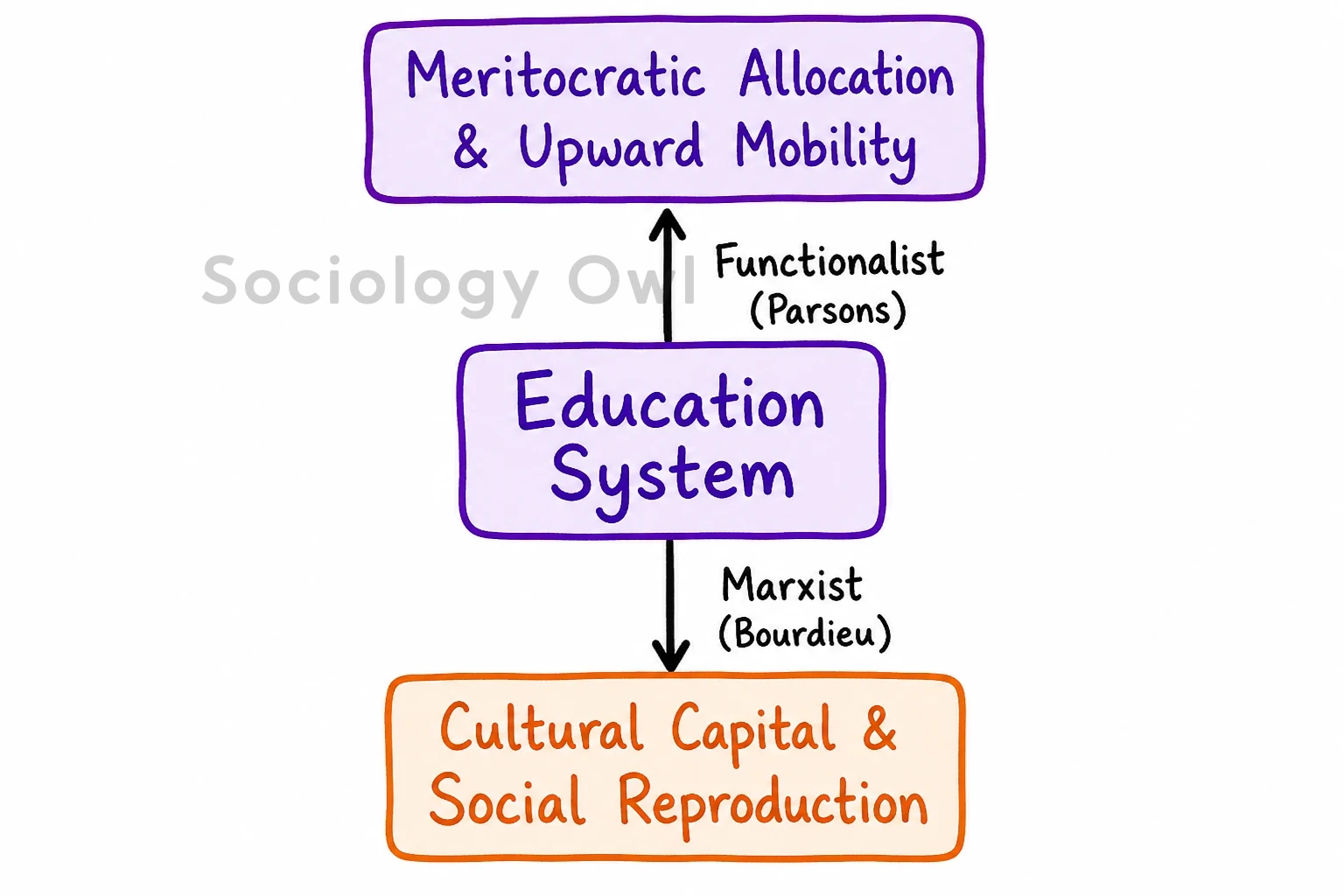
  • Functionalist Perspective: Talcott Parsons views education as a meritocratic bridge allocating roles based on talent. Empirically, John Goldthorpe’s Oxford Mobility Study demonstrated that the expansion of the educational system significantly increased absolute mobility by filling new service-sector jobs. Furthermore, Ralph Turner categorized educational pathways into “Contest Mobility” (open competition, e.g., India/USA) and “Sponsored Mobility” (elite selection, e.g., the UK).
  • Marxist & Neo-Marxist Perspective: Pierre Bourdieu argues that education reproduces inequality by exclusively rewarding the dominant class’s Cultural Capital. Similarly, Bowles and Gintis, outlining the “Correspondence Principle” in Schooling in Capitalist America, argue that schools mirror workplace hierarchies, socializing working-class students for subordinate roles rather than facilitating mobility.

Structural Barriers to Mobility

  • Credentialism: Randall Collins, in The Credential Society, argues that expanding education merely leads to “Credential Inflation”, creating a moving finish line that protects elite status.
  • Social Reproduction: Paul Willis’s Learning to Labour illustrates how working-class youth actively reject school culture, self-selecting into manual labor. Additionally, Raymond Boudon notes that mobility is structurally hindered by class-based primary and secondary effects.
  • Indian Context: While education and affirmative action have successfully facilitated the rise of a “New Middle Class” (Satish Deshpande), disparities persist for marginalized communities.

The recent pandemic exposed the Digital Divide, revealing that while EdTech promised democratized learning, it actually exacerbated gaps in cultural and economic capital. Consequently, the WEF Global Social Mobility Index consistently links unequal access to quality education with stalled social mobility in developing nations.

Conclusion

While education remains the theoretical engine of an open stratification system, without active state intervention to equalize material and cultural disparities, it risks functioning as a tool that merely legitimizes and reproduces existing structural inequalities.

Explain the concept of social mobility. Describe with suitable illustrations how education and social mobility are related to each other. Read More »

Critically examine the contribution of dependency theories in understanding the present global scenario.

Model Answers

Q: Critically examine the contribution of dependency theories in understanding the present global scenario.

Question asked in UPSC Sociology 2021 Paper 1. Download our app for last 20 year question with model answers.

Model Answer:

Dependency theories view underdevelopment not as an internal deficit, but as a historical condition caused by the unequal integration of “peripheral” societies into a capitalist world economy. Pioneered by A.G. Frank (Capitalism and Underdevelopment in Latin America), they shifted sociological focus to relational global power structures.

Manifestations of Dependency Today

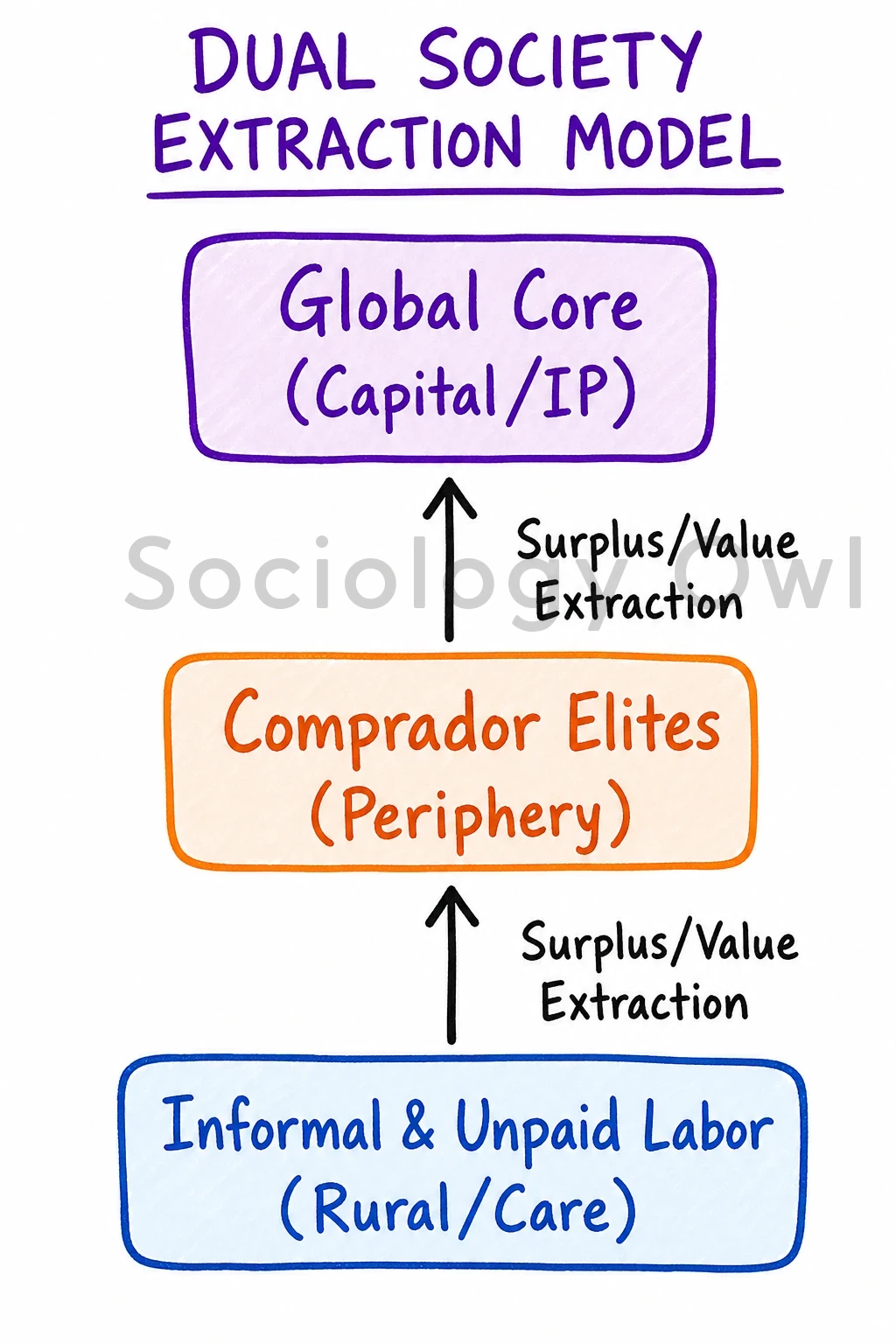
  • Surplus Extraction: Samir Amin highlighted how “Unequal Exchange” and “imperial rent” drain peripheral wealth. Today, core nations capture value via Intellectual Property rights and financialization.
  • Feminist Dependency: Maria Mies argues global capitalism extracts surplus from the unpaid reproductive labor of women in the Global South via the “housewifization” of labor.
  • Global Care Chains: Arlie Russell Hochschild notes how domestic labor continually flows from periphery to core, creating severe “care deficits” in developing nations.
  • Internal Stratification: Dependency creates a “dual society” where highly modernized comprador elites thrive alongside an impoverished, informal rural sector.

Sociological Limitations and Critiques

  • Over-structural Determinism: Dependency ignores local agency. Amartya Sen’s Capability Approach emphasizes that true development requires building internal human capacities, not just escaping capitalist structures.
  • Industrialization via Integration: Marxist critic Bill Warren (Imperialism: Pioneer of Capitalism) argues global integration actively fosters industrialization, evidenced by the East Asian tigers.
  • Dynamic Mobility: Immanuel Wallerstein’s World-Systems Theory addresses rigid binaries by introducing a dynamic semi-periphery, allowing for upward mobility.
  • Vaccine Nationalism: The COVID-19 “vaccine apartheid” exemplified dependency; core countries hoarded IP and manufacturing, leaving the periphery dependent on charity.
  • Neo-Dependency: China’s Belt and Road Initiative demonstrates that the core-periphery model persists; the “Core” has simply expanded through new “debt-trap diplomacy.”
  • Data Colonialism: Digital infrastructures systematically concentrate platform power in the Global North.

Conclusion

While orthodox dependency theories seem deterministic, their analytical spirit survives. In a world grappling with climate injustice, neo-colonial debt, and digital monopolies, dependency remains an evolving reality. Navigating it requires intersectional analysis and exploring radical alternatives like Samir Amin’s concept of “Delinking.”

Critically examine the contribution of dependency theories in understanding the present global scenario. Read More »

Explain how political parties and pressure groups are dialectically related to each other in terms of achieving their goals.

Model Answers

Q: Explain how political parties and pressure groups are dialectically related to each other in terms of achieving their goals.

Question asked in UPSC Sociology 2021 Paper 1. Download our app for last 20 year question with model answers.

Model Answer:

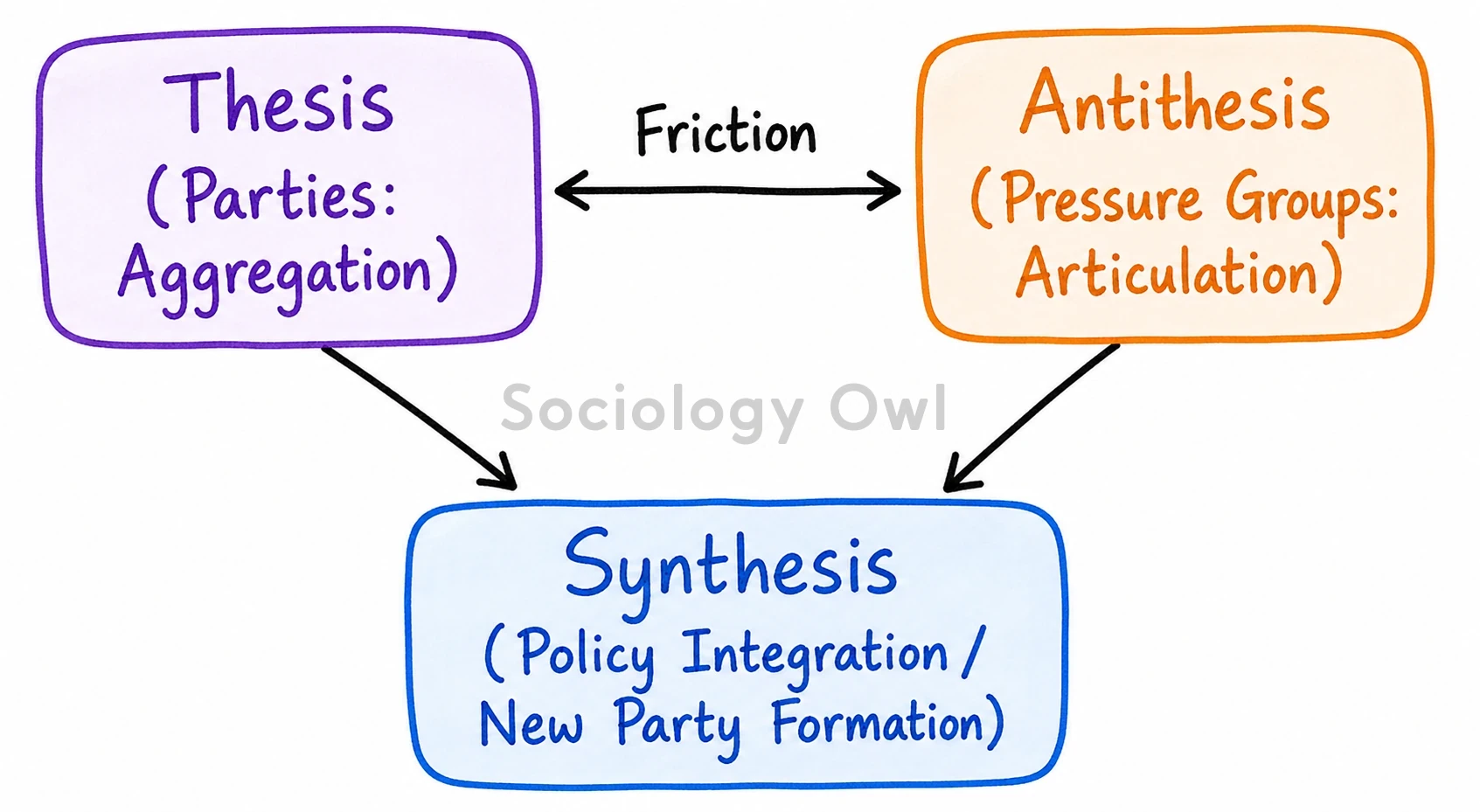
Max Weber defines political parties as vehicles for acquiring social power, while Robert Dahl views pressure groups as instruments of pluralist representation. Their relationship to achieve goals is inherently dialectical—operating through the Hegelian framework of Thesis, Antithesis, and Synthesis—where continuous friction and negotiation shape democratic governance.

The Dialectical Process: Articulation vs. Aggregation

The interaction between these entities represents a structural clash and subsequent integration:

  • Thesis (Consensus & Aggregation): Political parties seek broad institutional power. Otto Kirchheimer describes them as “Catch-all parties” that dilute specific ideologies to aggregate maximum voter consensus.
  • Antithesis (Disruption & Articulation): Pressure groups disrupt this broad consensus by prioritizing specific, uncompromised demands. In Gabriel Almond’s structural-functional framework, pressure groups articulate raw interests, challenging the party’s status quo.
  • Synthesis (Evolution): This friction forces a resolution. Parties either absorb the demands into legislation, or the pressure group captures power itself. Maurice Duverger noted that pressure groups often birth parties, such as UK Trade Unions forming the Labour Party. Similarly, in India, BAMCEF (a pressure group) dialectically evolved into the Bahujan Samaj Party (BSP).

Critical Perspectives: The Illusion of Dialectics

Critical sociologists argue this relationship is often asymmetrical and undemocratic:

  • Elite Theory: In The Power Elite, C. Wright Mills argues the dialectic is an illusion. Both political parties and powerful pressure groups (corporate lobbies) are controlled by the same interconnected elite.
  • Neo-Pluralism: Charles Lindblom notes an asymmetrical dialectic where business lobbies exert disproportionate influence over parties, distorting democratic goals.
  • Robert Michels: Through his “Iron Law of Oligarchy”, he asserts that as these groups interact and institutionalize, their leadership inevitably prioritizes organizational survival over their original grassroots goals.

Through the lens of New Social Movements (Jurgen Habermas), modern environmental groups act as antitheses to state “legitimation crises.” Globally, Germany’s Green Party exemplifies an extra-parliamentary pressure group dialectically synthesizing into a formal political party. Today, Manuel Castells’ “Network Society” shows digitized, leaderless flash-movements accelerating this dialectical cycle.

Conclusion

The dialectical relationship between parties and pressure groups is the primary engine of political modernization. While it ensures dynamic democratic deliberation by synthesizing marginalized voices into mainstream policy, critical sociological frameworks rightly caution against the overarching influence of elite oligopolies within this process.

Explain how political parties and pressure groups are dialectically related to each other in terms of achieving their goals. Read More »

What is cult ? Explain the growth of cults in the contemporary world.

Model Answers

Q: What is cult ? Explain the growth of cults in the contemporary world.

Question asked in UPSC Sociology 2021 Paper 1. Download our app for last 20 year question with model answers.

Model Answer:

Building on Ernst Troeltsch’s typology, Howard Becker defines a Cult as a loosely organized, transient, and individualistic religious group. Unlike sects, cults introduce entirely new traditions centered on the Charismatic Authority (Max Weber) of a leader.

Factors Driving the Growth of Cults

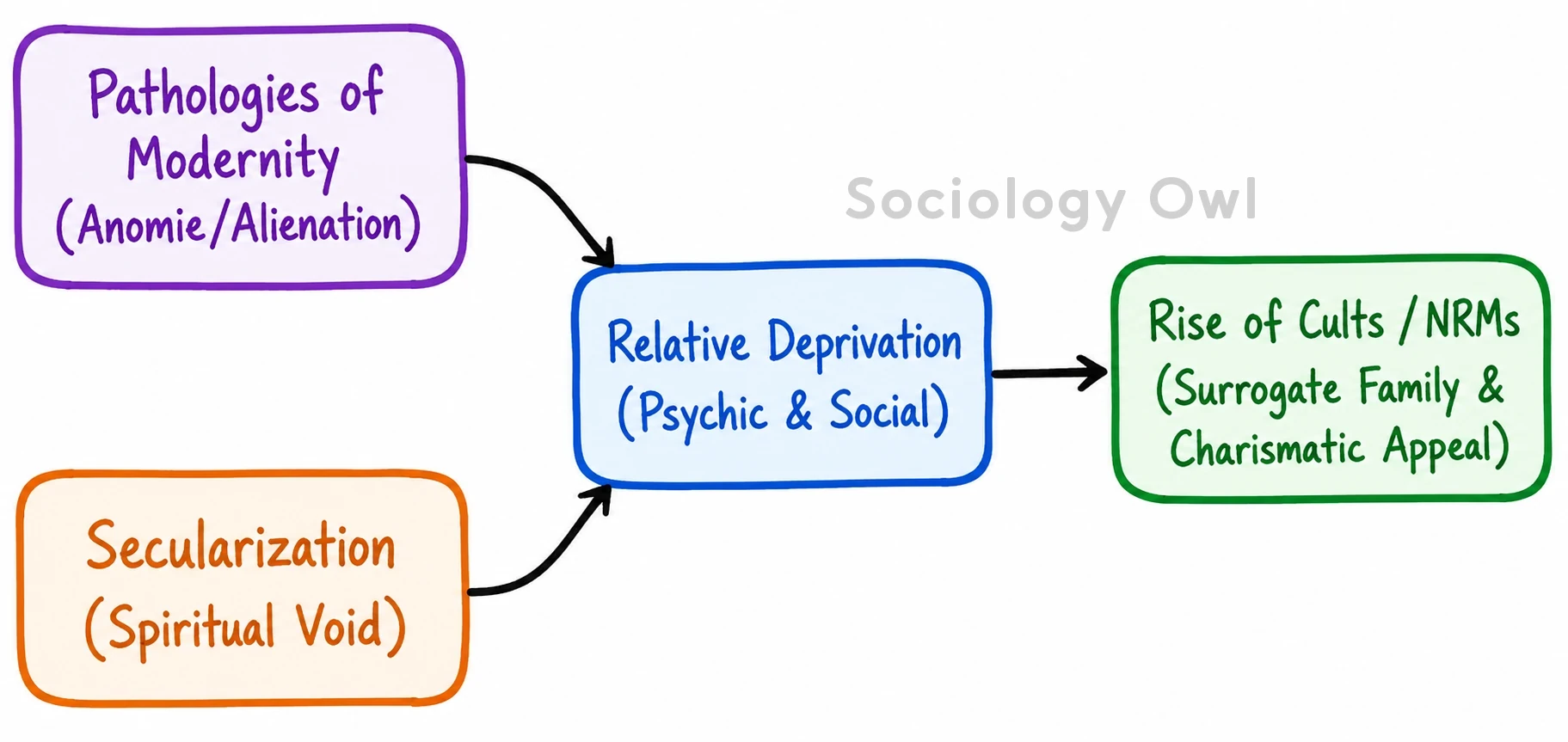
  • Pathologies of Modernity: Capitalism breeds Alienation (Karl Marx) and Anomie (Emile Durkheim). Cults offer a “surrogate family” to overcome isolation in fragmented urban societies.
  • Relative Deprivation: Charles Glock argues cults attract individuals facing psychic or social deprivation, rather than mere economic poverty.
  • World-Affirming Appeal: Roy Wallis notes that modern “world-affirming” cults promise practical success and self-realization in hyper-competitive capitalist societies.
  • Spiritual Marketplace: Secularization (Peter Berger) weakens institutional religions, creating an open market for alternative spiritualities amplified by global media.


Digital networks have globalized groups like NXIVM and Dera Sacha Sauda, illustrating how charismatic leadership exploits modern psychological vulnerabilities on a transnational scale.

Conclusion

Due to heavy media stigmatization, contemporary sociologists like Eileen Barker advocate replacing the term “cult” with the neutral framework of New Religious Movements (NRMs) to ensure objective sociological inquiry.

What is cult ? Explain the growth of cults in the contemporary world. Read More »

Do you think Talcott Parsons gave an adequate theory of social change? Justify your answer.

Model Answers

Q: Do you think Talcott Parsons gave an adequate theory of social change? Justify your answer.

Question asked in UPSC Sociology 2021 Paper 1. Download our app for last 20 year question with model answers.

Model Answer:

Talcott Parsons and Theory of Social Change

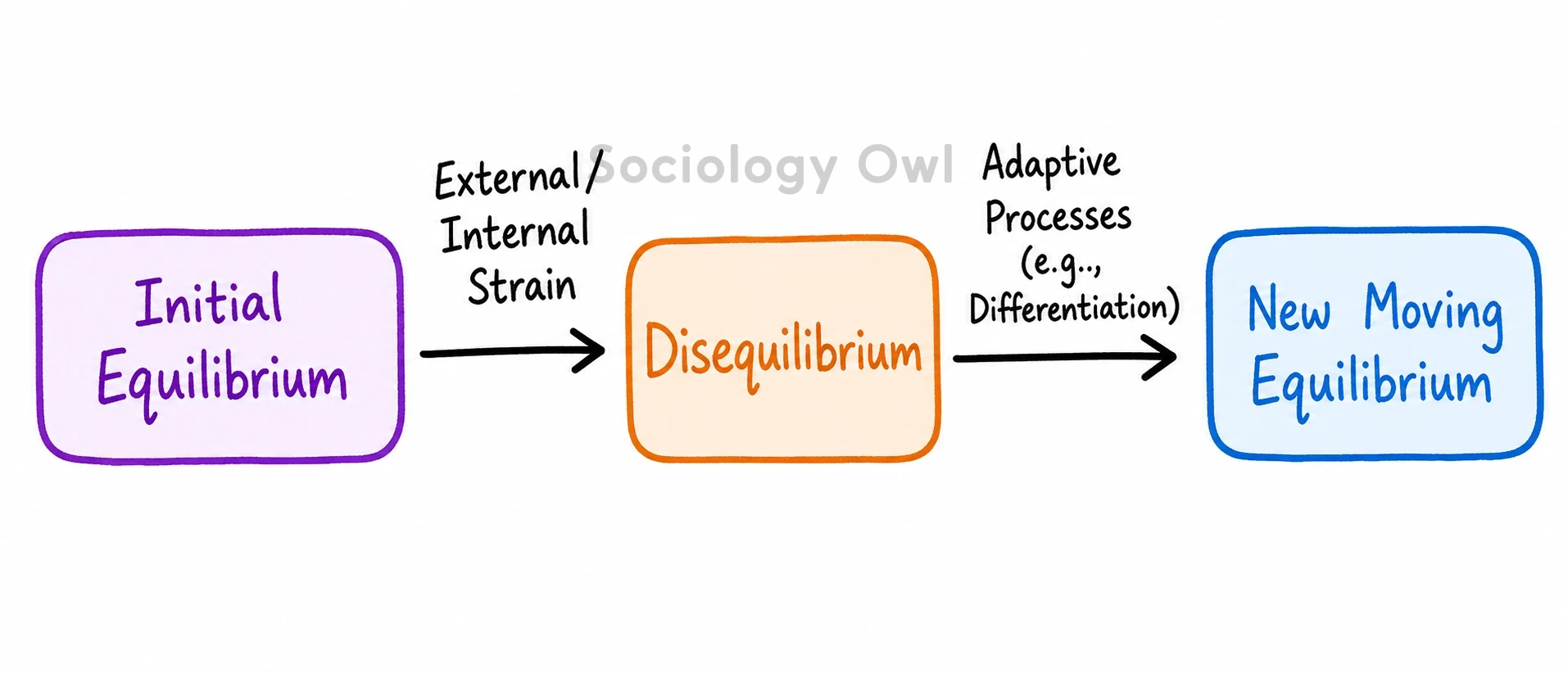
Talcott Parsons viewed social change through a structural-functionalist perspective, describing it as a “moving equilibrium” where social systems continuously adjust to internal and external strains to maintain stability.

Evolutionary Paradigm of Change

Parsons argued that institutional change is evolutionary and occurs via four interrelated processes:

  • Structural Differentiation: Single institutions splitting into specialized units (e.g., family losing economic functions to factories).
  • Adaptive Upgrading: Systems increasing their productive capacity and efficiency.
  • Inclusion: Integrating marginalized groups into the broader social system.
  • Value Generalization: Values broadening to accommodate highly complex, heterogeneous societies.

Sociological Critiques

  • Ralf Dahrendorf: Critiqued Parsons’ model as a “Utopia,” arguing it ignores coercion, power imbalances, and inevitable class conflicts.
  • C. Wright Mills: Dismissed it as an overly abstract “Grand Theory” disconnected from historical realities.
  • Robert Merton: Highlighted that Parsons ignored how internal “dysfunctions” can organically drive systemic change.

During the COVID-19 pandemic, global societies exhibited rapid adaptive upgrading (shifting to telemedicine and digital economies) to restore structural equilibrium.

Conclusion

Parsons’ theory is only partially adequate. While highly effective at explaining gradual, institutional evolution, it entirely fails to account for disruptive, revolutionary transformations (e.g., the Arab Spring), necessitating a synthesis with conflict perspectives.

Do you think Talcott Parsons gave an adequate theory of social change? Justify your answer. Read More »