2023 Sociology Paper 2

Citing some case studies, expand the concept of ‘Development-induced Displacement’.

Model Answers

Q: Citing some case studies, expand the concept of ‘Development-induced Displacement’.

Question asked in UPSC Sociology 2023 Paper 2. Download our app for last 20 year question with model answers.

Model Answer:

Development-Induced Displacement (DID) is a paradox of capitalist modernization where state-led projects marginalize the vulnerable. Walter Fernandes terms it Internal Colonialism, severely affecting marginalized groups.

Sociological Dimensions of Displacement

  • Marxist Perspective: A.R. Desai argues capitalist “national development” alienates the peasantry.
  • IRR Model: Michael Cernea expands DID to include economic deprivation and Social Disarticulation (loss of kinship networks).
  • Structural Inequality: Walter Fernandes notes Adivasis constitute nearly 40% of India’s displaced, highlighting a stark caste-tribe nexus.

Sardar Sarovar: Resistance by the Narmada Bachao Andolan highlights clashes between state utilitarianism and tribal rights, explored in Amita Baviskar’s In the Belly of the River.

Niyamgiri (Odisha): The Dongria Kondh’s struggle against Vedanta showcases resistance against cultural displacement and loss of sacred ecology.

Conclusion

Beyond legal frameworks like LARR 2013, which merely commodify land, resolving DID requires a shift towards participatory ethno-development and a “Just Transition” to protect subaltern social capital.

Citing some case studies, expand the concept of ‘Development-induced Displacement’. Read More »
What is ‘Ageing’ ? Discuss the major problems of aged people in India.

Model Answers

Q: What is 'Ageing' ? Discuss the major problems of aged people in India.

Question asked in UPSC Sociology 2023 Paper 2. Download our app for last 20 year question with model answers.

Model Answer:

Ageing is a social construct redefining social roles, status, and power. Driven by the Demographic Transition Theory, India is shifting from a traditional Gerontocracy (where age equaled authority) to the modern marginalization of its elderly population.

Sociological Problems of Ageing

  • Economic Marginalization: Sylvia Vatuk notes the transition to an urban wage-labor economy strips elders of traditional productive roles and economic authority, causing profound status loss.
  • Kinship & Care Deficit: A.M. Shah argues that despite persisting functional jointness in families, nuclear living and youth migration create a physical “care deficit”, fundamentally altering the traditional intergenerational contract.
  • Intersectionality: S. Irudaya Rajan highlights the “Feminization of Ageing,” where elderly widows face a “Triple Jeopardy” of age, gender discrimination, and lack of property rights.

The LASI report reveals rampant elderly multi-morbidity and pension exclusion. Consequently, the MWPSC Act, 2007 attempts to legally enforce filial piety, exposing severe strains in modern kinship structures.

Conclusion

Addressing India’s ageing crisis requires shifting from a charity-based welfare model to a rights-based framework, integrating the elderly as active participants in society rather than passive dependents.

What is ‘Ageing’ ? Discuss the major problems of aged people in India. Read More »

Do you think that the decades of Dalit political mobilizations and movements have helped in strengthening India’s democracy? Substantiate your arguments with facts.

Model Answers

Q: Do you think that the decades of Dalit political mobilizations and movements have helped in strengthening India’s democracy? Substantiate your arguments with facts.

Question asked in UPSC Sociology 2023 Paper 2. Download our app for last 20 year question with model answers.

Model Answer:

Dalit political mobilization has transformed India’s polity from a procedural democracy to a substantive democracy. Rajni Kothari conceptualizes this as the “politicization of caste,” where caste transitioned from a tool of traditional stratification into a vital instrument of democratic assertion.

  • The Silent Revolution: Christophe Jaffrelot argues that the transfer of political power to lower castes fundamentally democratized the Indian polity, weakening orthodox Brahmanical hierarchies.
  • Electoral Participation: Yogendra Yadav highlights the “Second Democratic Upsurge” of the 1990s, substantiated by electoral data showing Scheduled Caste (SC) voter turnout frequently matching or exceeding the general population.
  • State Power: Sudha Pai notes that mobilizations led by the Bahujan Samaj Party shifted the focus from mere social reform to capturing state machinery, converting numerical strength into legislative power.
  • Social Dignity: Gopal Guru asserts that these movements provided Dalits not just constitutional safeguards, but crucial psychological empowerment and agency.

Critical Evaluation and Limitations

  • Elite Capture: Anand Teltumbde critiques that electoral mobilization has largely benefited a “creamy layer,” leaving rural, landless Dalits alienated from democratic dividends.
  • Sub-caste Fragmentation: Collective bargaining is increasingly weakened by internal divisions, such as the Malas vs. Madigas conflict in Telangana.
  • Ideological Dilution: The radical assertion of early movements like the Dalit Panthers has often been replaced by opportunistic electoral alliances.

Modern movements like the Bhim Army and the Una protests demonstrate a shift towards youth-led, social-media-driven democratic assertion outside traditional party politics. Furthermore, university-level mobilizations, such as the Rohith Vemula protests, have expanded the discourse of democratic rights into institutional spaces.

Conclusion

While Dalit mobilizations have modernized Indian politics through structural representation, B.R. Ambedkar famously warned that political democracy (“one man, one vote”) cannot survive without social democracy (“one man, one value”). The ultimate strengthening of Indian democracy requires translating this political mobilization into the total eradication of socio-economic hierarchies.

Do you think that the decades of Dalit political mobilizations and movements have helped in strengthening India’s democracy? Substantiate your arguments with facts. Read More »

Explain the thematic linkages between ‘Patriarchy’ and ‘Honour killing’ in India, citing some recent cases.

Model Answers

Q: Explain the thematic linkages between ‘Patriarchy’ and ‘Honour killing’ in India, citing some recent cases.

Question asked in UPSC Sociology 2023 Paper 2. Download our app for last 20 year question with model answers.

Model Answer:

Honour killings in India are coercive social mechanisms enforcing endogamy and patrilineality. Patriarchy operationalizes itself through the cultural construct of Izzat (honour), where family and caste prestige are disproportionately located in the bodies and sexual purity of women.

Uma Chakravarti’s concept of “Brahmanical patriarchy” highlights how controlling female sexuality is central to maintaining caste purity.

Leela Dube’s “Seed and Earth” metaphor explains that Hindu patriarchy violently protects patrilineal “purity” against Pratiloma (hypogamous) marriages, which threaten the social order by inverting both caste and gender hierarchies.

B.R. Ambedkar emphasized that caste is fundamentally sustained by controlling women. Consequently, patriarchy violently resists inter-caste marriages to prevent the annihilation of caste.

Political Economy and Community Enforcement

Prem Chowdhry argues that honour killings, often orchestrated by Khap Panchayats, are deeply tied to land and property rights, ensuring inherited wealth does not pass outside the clan.

Such violence is also a reaction to a crisis of masculinity among dominant-caste youths who, facing agrarian distress, reassert dominance through a violent backlash against modern female educational and economic agency.

The 2018 Pranay Kumar case (a Dalit man murdered for marrying an upper-caste woman) and the Manoj-Babli case exemplify this caste-gender nexus.

In Shakti Vahini vs. Union of India (2018), the Supreme Court outlawed Khap interference in adult marriages, prompting progressive state responses like the Rajasthan Prohibition of Interference with the Freedom of Matrimonial Alliances Bill (2019).

Conclusion

Honour killings represent the violent death throes of a traditional patriarchal order resisting the constitutional morality of modern India. Eradicating this violence requires the structural dismantling of the caste-class-patriarchy nexus, fulfilling Ambedkar’s vision of a true social democracy.

Explain the thematic linkages between ‘Patriarchy’ and ‘Honour killing’ in India, citing some recent cases. Read More »

What actionable measures would you suggest to curb the recurrent child labour menace in India ?

Model Answers

Q: What actionable measures would you suggest to curb the recurrent child labour menace in India ?

Question asked in UPSC Sociology 2023 Paper 2. Download our app for last 20 year question with model answers.

Model Answer:

Child labour in India reflects a deeply entrenched caste-class nexus. Myron Weiner, in The Child and the State in India, argues its recurrence fundamentally stems from elite apathy towards educating the marginalized strata.

Actionable Structural Measures

  • Legal Reform: The Child Labour Amendment Act, 2016 allows work in “family enterprises,” which inadvertently reproduces traditional caste-based occupational continuity. This loophole requires stringent state auditing to prevent exploitation.
  • Economic Restructuring: To combat the hyper-exploitation of informal, migrant “footloose labour” (Jan Breman), stabilizing adult wages through schemes like MGNREGA structurally destroys the familial dependency on “cheap” child labour.
  • Socio-Cultural and Gender Interventions: Leela Dube highlights the “invisible” domestic labour of the girl child. Expanding state-sponsored Anganwadi crèches frees girls for schooling, alongside targeted interventions for vulnerable SC/ST groups (A.R. Desai).

Fostering digital community-state synergy via the PENCIL Portal enables robust tracking, reporting, and rehabilitation in hazardous informal sectors like the Sivakasi fireworks industry.

Conclusion

Eradicating child labour requires moving beyond purely legal bans to structurally dismantling the socio-economic inequalities and caste-based hierarchies that make children’s labour necessary for family survival.

What actionable measures would you suggest to curb the recurrent child labour menace in India ? Read More »

Elaborate the salient features and the role of middle class in India’s democracy and development.

Model Answers

Q: Elaborate the salient features and the role of middle class in India’s democracy and development.

Question asked in UPSC Sociology 2023 Paper 2. Download our app for last 20 year question with model answers. 

Model Answer:

The Indian middle class has evolved from a colonial, state-dependent group to the post-1991 LPG-driven “New Middle Class.” Sociologically, it is a complex socio-cultural formation pivotal to India’s trajectory, moving beyond mere economic categorization.

Salient Features of the Indian Middle Class

  • Caste-Class Nexus: Andre Beteille notes that this class remains disproportionately dominated by upper castes, though globalization and reservation policies are gradually fracturing this dominance.
  • Cultural Capital: It is defined by its possession of Cultural Capital, notably English-language proficiency and elite education.
  • Consumerism: Pawan Varma in The Great Indian Middle Class highlights its shift from Nehruvian frugality to aggressive neoliberal consumerism.

Role in Democracy

  • Civil Society vs. Anti-Politics: While historically driving nationalism (A.R. Desai), the contemporary middle class often prefers technocratic governance over grassroots politics. Partha Chatterjee notes their dominance in elite “civil society” versus subaltern “political society.”
  • The Democratic Paradox: Christophe Jaffrelot highlights the “secession of the successful”—where the upper-middle class retreats into gated communities, increasingly apathetic to systemic inequalities.

Role in Development

  • Engines of Neoliberal Growth: As drivers of the tertiary IT/service sector, they emulate global consumerist lifestyles, reflecting Embourgeoisement and M.N. Srinivas’s concept of Westernization.
  • Hegemony over Narratives: Amartya Sen argues they dictate national agendas (e.g., smart cities, bullet trains), often at the expense of subaltern developmental needs like primary healthcare.

Middle-class civil society intervention is evident in the India Against Corruption movement and urban Resident Welfare Associations (RWAs), which demand accountability but frequently exhibit exclusionary spatial politics.

Conclusion

The Indian middle class acts as a “double-edged sword” (Satish Deshpande). While it is the primary engine of macroeconomic integration and governance reform, its inherent caste-privilege and technocratic elitism pose continuous challenges to substantive democratization.

Elaborate the salient features and the role of middle class in India’s democracy and development. Read More »

Discuss the nature of regional variations in sex ratio in India, stating reasons thereof.

Model Answers

Q: Discuss the nature of regional variations in sex ratio in India, stating reasons thereof.

Question asked in UPSC Sociology 2023 Paper 2. Download our app for last 20 year question with model answers.

Model Answer:

India’s sex ratio mirrors structural inequalities. Barbara Miller (The Endangered Sex) maps a stark regional dichotomy: the culturally masculine North-West (adverse ratio) versus the egalitarian South/North-East. While NFHS-5 indicates overall progress (1020/1000), the Child Sex Ratio remains skewed.

Sociological Reasons for Variations

  • Kinship Zones: Irawati Karve links northern patrilocal kinship to deep “daughter aversion.” Leela Dube’s “Seed and Earth” metaphor explains how northern patriarchy devalues women as mere receptacles, contrasting with southern endogamy and female autonomy.
  • Agrarian Economy: Prem Chowdhry attributes Haryana’s adverse ratios to hyper-masculinity and patriarchal land-ownership. Conversely, Bina Agarwal connects better Southern/Eastern ratios to female property rights.
  • The Prosperity Paradox: Mary E. John argues declining ratios reflect modernity, not backwardness. Capitalist medical nexuses make sex-selective abortions highly accessible among urban, prosperous classes.

Strict enforcement of the PCPNDT Act and behavioral campaigns like Beti Bachao Beti Padhao have yielded marginal improvements in Sex Ratio at Birth in traditionally skewed states like Haryana, demonstrating state-led demographic correction.

Conclusion

Regional variations in sex ratios are not merely demographic statistics; they are vivid reflections of the deeply entrenched caste-class-gender nexus operating within a rapidly modernizing India.

Discuss the nature of regional variations in sex ratio in India, stating reasons thereof. Read More »

In the face of rising global climatic concerns, how do you contextualize the relevance of Chipko Movement and its Gandhian tone? Answer analytically.

Model Answers

Q: In the face of rising global climatic concerns, how do you contextualize the relevance of Chipko Movement and its Gandhian tone? Answer analytically.

Question asked in UPSC Sociology 2023 Paper 2. Download our app for last 20 year question with model answers.

Model Answer:

The Chipko movement, an early New Social Movement, exemplifies what Ramachandra Guha terms the “Environmentalism of the Poor.” Rooted in the Gandhian ethics of Ahimsa and Sarvodaya, it provides a critical sociological framework to critique modern global climate crises.

The Gandhian Tone and Sociological Debates

Satyagraha as a Subaltern Tool: Mobilized by leaders like Sunderlal Bahuguna, peaceful resistance challenged state-corporate logging nexuses. In The Unquiet Woods, Guha debates the movement’s nature, arguing Chipko was fundamentally a peasant struggle for economic survival and resource rights, contrasting sharply with Western “empty-stomach” (leisure-based) environmentalism.

Gram Swaraj (Decentralization): Chipko was a protest against top-down colonial forestry models. It demanded indigenous control over local resources, an ethos crucial today against centralized global climate governance.

Gender Dynamics in Ecology

Eco-Feminism vs. Feminist Environmentalism: Vandana Shiva analyzes Chipko through Eco-Feminism, positing that women share a spiritual connection with nature (Prakriti) and resisted patriarchal “maldevelopment.” Conversely, Bina Agarwal offers a materialist critique via “Feminist Environmentalism,” arguing that women’s participation stemmed from their lived realities, as deforestation disproportionately increased their daily labor for fuel and fodder.

Chipko’s fight for local rights prefigures modern Climate Justice debates, mirroring the Global South’s demands against the industrialized Global North. Domestically, its Gandhian continuum is visible in the recent Hasdeo Arand protests, where indigenous communities utilized Satyagraha against corporate coal mining to protect their habitat.

Conclusion

In an era dominated by top-down, technocratic climate solutions like carbon credits, Chipko’s Gandhian legacy serves as a potent reminder. It asserts that sustainable ecology is impossible without sociological equity, Gram Swaraj, and justice for marginalized communities.

In the face of rising global climatic concerns, how do you contextualize the relevance of Chipko Movement and its Gandhian tone? Answer analytically. Read More »

Discuss the phenomenon of rural-urban continuum with suitable examples.

Model Answers

Q: Discuss the phenomenon of rural-urban continuum with suitable examples.

Question asked in UPSC Sociology 2023 Paper 2. Download our app for last 20 year question with model answers.

Model Answer:

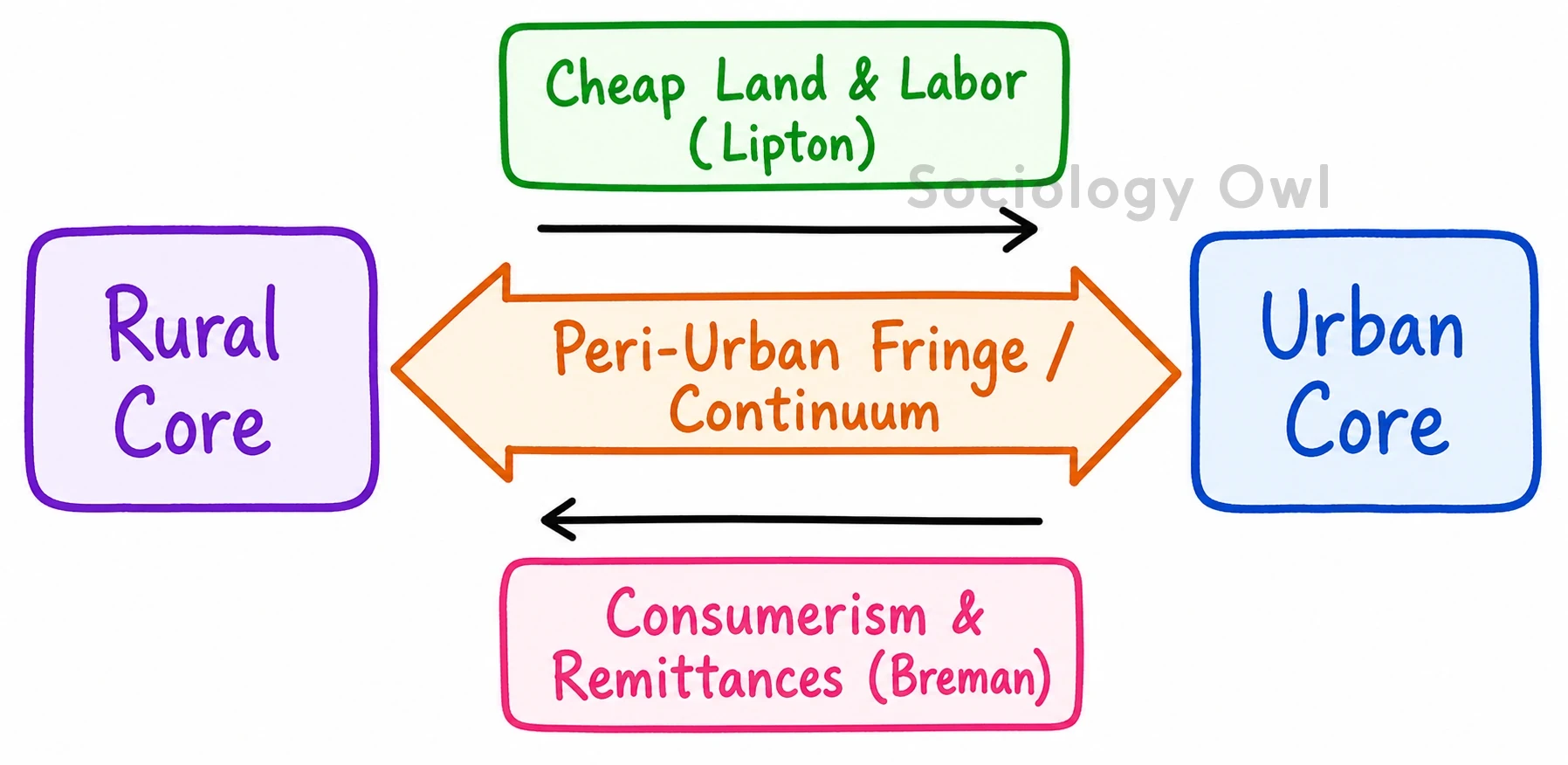
The rural-urban continuum (Robert Redfield) denotes a spatial and cultural spectrum blending rural and urban traits. Contextualizing this in India, G.S. Ghurye argued a strict dichotomy never existed, noting deep historical and structural linkages.

Sociological Dynamics of the Continuum

Economic Integration (M.S.A. Rao)

His Okhla study highlights the “Urban Fringe”, where expanding cities absorb agrarian economies, frequently transforming traditional dominant castes into local real-estate capitalists.

Socio-Cultural Blending (Jan Breman)

The phenomenon of Circular Migration ensures migrants adopt Modernization in cities, transmitting urban consumerism backward, thereby blurring traditional caste-class boundaries in rural peripheries.

The National Capital Region (NCR) exemplifies peri-urbanization, merging agricultural lands with tech-parks. However, Dipankar Gupta critiques this as the “vanishing village”, where rural spaces adopt urban consumerism without civic infrastructure. Furthermore, Marxists like Michael Lipton highlight an “Urban Bias”, where cities structurally extract cheap land and labor from this continuum.

Conclusion

The continuum reflects complex, unequal structural transformations. Acknowledging this, policies like the Shyama Prasad Mukherji Rurban Mission are critical to bridge developmental deficits and manage equitable spatial integration.

Discuss the phenomenon of rural-urban continuum with suitable examples. Read More »

Discuss the main features of Land Reforms in post-independence India

Model Answers

Q: Discuss the main features of Land Reforms in post-independence India.

Question asked in UPSC Sociology 2023 Paper 2. Download our app for last 20 year question with model answers. 

Model Answer:

Post-independence land reforms aimed to democratize India’s agrarian structure, dismantling the feudal caste-class nexus to build an egalitarian society (P.C. Joshi).

Features and Sociological Impact

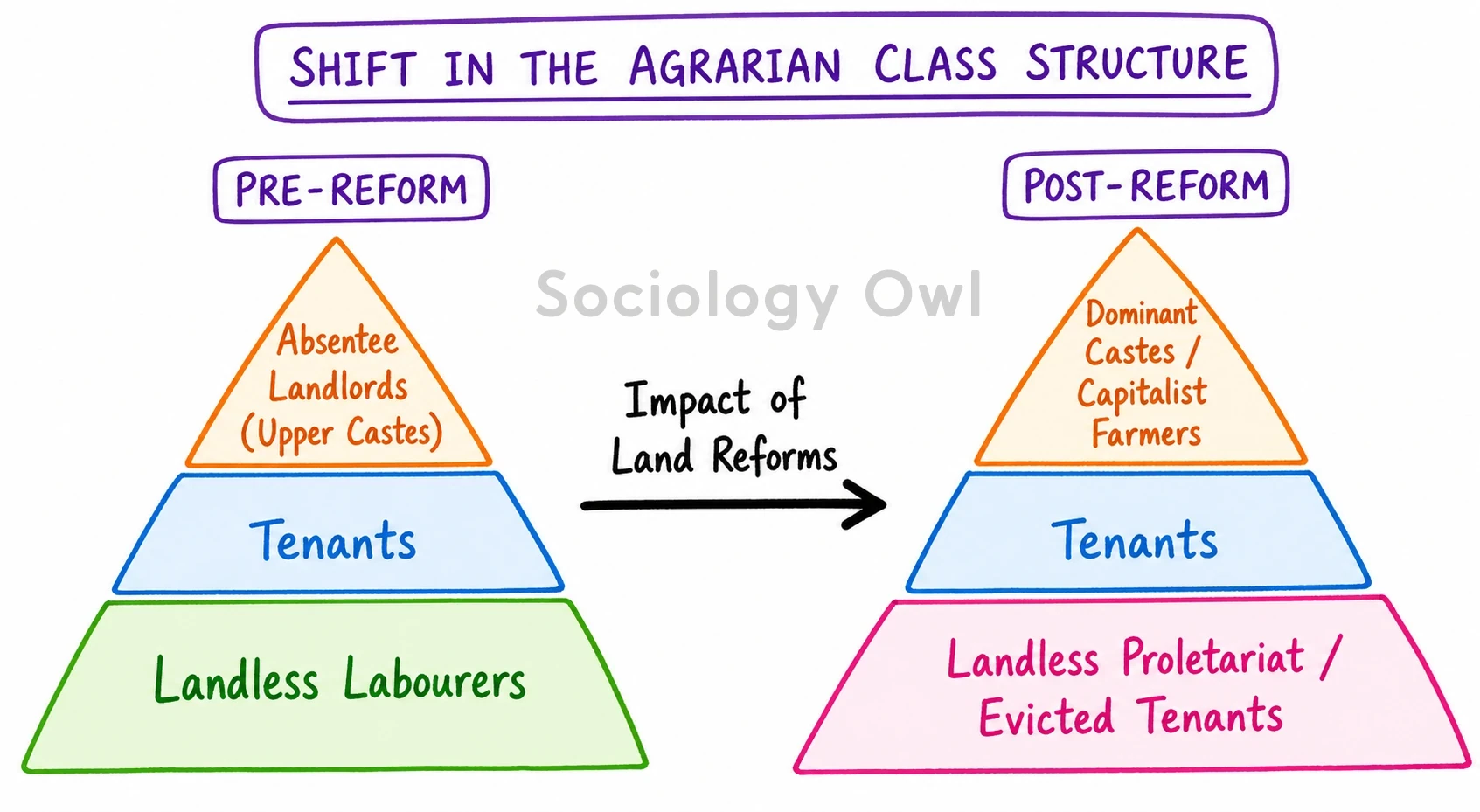
  • Abolition of Intermediaries: Altered the traditional Malik-Kisan-Mazdoor hierarchy (Daniel Thorner), severing direct feudal ties.
  • Tenancy Reforms: Intended to secure tenure but inadvertently led to tenant evictions and hidden sharecropping.
  • Ceiling and Redistribution: Thwarted by “benami” transfers by rural elites, keeping Dalit agricultural laborers largely landless.
  • Consolidation and Cooperatives: Failed largely due to entrenched upper-caste prejudices against pooling resources with lower castes.

Sociological Critiques

  • M.N. Srinivas: In The Remembered Village, he argued that reforms empowered middle-peasant Dominant Castes (e.g., Jats, Yadavs) as the new rural elites.
  • A.R. Desai: A Marxist critique noting that reforms merely created capitalist “kulaks” while completely neglecting the rural proletariat.

Historically, reforms neglected the feminization of agriculture by denying women joint land titles. Today, modern policies like the SVAMITVA Scheme digitize land records to resolve these historical administrative loopholes and prevent elite capture.

Conclusion

Though land reforms successfully shifted rural power dynamics from “cumulative” to “dispersed” inequalities (Andre Beteille), achieving genuine egalitarianism requires continuous institutional alignment with digital modernization and gender-inclusive rights.

Discuss the main features of Land Reforms in post-independence India Read More »