2022 Sociology Paper 1

What are the shortfalls of positivist philosophy that gave rise to the non-positivist methods of studying social reality ?

Model Answers

Q: What are the shortfalls of positivist philosophy that gave rise to the non-positivist methods of studying social reality ?

Question asked in UPSC Sociology 2022 Paper 1. Download our app for last 20 year question with model answers.

Model Answer:

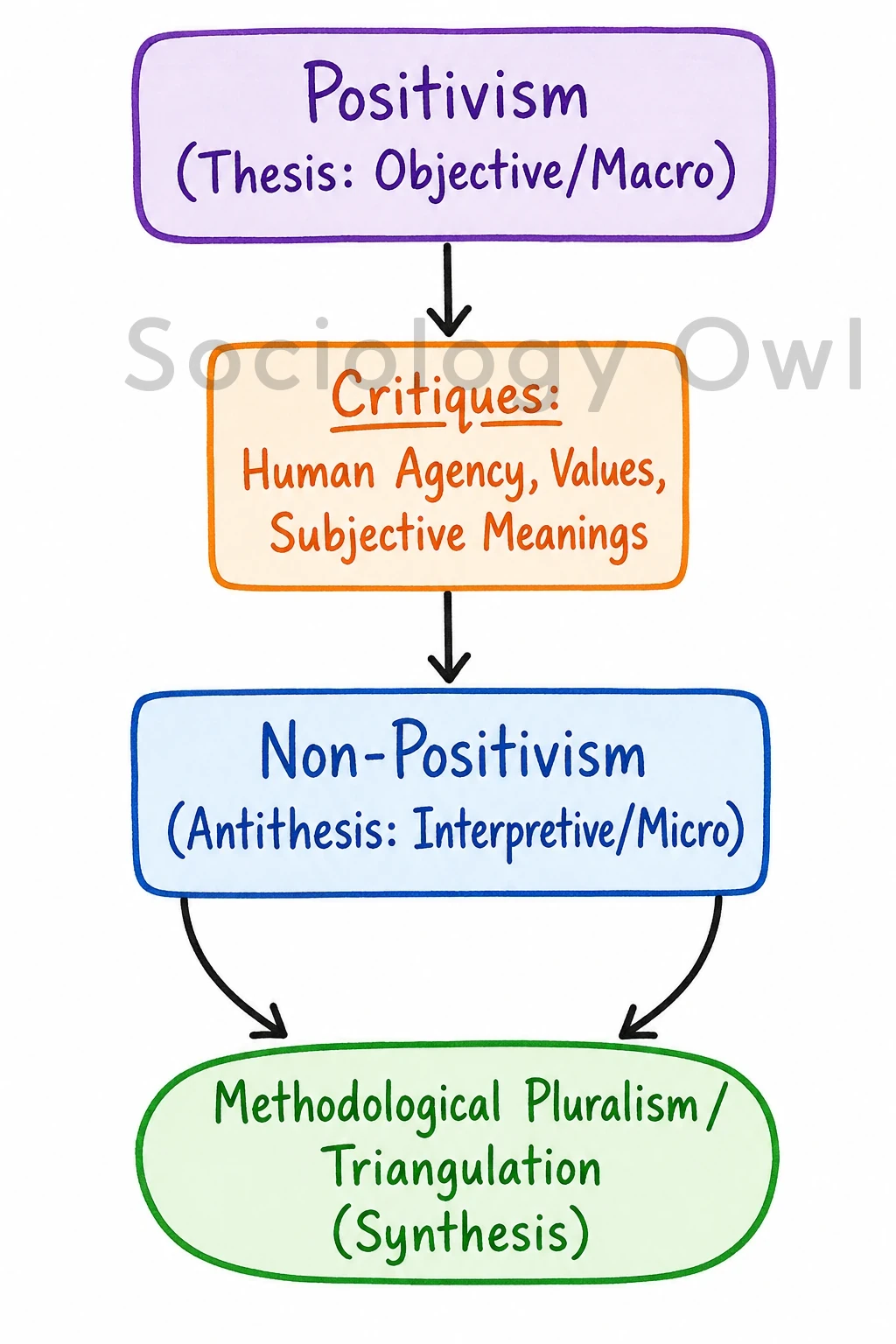
Positivism, championed by Auguste Comte and Emile Durkheim in The Rules of Sociological Method, advocated studying “social facts as things” using objective, natural science methods. However, the late 19th-century Methodenstreit debate exposed fundamental flaws in applying natural science principles to conscious human behavior, paving the way for non-positivist methodologies.

Critiques of Positivism

Ontological and Epistemological Shortfalls: Positivism treats society as a deterministic, physical object. Peter Berger and Thomas Luckmann in The Social Construction of Reality counter this, arguing society is an ongoing human production. Symbolic interactionists argue individuals actively interpret reality rather than passively reacting to macro-laws.

The myth of value-neutrality: Frankfurt School critical theorists argued that objective neutrality is impossible; all research is value-laden. Additionally, the Feminist critique by Ann Oakley highlighted that positivism is inherently hierarchical and patriarchal, reducing human subjects to passive data-mining objects rather than equal participants.

Methodological Shortfalls: Inability to study subjective meaning: Neo-Kantian thinkers like Wilhelm Dilthey argued human consciousness demands interpretive understanding, not just observation. This birthed Max Weber’s concept of Verstehen (empathetic understanding) and Alfred Schutz’s phenomenological approach to capture intricate lived experiences that statistics ignore.

Rejection of universal laws: Positivism’s search for static, universal generalizations was dismantled by the Post-Modernist critique. Michel Foucault argued against absolute “meta-narratives,” emphasizing instead how historical contexts, discourse, and power dynamics constantly shift social realities.
During the COVID-19 pandemic, positivist statistical surveys successfully captured how many people refused vaccines. However, non-positivist interpretivist methods, like in-depth interviews, were critical to understanding the subjective meaning behind vaccine hesitancy, such as political identity and historical distrust of medical institutions.

Conclusion

While non-positivist methods effectively capture micro-level meanings, they often face criticisms of extreme subjectivity. Contemporary sociology has largely moved past this binary debate toward Methodological Pluralism or Triangulation, a concept advanced by Norman Denzin. By combining positivist macro-structures with non-positivist lived experiences, sociologists achieve a holistic understanding of dynamic social realities.

What are the shortfalls of positivist philosophy that gave rise to the non-positivist methods of studying social reality ? Read More »

Critically examine the relevance of Durkheim’s views on religion in contemporary society.

Model Answers

Q: Critically examine the relevance of Durkheim’s views on religion in contemporary society.

Question asked in UPSC Sociology 2022 Paper 1. Download our app for last 20 year question with model answers.

Model Answer:

In The Elementary Forms of Religious Life, Emile Durkheim defines religion as a unified system of beliefs and practices relative to Sacred things, uniting adherents into a single moral community.

Relevance of Durkheim’s Views

  • Civil Religion: Robert Bellah shows how secular nationalism (e.g., constitutional reverence, Independence Day) fosters cohesion identically to traditional religion.
  • Neo-Totemism: National flags and corporate logos function as modern totems, projecting collective identity.
  • Collective Effervescence: Mega-events like the FIFA World Cup or Kumbh Mela generate unifying social energy, mimicking religious fervor.

Religion

Limitations in Contemporary Society

  • Privatization: Grace Davie identifies “believing without belonging”, emphasizing individualized spirituality over collective ritual.
  • Dysfunction: Religion frequently triggers sectarian violence globally, contradicting Durkheim’s integration thesis and supporting Karl Marx’s conflict perspective.

Regarding contemporary relevance, the global emergence of environmentalism as a moral duty proves Durkheim’s concept of the Sacred continuously adapts to secular, modern contexts. Conversely, the rise of religious “Nones” challenges the universality of a singular moral community.

Conclusion

Despite secularization weakening orthodox faith, Durkheim’s functional premise survives. Modern societies continuously reinvent Sacred symbols and rituals to maintain the collective solidarity essential for social integration.

Critically examine the relevance of Durkheim’s views on religion in contemporary society. Read More »

Delimit the scope of sociology in relation to other social sciences

Model Answers

Q: Delimit the scope of sociology in relation to other social sciences.

Question asked in UPSC Sociology 2022 Paper 1. Download our app for last 20 year question with model answers.

Model Answer:

The scope of sociology is fundamentally debated between the Formalistic School (Georg Simmel), which limits it to specific forms of social relationships, and the Synthetic School (Emile Durkheim), which views it as a comprehensive, generalizing science. Despite overlaps, sociology maintains distinct analytical boundaries.

Delimiting Sociology from Other Disciplines

  • Psychology: Focuses on internal mental states and individual behavior, whereas sociology studies external, coercive Social Facts (Emile Durkheim).
  • Anthropology: Traditionally studies pre-modern, simple societies via ethnography, while sociology examines complex, industrial societies, though A.L. Kroeber notably calls them “twin sisters.”
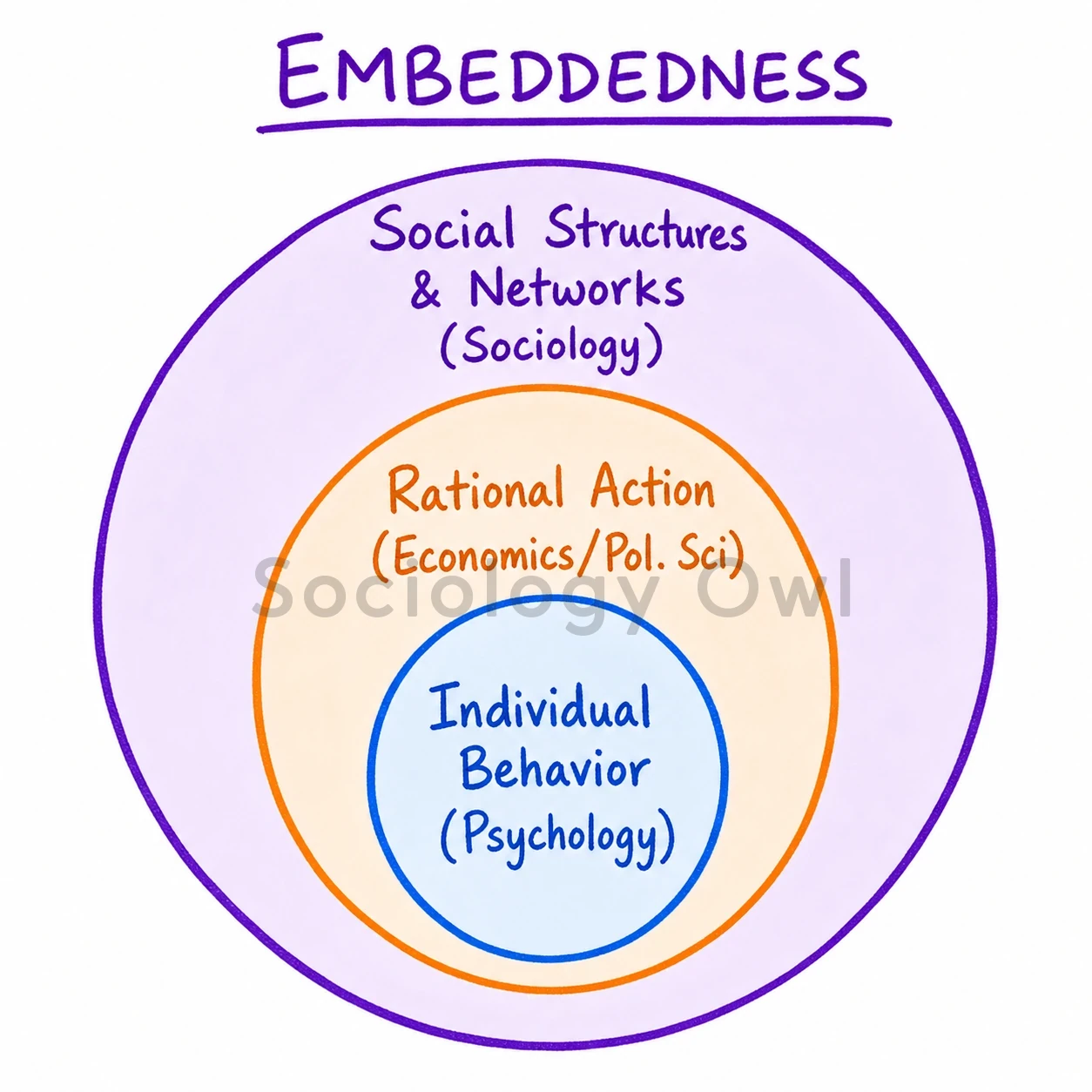
  • Economics & Political Science: While they study rational markets and governance structures, sociology explores the “Embeddedness” of economic and political actions within broader social networks (Mark Granovetter).

Sociology Vs others

In studying the global Gig Economy, economics analyzes algorithmic wage structures, whereas sociology uniquely examines the resulting worker Alienation, social isolation, and shifting family dynamics.

Conclusion

While sociology possesses a distinct scope centered on systemic relationships and social structures, the complexities of modern society necessitate Interdisciplinarity. The rise of hybrid fields like Political Sociology demonstrates that rigid disciplinary boundaries are increasingly blurring.

Delimit the scope of sociology in relation to other social sciences Read More »

Critically analyse Parsons views on society as a social system.

Model Answers

Q: Critically analyse Parsons views on society as a social system.

Question asked in UPSC Sociology 2022 Paper 1. Download our app for last 20 year question with model answers.

Model Answer:

Talcott Parsons, in his seminal work The Social System, sought to resolve the “Hobbesian problem of order” by synthesizing Max Weber’s focus on social action with Emile Durkheim’s macro-social order. He defined a Social System as a plurality of interacting actors motivated by gratification optimization, whose relations are guided by a culturally structured system of shared symbols.

Parsons’ Conception of the Social System

  • AGIL Schema: Parsons argued systems survive by fulfilling four functional prerequisites through specific institutions:
    • Adaptation: Economy (extracting resources and wealth creation).
    • Goal Attainment: Polity (political decision-making).
    • Integration: Law and Religion (maintaining solidarity and coordination).
    • Latency (Pattern Maintenance): Family and Education (socializing and transmitting values).
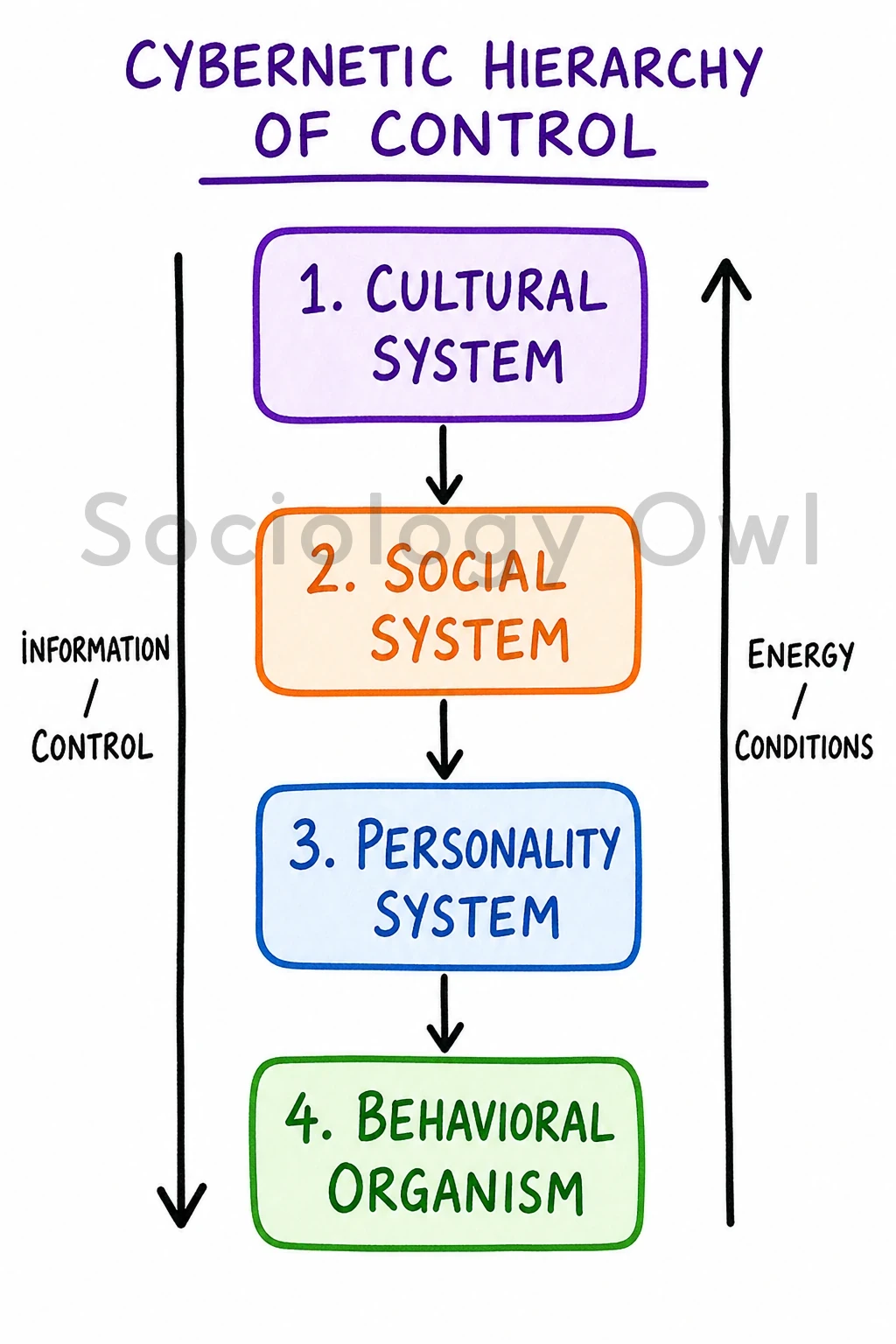
  • Cybernetic Hierarchy of Control: Parsons postulated that social systems are regulated by this hierarchy, where systems with high information (culture/values) control systems with high energy (economy/biology).
  • Moving Equilibrium: Society is not entirely static; it maintains a “moving equilibrium” through continuous structural differentiation and shared value consensus.

Parsons' Social System

Critical Analysis

  • “Grand Theory” Abstraction: C. Wright Mills criticized Parsons’ framework as an overly abstract “Grand Theory” detached from empirical, historical reality.
  • Overemphasis on Stability: Conflict theorists like Ralf Dahrendorf argued Parsons ignored coercion, inequality, and the constructive role of conflict, acting as an apologist for the status quo.
  • Lack of Agency: Ethnomethodologist Harold Garfinkel critiqued Parsons for treating actors as “cultural dopes” who blindly act out pre-programmed systemic scripts.
  • Internal Critique: R.K. Merton rejected Parsons’ postulate of universal functionalism, introducing “dysfunctions” to account for negative systemic consequences.

Contemporary Relevance

Parsons’ AGIL schema elegantly maps systemic responses to modern crises like the COVID-19 pandemic: societies had to Adapt (remote digital economy), set Goals (vaccine deployment by the State), ensure Integration (public health mandates), and rely on Latency (appealing to shared community values).

Conclusion

While classical Parsonian functionalism declined, its quest to understand society as an interconnected whole remains vital. It laid the foundation for Niklas Luhmann’s Systems Theory and Jeffrey Alexander’s Neo-functionalism, proving continuously relevant for analyzing complex, highly differentiated global societies.

Critically analyse Parsons views on society as a social system. Read More »

What aspects of Enlightenment do you think paved way for the emergence of sociology ? Elaborate.

Model Answers

Q: What aspects of Enlightenment do you think paved way for the emergence of sociology ? Elaborate.

Question asked in UPSC Sociology 2022 Paper 1. Download our app for last 20 year question with model answers.

Model Answer:

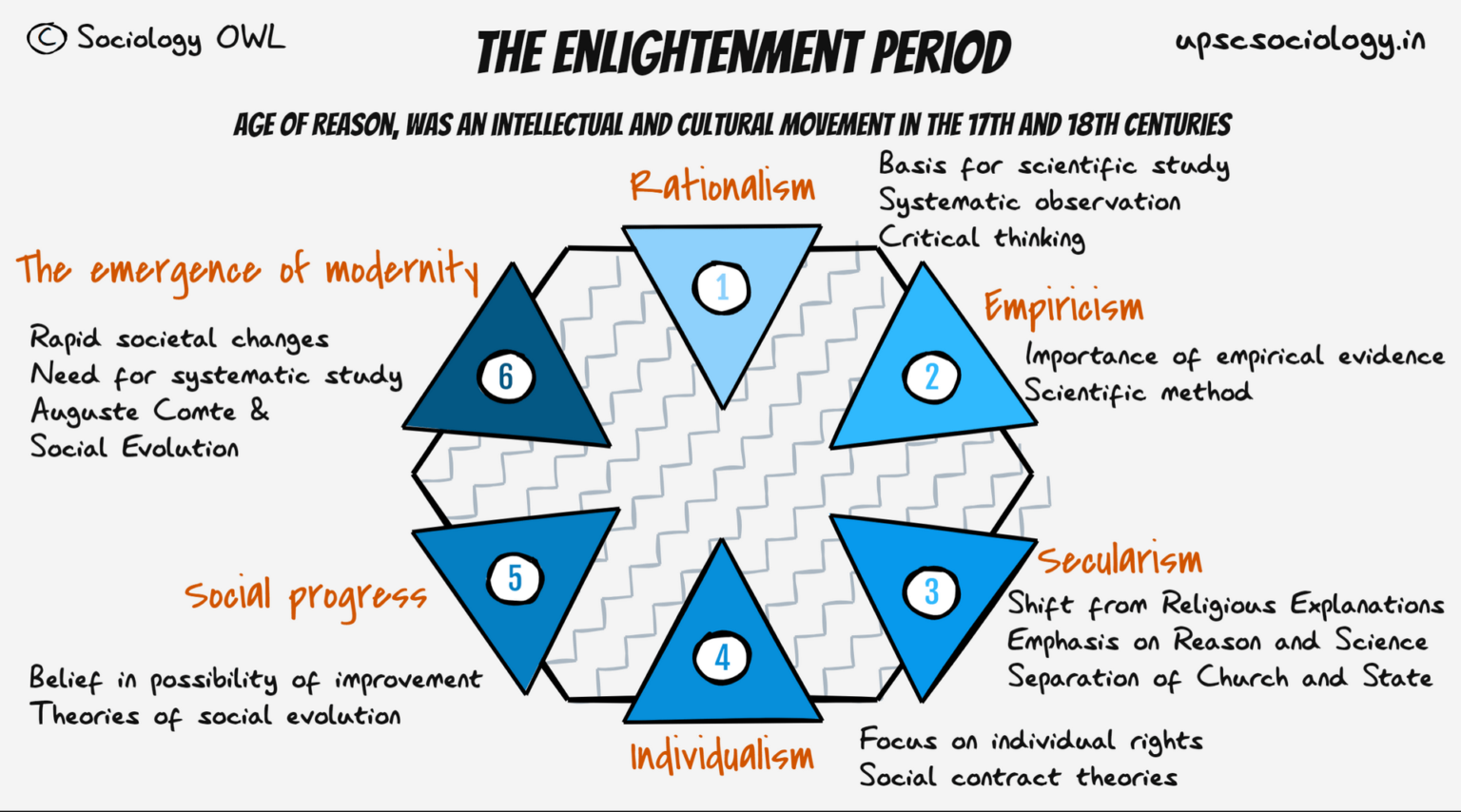
The Enlightenment (18th century) marked a radical shift from a theocentric (God-centered) medieval worldview to an anthropocentric (human-centered) “Age of Reason.” Alongside the material chaos of the French and Industrial Revolutions (the “Dual Revolution”), this intellectual awakening created the epistemological foundation for sociology.

Direct Contributions of the Enlightenment

  • Rationalism and the Comparative Method: Thinkers rejected religious dogma in favor of empirical observation. Montesquieu, in The Spirit of the Laws, acted as a proto-sociologist by empirically comparing different societal structures.
  • Secularization of Thought: Society was reconceptualized as a human construct rather than divine will. This framework allowed later sociologists like Emile Durkheim to study religion purely as an observable Social Fact.
  • Discovery of “Civil Society”: Jean-Jacques Rousseau distinguished between the formal “State” and “Civil Society,” providing sociologists with a distinct structural realm to study independent of political science.
  • Teleological View of Progress: The optimistic belief in human perfectibility inspired the systematic study of society for social reform.

Conservative Reaction and Sociological Synthesis

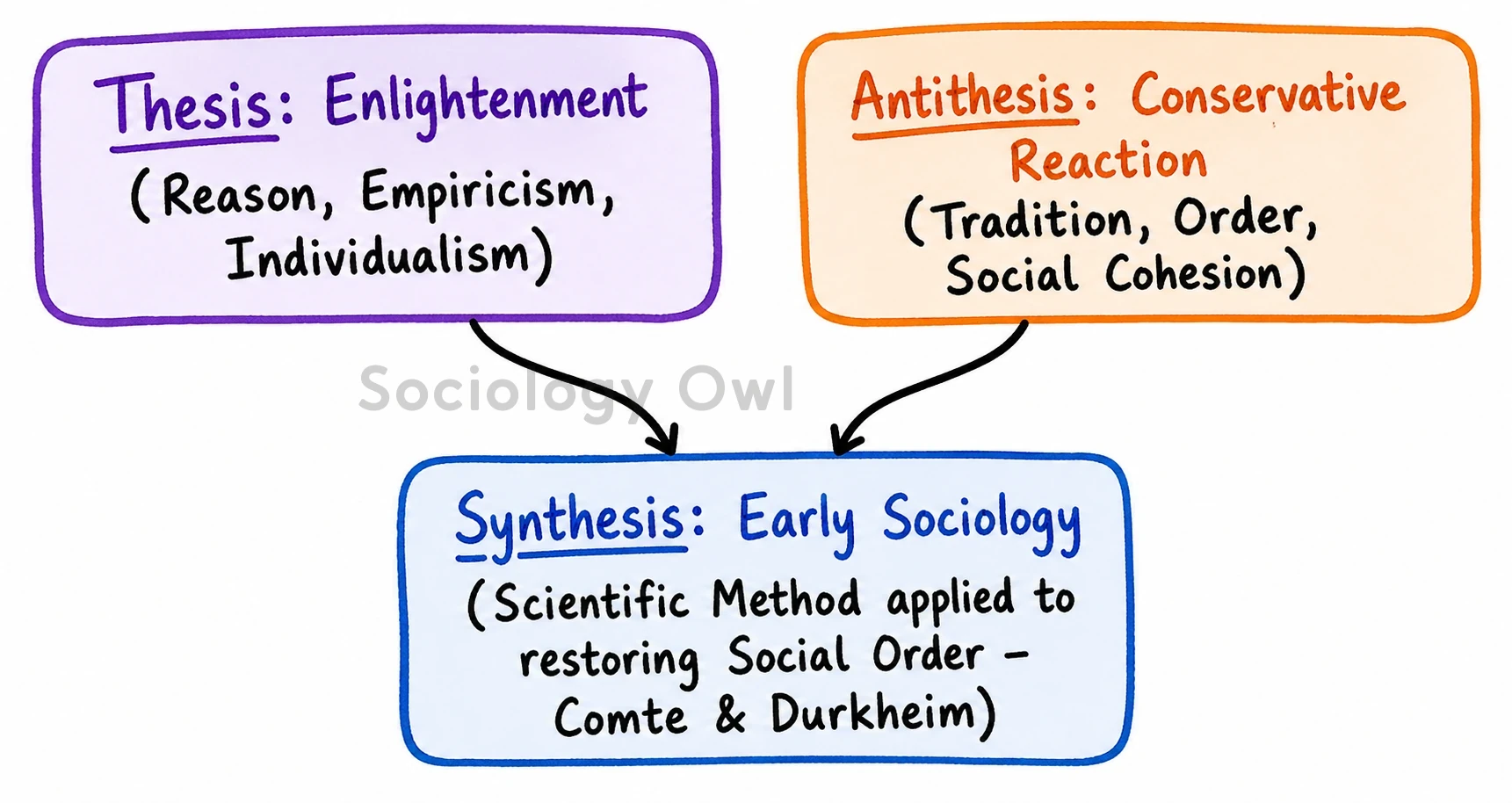
Sociology emerged not just from a linear progression of Enlightenment ideals, but dialectically through a Conservative Reaction.

  • Thinkers like Louis de Bonald and Joseph de Maistre fiercely criticized the Enlightenment for promoting extreme individualism and destroying traditional social cohesion.
  • Irving Zeitlin famously asserted that “early sociology developed as a reaction to the Enlightenment.”
  • Early sociology was a synthesis: Auguste Comte and Emile Durkheim borrowed the scientific method from the Enlightenment but applied it to the Conservative goal of restoring social order. Comte’s motto, “Order and Progress,” perfectly encapsulates this synthesis.

enlightenment

Critical Perspective: The Dark Side of Enlightenment

The Frankfurt School sociologists Theodor Adorno and Max Horkheimer, in Dialectic of Enlightenment, critiqued extreme instrumental rationality, arguing that it ultimately led to modern alienation and hyper-bureaucratized oppression, such as the Holocaust.

Today, sociology uses rational inquiry to study the limits of Enlightenment rationality, evident in the critical analysis of technologically driven algorithmic biases and the global ecological crises born from unchecked scientific “progress.”

Conclusion

Ultimately, sociology emerged as an intellectual response to the structural chaos of modernity. It was born from a unique dialectical synthesis—merging the Enlightenment’s empirical and rational methods with the Conservative desire for social solidarity and structural equilibrium.

Enlightenment period Explained Mind Map

What aspects of Enlightenment do you think paved way for the emergence of sociology ? Elaborate. Read More »

Illustrate with examples the role of pressure groups in the formulation of social policies.

Model Answers

Q: Illustrate with examples the role of pressure groups in the formulation of social policies.

Question asked in UPSC Sociology 2022 Paper 1. Download our app for last 20 year question with model answers.

Model Answer:

Role of Pressure Groups in Social Policy Formulation

Pressure groups play a significant role in shaping social policies by influencing decision-makers and public opinion. These organized groups advocate for specific interests or causes, often representing marginalized communities or addressing particular social issues.

Key points on the role of pressure groups in social policy formulation:

1. Agenda setting: Pressure groups bring attention to social issues, forcing them onto the political agenda. For example, environmental groups in India, like the Chipko Movement, highlighted deforestation concerns, leading to policy changes in forest conservation.

2. Information provision: They provide policymakers with specialized knowledge and research, influencing policy decisions. The Centre for Science and Environment in India has been instrumental in shaping air pollution policies by presenting scientific data.

3. Mobilization of public opinion: Pressure groups use media campaigns and public demonstrations to garner support. The Nirbhaya case in India saw women’s rights groups mobilizing public opinion, leading to stricter laws against sexual violence.

4. Lobbying: They directly engage with policymakers to advocate for their cause. The Right to Information (RTI) movement in India lobbied extensively, resulting in the RTI Act of 2005.

5. Policy alternatives: Pressure groups often propose alternative policy solutions. The National Alliance of People’s Movements in India has been influential in shaping resettlement policies for people displaced by development projects.

Mancur Olson’s theory of collective action explains how these groups overcome the “free-rider problem” to effect change. However, critics like Robert Dahl warn of the potential for unequal influence based on resources and power.

In conclusion, pressure groups serve as a vital link between citizens and policymakers, playing a crucial role in democratic societies by ensuring diverse voices are heard in the policy-making process.

Illustrate with examples the role of pressure groups in the formulation of social policies. Read More »

Social stratification is claimed to contribute to maintenance of social order and stability in society. Critically assess.

Model Answers

Q: Social stratification is claimed to contribute to maintenance of social order and stability in society. Critically assess.

Question asked in UPSC Sociology 2022 Paper 1. Download our app for last 20 year question with model answers.

Model Answer:

Social Stratification :  Social Order & Stability

Social stratification refers to the hierarchical arrangement of individuals or groups within a society based on factors such as socioeconomic status, race, and gender. It is a universal phenomenon that exists in all societies, and it is often justified as necessary for maintaining social order and stability. However, this claim has been critically assessed by various sociological thinkers who have presented different perspectives on the role of social stratification in society.

Functionalist theorists, such as Talcott Parsons and Kingsley Davis, argue that social stratification serves essential functions for society:

1. Motivation: Stratification encourages individuals to strive for higher positions, thus promoting social mobility and productivity. This, in turn, contributes to overall societal progress and stability.

2. Role allocation: It helps in efficiently allocating individuals to different social roles based on their abilities and qualifications, ensuring that the most capable individuals occupy the most important positions.

3. Social integration: Shared values and norms associated with different strata can foster a sense of collective identity and social cohesion.

4. Reward system: Stratification provides a system of rewards that incentivizes individuals to perform their roles effectively, thereby maintaining social order.

However, this functionalist perspective has been critiqued by conflict theorists like Karl Marx and Max Weber:

1. Exploitation and inequality: Stratification often leads to the exploitation of lower classes by the elite, perpetuating social inequalities and creating tensions rather than stability.

2. False consciousness: Marx argued that the ruling class uses ideology to maintain their dominance, creating a false sense of order that masks underlying conflicts.

3. Power dynamics: Weber emphasized that stratification is not just about economics but also involves status and power, which can lead to social conflicts and instability.

4. Social exclusion: Stratification can result in the marginalization of certain groups, leading to social fragmentation rather than cohesion.

Empirical evidence suggests a mixed picture. While some degree of stratification may provide structure and motivation, excessive inequality has been linked to social unrest, as seen in historical revolutions and contemporary protest movements.

In conclusion, while social stratification may contribute to social order in some ways, its role in maintaining stability is complex and contestable. A more nuanced understanding recognizes both the functional aspects of stratification and its potential to generate conflict and instability, especially when inequalities become too pronounced.

Social stratification is claimed to contribute to maintenance of social order and stability in society. Critically assess. Read More »

Write a note on global trends of secularization.

Model Answers

Q: Write a note on global trends of secularization.

Question asked in UPSC Sociology 2022 Paper 1. Download our app for last 20 year question with model answers.

Model Answer:

Global Trends of Secularization

Global secularization refers to the worldwide trend of declining religious influence in various spheres of social life. This process has been observed across many societies, though its pace and extent vary significantly.

Key aspects of global secularization include:

1. Institutional differentiation: Religious institutions have increasingly separated from other social institutions like education, healthcare, and governance. This has led to a reduction in religious authority over public life.

2. Decline in religious practice: Many countries have witnessed decreasing rates of religious attendance, particularly in Western Europe and parts of North America. For instance, church attendance in the UK has dropped from 50% in the 1950s to less than 10% today.

3. Privatization of religion: Religion has increasingly become a personal matter rather than a public one, with faith being viewed as an individual choice rather than a societal obligation.

4. Rise of secular alternatives: Non-religious worldviews and ethical systems have gained prominence, offering alternatives to traditional religious beliefs and practices.

5. Secularization of education: Many countries have moved towards secular education systems, reducing the role of religious instruction in schools.

It’s important to note that secularization is not universal or irreversible. Some regions, such as parts of the Middle East and sub-Saharan Africa, have experienced religious resurgence.

The process of secularization is complex and multifaceted, influenced by factors such as modernization, urbanization, and globalization. While the trend is evident in many parts of the world, its future trajectory remains a subject of ongoing sociological debate.

Write a note on global trends of secularization. Read More »

Discuss how “environmentalism” can be explained with new social movements approach.

Model Answers

Q: Discuss how “environmentalism” can be explained with new social movements approach.

Question asked in UPSC Sociology 2022 Paper 1. Download our app for last 20 year question with model answers.

Model Answer:

Environmentalism Explained Through New Social Movements Approach

Environmentalism can be effectively explained through the lens of new social movements (NSMs), which emerged in the 1960s and 1970s as a distinct form of collective action. This approach provides valuable insights into the nature, goals, and tactics of environmental movements.

Key features of NSMs that apply to environmentalism include:

1. Focus on non-material goals: Environmental movements prioritize quality of life issues, ecological preservation, and sustainable development rather than purely economic concerns.

2. Identity-based mobilization: Environmentalists often form collective identities based on shared values and concerns for the planet, transcending traditional class-based divisions.

3. Decentralized and network-based organization: Many environmental groups operate through loose, horizontal networks rather than rigid hierarchical structures.

4. Use of unconventional tactics: Environmental activists frequently employ direct action, civil disobedience, and symbolic protests to raise awareness and influence policy.

5. Emphasis on cultural and lifestyle changes: Environmentalism promotes alternative lifestyles and consumption patterns, challenging dominant societal norms.

6. Critique of technocratic society: Environmental movements often resist the encroachment of state and market forces on nature and community life.

7. Global perspective with local action: Environmental movements often address global issues like climate change while encouraging local, community-based initiatives and solutions.

Theorists like Alberto Melucci and Alain Touraine have highlighted how NSMs like environmentalism construct new collective identities and challenge dominant cultural codes. For example, the concept of “ecological citizenship” has emerged as a new form of identity linking individual behavior to global environmental concerns.

The NSM approach helps explain environmentalism’s focus on personal responsibility, its emphasis on grassroots action, and its ability to mobilize diverse groups around shared ecological concerns. It also illuminates how environmental movements have shaped public discourse and policy on issues like climate change, biodiversity loss, and sustainable development.

Discuss how “environmentalism” can be explained with new social movements approach. Read More »