Model Answer

Q. Sociology is the product of European enlightenment and renaissance. Critically examine this statement.

Q.Sociology is the product of European enlightenment and renaissance. Critically examine this statement.

UPSC Sociology 2024 Paper 1

Model Answer:

The emergence of sociology marked an epistemological shift from “Theodicy” (explaining society through divine will) to “Sociodicy” (rational understanding of society). The Renaissance birthed Humanism, while the Enlightenment introduced Reason and Positivism, providing the primary intellectual bedrock for the discipline.

Intellectual Foundations: Enlightenment and Renaissance

Rationalism and Positivism

Thinkers like Montesquieu (The Spirit of the Laws) pioneered comparative methods, while the Enlightenment belief that society is governed by discoverable laws inspired Auguste Comte’s Positivism.

Humanism and Secularization

The Renaissance shifted the analytical focus to human-centric studies, empowering Karl Marx’s historical materialism and critique of capitalism over religious dogmas.

Sociology Europe

Critical Examination: Catalysts, Reactions, and Eurocentrism

The Conservative Reaction

The Counter-Enlightenment heavily shaped classical sociology. Thinkers like Louis de Bonald and Joseph de Maistre rejected extreme Enlightenment individualism. Emile Durkheim drew from this, scientifically studying the breakdown of community and diagnosing modernity’s “Anomie”.

Material and Political Catalysts

Enlightenment provided the ideas, but the French Revolution and Industrial Revolution provided the chaos. Sociology emerged fundamentally as a quest for “Social Order” amid these upheavals.

Critique of Enlightenment Optimism

Max Weber challenged the unbridled celebration of reason, warning of modernity’s “Iron Cage of Rationality” and the consequent “Disenchantment of the World”.

The Eurocentric Blindspot

Raewyn Connell (Southern Theory) and Gurminder K. Bhambra argue classical sociology ignored how colonialism built “modernity.” Furthermore, Ibn Khaldun’s 14th-century work on “Asabiyyah” (social cohesion) significantly predates European sociology.

Contemporary Relevance

The ongoing global movement of “Decolonizing the Curriculum” actively challenges sociology’s Eurocentric origins. By integrating Indigenous, African (Ubuntu), and Asian epistemologies, modern universities are transforming sociology into a truly multipolar discipline.

Conclusion

While the Renaissance and Enlightenment supplied the crucial intellectual raw materials of reason and empiricism, sociology was fundamentally forged in the furnace of 19th-century socio-political crises. Today, the discipline continuously evolves past its European birth to critically analyze diverse global realities.

Q. Sociology is the product of European enlightenment and renaissance. Critically examine this statement. Read More »

Does regionalism essentially lead to decentralization of power? Substantiate your answer with relevant examples.

Model Answers

Q: Does regionalism essentially lead to decentralization of power? Substantiate your answer with relevant examples.

Question asked in UPSC Sociology 2021 Paper 2. Download our app for last 20 year question with model answers.

Model Answer:

Regionalism in India and its Impact on Power Decentralization

Regionalism denotes political articulation of territorially based identities (linguistic, cultural, economic) seeking greater recognition or autonomy. Decentralization of power refers to constitutionally structured dispersal of authority from the Centre to states and below. In India, regionalism has been a major driver of federal restructuring, but its relationship with decentralization is complex, not automatic.

1. How regionalism has promoted decentralization

• Linguistic reorganisation of states (States Reorganisation Act, 1956) – As Paul Brass shows, linguistic regionalism led to creation of states like Andhra Pradesh, Maharashtra, Gujarat, which brought administration closer to vernacular publics and deepened “territorial democracy”.

• Strengthening federalism – Myron Weiner argued that accommodating regional demands through state formation (e.g., Haryana, Himachal Pradesh, later Uttarakhand, Jharkhand, Chhattisgarh, Telangana) has integrated peripheral regions and improved representation of historically neglected areas, a functional decentralization of political power.

• Rise of regional parties – Rajni Kothari and later Yogendra Yadav note that parties like DMK, TDP, Akali Dal, BJD, TRS converted regional grievances into bargaining power within coalition politics, shifting India from one‑party dominance to a multi-centric federal political system.

• Sub‑regional and tribal regionalism – Demands of Jharkhand, Bodoland, Gorkhaland, and North‑Eastern autonomy compelled greater recognition of ethnic and sub‑regional diversities and fed into reforms like the 73rd and 74th Amendments, pushing power downwards to local bodies.

2. Limits and contradictions: when regionalism does not decentralize

• Elite capture of regions – Brass points out that regionalism is often mobilized by dominant elites. Once in power, these elites can centralize authority within the state (e.g., highly centralized leadership patterns in some Dravidian or North Indian parties), substituting central domination with regional domination.

• Centralised responses to regionalism – Secessionist or militant regionalism (Punjab’s Khalistan movement, Naga and Kashmiri movements) invited heavy central intervention, AFSPA, and President’s Rule, leading to re-centralization rather than decentralization.

• Fiscal and administrative centralisation – Economic regionalism (demands for special packages, backward-region status) can intensify vertical dependence on the Centre through grants, planning and regulatory controls, as noted by Rudolph and Rudolph in their analysis of “overdeveloped” central bureaucracy.

Thus, regionalism has often acted as a vehicle for democratizing and decentralizing Indian federalism, but its outcomes depend on state response and internal class power within regions.

Does regionalism essentially lead to decentralization of power? Substantiate your answer with relevant examples. Read More »

The problem of displacement is inherent in the idea of development. Analyze the statement critically.

Model Answers

Q: The problem of displacement is inherent in the idea of development. Analyze the statement critically.

Question asked in UPSC Sociology 2021 Paper 2. Download our app for last 20 year question with model answers.

Model Answer:

Displacement & Development

Displacement refers not only to physical uprooting from habitat, but also to loss of livelihood, community ties and cultural identity. In India, Walter Fernandes estimates over 50 million people displaced since Independence, largely by state-led development projects. The issue is central to understanding the contradictions of “development” in a democratic, welfare-oriented society.

Why displacement appears inherent in dominant development models

1. Modernization and statist paradigm
• Post-independence planning, influenced by modernization theory, equated development with rapid industrialisation, big dams and mining. Nehru’s “temples of modern India” meant large projects needing vast land, forests and rivers.
• A.R. Desai saw the Indian state as a “developmental bourgeois” state that facilitates capitalist accumulation, making displacement of peasants, tribals and the urban poor almost built-in to development.

2. Class, caste and tribal dimensions
• David Harvey’s idea of “accumulation by dispossession” explains how SEZs, expressways, mining and real-estate projects convert common and peasant lands into capital.
• Displacement disproportionately affects STs and SCs; André Béteille and Nandini Sundar highlight how adivasi homelands become sacrifice zones for energy and mineral projects (Narmada, Singrauli, POSCO, Vedanta).

3. Structural impoverishment
• Michael Cernea’s Impoverishment Risks and Reconstruction (IRR) model shows displacement creates landlessness, joblessness, homelessness, marginalisation, food insecurity and social disarticulation.
• Such recurring patterns suggest that, within the prevailing growth-centric model, displacement is not accidental but structurally generated.

Critical view: Is displacement inevitable?

1. Alternative conceptions of development
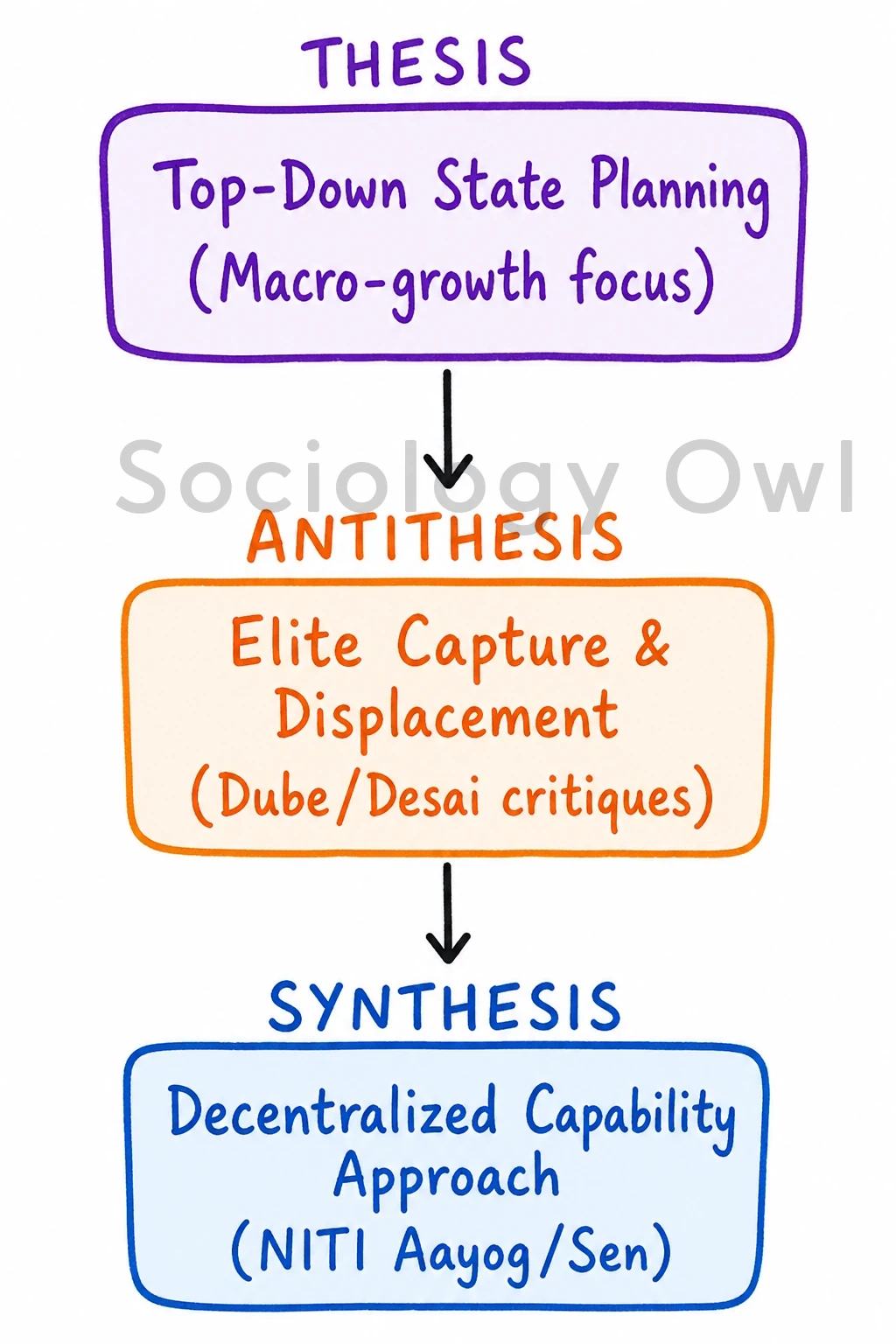
• Amartya Sen’s capability approach and human development thinking redefine development as expansion of freedoms, not just GDP or mega-projects. This allows for growth without, or with minimal, forced displacement.

2. Empirical counter-tendencies
• Decentralised, small-scale initiatives (rainwater harvesting in Alwar, community forestry in Odisha, micro-hydel projects) show resource use without mass relocation.
• Participatory planning (Kerala’s People’s Plan, Gram Sabhas under PESA; in-situ slum upgrading in Ahmedabad) indicates that people-centred planning can limit displacement.

3. Rights-based and movement politics
• Laws like FRA 2006 and LARR 2013 (consent, social impact assessment, R&R) and movements such as Narmada Bachao Andolan and anti-POSCO struggles push “development with justice”, questioning inevitability of displacement.

Conclusion
Displacement is inherent in India’s current growth-centric paradigm, but not in development per se; redefining development around rights, participation and sustainability can significantly reduce forced uprooting.

The problem of displacement is inherent in the idea of development. Analyze the statement critically. Read More »

Urban settlements in India tend to replicate its rural caste-kinship imprints. Discuss the main reasons.

Model Answers

Q: Urban settlements in India tend to replicate its rural caste-kinship imprints. Discuss the main reasons.

Question asked in UPSC Sociology 2021 Paper 2. Download our app for last 20 year question with model answers.

Model Answer:

Urban Settlements in India: Persistence of Caste-Kinship System

Urban settlements are expected to be impersonal, contract-based spaces where ascriptive ties weaken. Yet in India, cities often reproduce rural caste–kinship patterns. This reflects the specific trajectory of Indian urbanisation, where community continues to mediate access to opportunities and security.

1. Pattern of migration and rural–urban continuum
Redfield–Singer and M.N. Srinivas highlight the rural–urban continuum rather than a sharp break.
– Migration is predominantly chain and kin-based: early migrants sponsor relatives and caste fellows, creating “urban villages” and caste enclaves (M.S.A. Rao’s studies on Bangalore and Hyderabad).
– Strong circulation of people, remittances and ritual obligations keeps village networks alive, extending kinship fields across rural and urban spaces.

2. Economic organisation and informal labour markets
– In the largely informal urban economy, recruitment for petty trade, construction, domestic work or transport relies on trust; caste and kinship serve as low-cost screening mechanisms.
– Traditional caste-based skills (weavers, goldsmiths, leather workers) are relocated rather than dissolved, generating caste-clustered occupational niches.
– Andre Béteille notes institutional inadequacy of universalistic markets, making particularistic ties economically rational.

3. Housing, neighbourhoods and associational life
– Residential segregation often follows caste/region lines: community colonies, chawls and slums organised around jati/biradari offer protection, credit and cultural familiarity.
– Caste and regional associations in cities (studied by N. Jayaram) provide hostels, scholarships, dispute settlement and marriage alliances, thus reactivating rural solidarities.

4. Family, marriage and cultural continuity
– Despite exposure to diversity, marriage remains overwhelmingly caste-endogamous, often arranged through kin and caste networks; biradari panchayats operate even in metros.
– Urban temples, festival committees and community halls are frequently caste-based, reinforcing symbolic boundaries (Louis Dumont’s hierarchy–purity framework remains relevant).

5. Politics and control over urban resources
– Urban local politics mobilises voters as caste blocs; dominant rural castes (Jats around Delhi, Patels in Gujarat, Reddys in Andhra cities) extend control over peri-urban land, real estate and contracts.
– Rajni Kothari’s notion of “caste in politics” explains how caste becomes an organisational resource in competitive urban settings.

Thus, Indian urbanisation remains “rurban”, where caste-kinship adapt to new opportunities; future deepening of universalistic institutions alone can dilute these imprints.

Urban settlements in India tend to replicate its rural caste-kinship imprints. Discuss the main reasons. Read More »

Does “economic empowerment” automatically bring about “substantive empowerment” for women ? Briefly describe the main issues in women empowerment in India.

Model Answers

Q: Does "economic empowerment" automatically bring about "substantive empowerment" for women ? Briefly describe the main issues in women empowerment in India.

Question asked in UPSC Sociology 2021 Paper 2. Download our app for last 20 year question with model answers.

Model Answer:

Relationship between Economic and Substantive Women’s Empowerment in India

Economic empowerment refers to women’s access to paid work, income and productive assets, while substantive empowerment implies real control over resources, decision‑making, bodily autonomy and voice in family, community and state. In a deeply patriarchal society like India, this distinction is crucial for understanding the limits of current development strategies.

Economic empowerment does not automatically translate into substantive empowerment.
Naila Kabeer sees empowerment as a process where resources must convert into agency and achievements. Paid work can:

– Enhance bargaining power within the household (Amartya Sen’s idea of “cooperative conflicts”).
– Provide “exit options” from abusive marriages.
– Increase mobility and public visibility, as seen in SHGs, Kudumbashree or women’s participation in MGNREGA.

Yet, several constraints block substantive change:

– Male control over women’s earnings and property; Bina Agarwal shows that without land/asset rights, bargaining power remains weak.
– “Patriarchal bargains” (Deniz Kandiyoti) make women accept subordination in return for protection, even when they earn.
– Persistence of domestic violence, dowry and son preference among working and even affluent women.
– Double burden of paid work plus unpaid care work (Ann Oakley’s gendered division of labour).
– Low unionisation and informal, insecure jobs that do not challenge Sylvia Walby’s “public patriarchy” in state and market.

Thus, economic empowerment is necessary but not sufficient; it must be accompanied by changes in norms, law, education and politics.

Major issues in women’s empowerment in India include:

– Structural patriarchy: patrilineal inheritance, patrilocal residence, dowry, control over sexuality, declining child sex ratio.
– Economic marginalisation: low and falling female labour force participation, wage gaps, over‑representation in informal work, invisibilised care work.
– Violence and bodily autonomy: domestic violence, marital rape not criminalised, honour killings, workplace harassment despite legal safeguards.
– Education and health deficits: gender gaps in literacy, high dropout, early marriage, anaemia and maternal mortality.
– Political under‑representation: reservations in PRIs with “proxy” women; limited presence in higher legislatures despite recent reforms.
– Intersectionality: Dalit, Adivasi, Muslim and rural women face compounded exclusion.
– Weak implementation of progressive laws and inadequate gender‑sensitive institutions.

Way forward lies in integrating economic opportunities with rights‑based education, property reforms, legal enforcement and transformation of patriarchal norms within family, market and state.

Does “economic empowerment” automatically bring about “substantive empowerment” for women ? Briefly describe the main issues in women empowerment in India. Read More »

Q. In what respects have the constitutional provisions changed the socio-economic and political conditions of Scheduled Castes and Scheduled Tribes in India? Critically examine.

Q. In what respects have the constitutional provisions changed the socio-economic and political conditions of Scheduled Castes and Scheduled Tribes in India? Critically examine.

UPSC Sociology 2025 Paper 2

Model Answer:

The Indian Constitution’s policy of ‘protective discrimination’ has served as an instrument of social engineering for Scheduled Castes and Scheduled Tribes. While catalyzing significant changes, the impact reveals a persistent gap between formal and substantive equality.

Political Empowerment

Constitutional provisions have democratized political space through:
– Reserved constituencies (Articles 330-332) ensuring proportional representation in Parliament and State Assemblies
– Panchayati Raj reservations (73rd/74th Amendments) enabling grassroots participation
– Emergence of assertive Dalit politics exemplified by BSP’s rise, challenging upper-caste hegemony
– Rise of SC/ST leaders to highest offices—K.R. Narayanan as President symbolizing political mainstreaming

However, Christophe Jaffrelot notes this often results in ‘tokenism’, where elected representatives remain dependent on party high commands rather than functioning as autonomous community voices.

Socio-Economic Advancement

Article 16(4) and 15(4) provisions have facilitated:
– Educational mobility: Literacy among SCs increased from 10% (1961) to 66% (2011); scholarships enabling higher education access
– Employment opportunities: Creation of educated middle class through public sector reservations, as observed by Andre Beteille
– Legal protection: Prevention of Atrocities Act (1989) and Protection of Civil Rights Act (1955) providing anti-discrimination framework
– Targeted schemes: Special Component Plan and Tribal Sub-Plan earmarking funds for development

Critical Limitations

Despite constitutional safeguards, structural challenges persist:

Economic Inequality: Benefits largely cornered by urban educated elite—the ‘creamy layer’—while rural majority remains landless and impoverished. Private sector exclusion and declining public employment further limit opportunities.

Social Discrimination: Ghanshyam Shah highlights continued prevalence of untouchability and caste atrocities. Manual scavenging persists despite prohibition; weak implementation undermines legislative intent.

Tribal Marginalization: STs face displacement through development projects, with Fifth and Sixth Schedule protections frequently violated, eroding cultural rights, traditional livelihoods, and forest access.

Conclusion: Constitutional provisions created a rights framework and enabled Dalit-Adivasi political consciousness. However, deep-rooted caste hierarchies persist. The transition from de jure to de facto equality requires comprehensive social reform beyond legal measures.

Q. In what respects have the constitutional provisions changed the socio-economic and political conditions of Scheduled Castes and Scheduled Tribes in India? Critically examine. Read More »

Q. How would you appropriate to characterise G. S. Ghurye as a practitioner of ‘theoretical pluralism’?

Q. How would you appropriate to characterise G. S. Ghurye as a practitioner of ‘theoretical pluralism’?

UPSC Sociology 2025 Paper 2

Model Answer:

G.S. Ghurye, the ‘father of Indian sociology,’ exemplified theoretical pluralism by consciously avoiding any single theoretical dogma, employing diverse perspectives to analyze Indian society’s multifaceted reality.

Integration of Multiple Approaches

Ghurye’s eclectic methodology synthesized:

• Indological-Textual Analysis: Used Sanskrit texts to trace historical origins of social institutions, particularly in “Caste and Race in India” where he analyzed Vedic literature to understand caste origins

• Diffusionist Perspective: Explained how Indo-Aryan cultural traits spread and interacted with local cultures across the subcontinent, blending textual with historical-anthropological methods

• Historical-Comparative Method: Applied to diverse topics including kinship systems, urbanization in “Cities and Civilization”, and religious consciousness in “Indian Sadhus”

Rejection of Theoretical Dogmatism

Unlike contemporaries who adopted single Western frameworks, Ghurye believed Indian civilization’s complexity required a unique synthetic approach:

• Deliberately avoided grand theories like structural-functionalism or Marxism as sole analytical lenses

• His study of tribes as “backward Hindus” used a civilizational-historical framework rather than purely structural analysis, integrating tribes into broader Indian society’s narrative

• Combined empirical fieldwork with classical scholarship, bridging past and present

Conclusion:

Ghurye’s theoretical pluralism created a distinctive Indian sociological perspective. By weaving together Indology, diffusionism, historical comparison, and empirical analysis, he developed a holistic approach tailored to Indian context, demonstrating that complex societies require multiple theoretical lenses for comprehensive understanding.

Q. How would you appropriate to characterise G. S. Ghurye as a practitioner of ‘theoretical pluralism’? Read More »

Q. How did Colonial Policies for the tribes affected their socio-economic conditions in India? Discuss.

Q. How did Colonial Policies for the tribes affected their socio-economic conditions in India? Discuss.

UPSC Sociology 2025 Paper 2

Model Answer:

Colonial rule marked a radical departure from the relative autonomy and symbiotic relationship tribes had with their natural habitat. British policies systematically dismantled traditional socio-economic structures, leading to widespread marginalization.

Forest Policies and Economic Dispossession

The Forest Acts (1865, 1878, 1927) declared forests as state property, criminalizing traditional practices:
• Restricted jhum cultivation, hunting, and gathering of forest produce central to subsistence economy
• Loss of access to Minor Forest Produce forced tribes into exploitative wage labor in plantations and mines
• Severed deep cultural-spiritual connections with forests, causing social disorganization

Land Revenue Systems and Administrative Changes

Introduction of alien administrative structures disrupted tribal ethos:
• Land Alienation: Individual private property replaced communal ownership, facilitating land transfer to non-tribal moneylenders (dikus), particularly in Chotanagpur region
• Erosion of Traditional Authority: Formal centralized administration undermined tribal councils and chiefs, disrupting indigenous justice systems

Market Integration and Exploitation

Forced integration into colonial economy created systematic exploitation:
• Cash taxes and trader influx trapped tribes in debt cycles, creating bonded labor for colonial enterprises
• Detribalization: G.S. Ghurye noted tribes lost cultural identity without proper mainstream integration, resulting in anomie
• Contractor-moneylender-official nexus emerged, establishing “internal colonialism”

Conclusion:

Colonial policies transformed autonomous tribal communities into impoverished, exploited underclass through systematic dispossession and marginalization. This widespread discontent fueled numerous uprisings like the Santhal Rebellion and Birsa Munda’s Ulgulan, reflecting organized resistance against colonial oppression.

Q. How did Colonial Policies for the tribes affected their socio-economic conditions in India? Discuss. Read More »

Q. According to you, which social reform movement has played the most effective role in uplifting the status of women? Explain.

Q. According to you, which social reform movement has played the most effective role in uplifting the status of women? Explain.

UPSC Sociology 2025 Paper 2

Model Answer:

Social Reform Movements and Women’s Upliftment

Among various social reform movements in colonial India, the Satyashodhak Samaj led by Jyotiba and Savitribai Phule stands as the most effective in transforming women’s status through its radical intersectional approach and emphasis on education as liberation.

The Phules pioneered the recognition of interconnected oppression. In Gulamgiri, Jyotiba Phule articulated how Brahmanical patriarchy doubly subjugated lower-caste women, linking gender liberation with caste annihilation—a perspective later echoed by feminist scholars like Uma Chakravarti. This holistic analysis addressed root causes rather than symptoms.

Education as Revolutionary Praxis

Savitribai Phule’s pioneering role as India’s first female teacher and founder of the first girls’ school (Pune, 1848) demonstrated education’s transformative potential. The Phules believed literacy would:
– Foster critical consciousness against oppressive traditions
– Enable economic independence
– Create self-reliant agents of social change

This sustainable model proved more effective than mere legislative reforms.

Comprehensive Grassroots Initiatives

The movement’s practical interventions included:
– Establishing Balhatya Pratibandhak Griha for pregnant widows
– Organizing barbers’ strikes against widow tonsuring
– Promoting widow remarriage
– Campaigning against child marriage

Lasting Impact:

The Phules’ work laid the ideological and practical foundation for subsequent women’s movements. By attacking patriarchy’s structural basis through education and challenging caste-gender intersections, they created a blueprint for genuine social transformation that resonates even today in Dalit feminist movements.

Q. According to you, which social reform movement has played the most effective role in uplifting the status of women? Explain. Read More »

Q. What do you understand by gender-based domestic division of labour? Is it undergoing a change in the wake of increasing participation of women in formal employment? Clarify your answer with illustrations.

Q. What do you understand by gender-based domestic division of labour? Is it undergoing a change in the wake of increasing participation of women in formal employment? Clarify your answer with illustrations.

UPSC Sociology 2025 Paper 1

Model Answer:

Gender-based domestic division of labour refers to the socially constructed allocation of unpaid household work based on sex. This system traditionally assigns women to the private sphere for routine, repetitive tasks like cooking, cleaning, and childcare (what Talcott Parsons termed “expressive roles”), while men occupy the public sphere of paid work (“instrumental roles”). Ann Oakley demonstrated this division is not natural but a social construct that institutionalizes women’s economic dependence and perpetuates gender inequality.

Changes with Women’s Formal Employment

The ‘Dual Burden’ Phenomenon:
Rather than equitable redistribution, women’s employment has created what Arlie Hochschild calls the “second shift.” Women now shoulder dual responsibilities—paid work plus domestic labour. Their entry into the public sphere hasn’t been matched by men’s equivalent participation in the private sphere.

– Illustration: A female software engineer works 10-hour days but returns home to manage cooking, children’s homework, and household planning, while her husband enjoys leisure time after work.

Limited Male Participation:
Urban, educated dual-earner households show marginal increases in male involvement, particularly in childcare and weekend tasks. However, this participation remains peripheral rather than fundamental.

– Illustration: Husbands may help with weekend grocery shopping or playing with children, but daily time-intensive responsibilities—meal preparation, cleaning, emotional labour—remain predominantly women’s domain.

Class-Based Outsourcing:
Affluent families increasingly outsource domestic work to paid help, resolving couple conflicts without challenging gendered assumptions. This creates new intersections of class and gender inequality, as domestic work management still remains women’s responsibility.

– Example: Upper-middle-class working women supervise domestic workers, plan meals, and coordinate household schedules, perpetuating their role as household managers.

Conclusion:

While women’s workforce participation has initiated conversations about domestic equality, fundamental transformation remains elusive. The patriarchal ideology underlying domestic division adapts to economic realities rather than being dismantled, resulting in role-conflict and the persistence of gender inequality within households.

Q. What do you understand by gender-based domestic division of labour? Is it undergoing a change in the wake of increasing participation of women in formal employment? Clarify your answer with illustrations. Read More »