2022 Sociology Paper 2

Critically examine Yogendra Singh’s thesis on ‘Modernization of Indian Tradition’.

Model Answers

Q: Critically examine Yogendra Singh’s thesis on ‘Modernization of Indian Tradition’.

Question asked in UPSC Sociology 2022 Paper 2. Download our app for last 20 year question with model answers.

Model Answer:

Yogendra Singh: Modernization of Indian Tradition

In his seminal work, Modernization of Indian Tradition, Yogendra Singh synthesizes the Structural-Functionalist and Historical/Indological approaches to argue that modernization in India is not a total rupture from the past. Instead, it involves a dialectical process where tradition adapts and coexists with modern elements.

Singh’s Paradigm of Modernization

Singh conceptualizes modernization along two axes: Sources of Change (Orthogenetic/internal like Sanskritization, vs. Heterogenetic/external like Westernization or Islam) and Substantive Domains (Cultural vs. Structural).
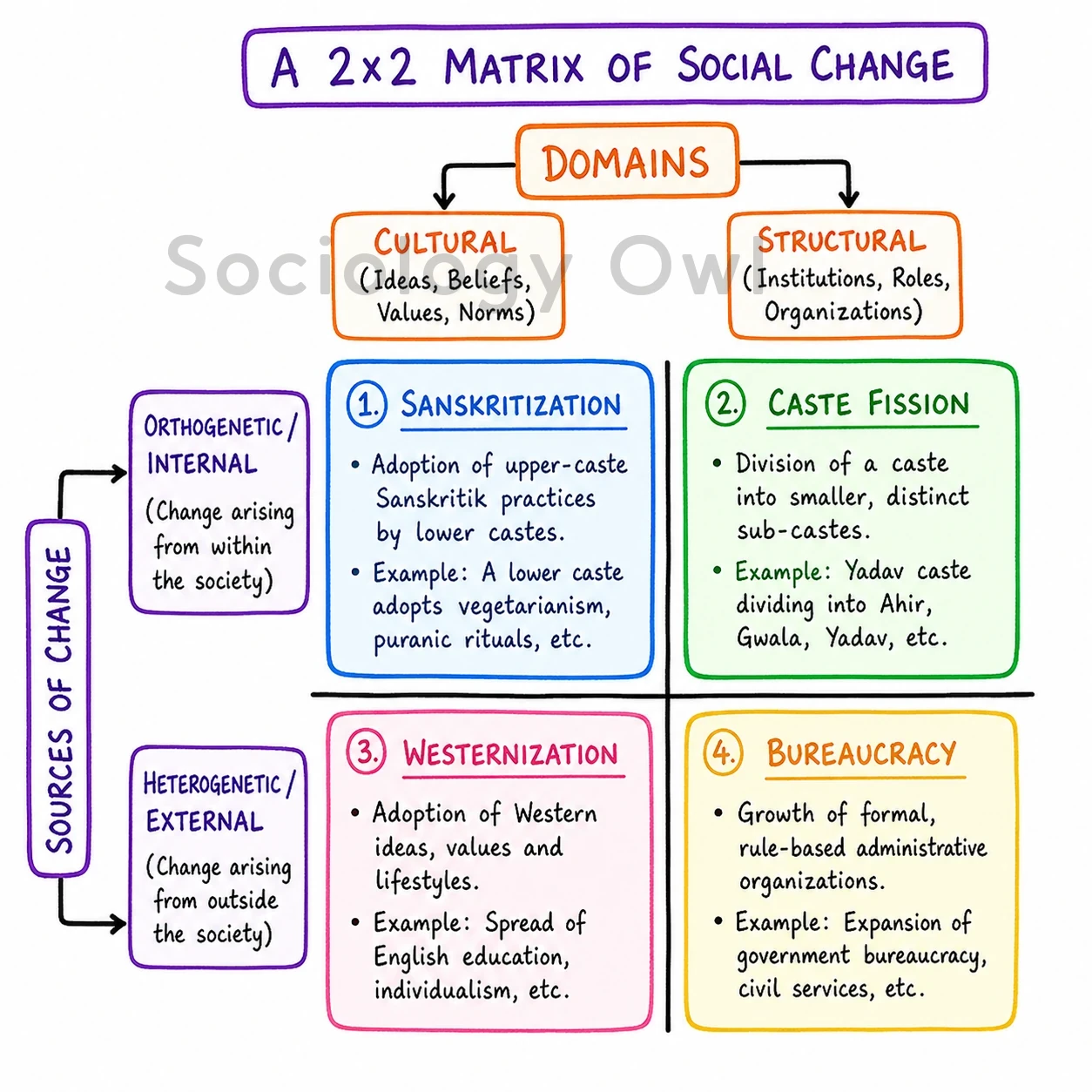
Modernization of Indian Tradition

The core of Singh’s thesis is that cultural modernization (changes in dress, education, and lifestyle) is occurring rapidly, whereas structural modernization (the breakdown of caste hierarchies and structural class inequalities) is highly restricted.

Drawing on Milton Singer, Singh notes that Indians manage conflicting values through Compartmentalization, embracing modernity in workplaces while strictly adhering to traditional rituals and familial norms at home.

Sociological Critiques

A.R. Desai critiques Singh for over-focusing on cultural traditions while ignoring that “modernization” in India is essentially capitalist development, which inherently generates structural class inequalities.

Dipankar Gupta challenges Singh with the concept of “Mistaken Modernity” (Westoxification), arguing that Indians have merely adopted Western consumerism and technology without internalizing core modern values like universalism, egalitarianism, and the rule of law.

Rajni Kothari’s concept of the Politicization of Caste illustrates Singh’s thesis, showing how traditional caste identities adapted to the modern institution of democracy.

Modern tools are frequently used to reinforce traditional identities. E-matrimony websites use advanced algorithms yet strictly filter for caste and gotra. Similarly, tech professionals in Bengaluru performing Ayudha Puja on laptops reflects the synthesis of the modern economy and traditional rituals.

Conclusion

Singh’s framework aligns with S.N. Eisenstadt’s concept of “Multiple Modernities”. It indicates that modernization in India is not a zero-sum game against tradition. Instead, it has produced a unique neo-traditionalism, where modernity is systematically Indianized and tradition is continually modernized.

Critically examine Yogendra Singh’s thesis on ‘Modernization of Indian Tradition’. Read More »
Critically examine GS Ghurye’s Indological approach to the understanding of Indian society.

Model Answers

Q: Critically examine GS Ghurye’s Indological approach to the understanding of Indian society.

Question asked in UPSC Sociology 2022 Paper 2. Download our app for last 20 year question with model answers.

Model Answer:

G.S. Ghurye’s Indological Approach

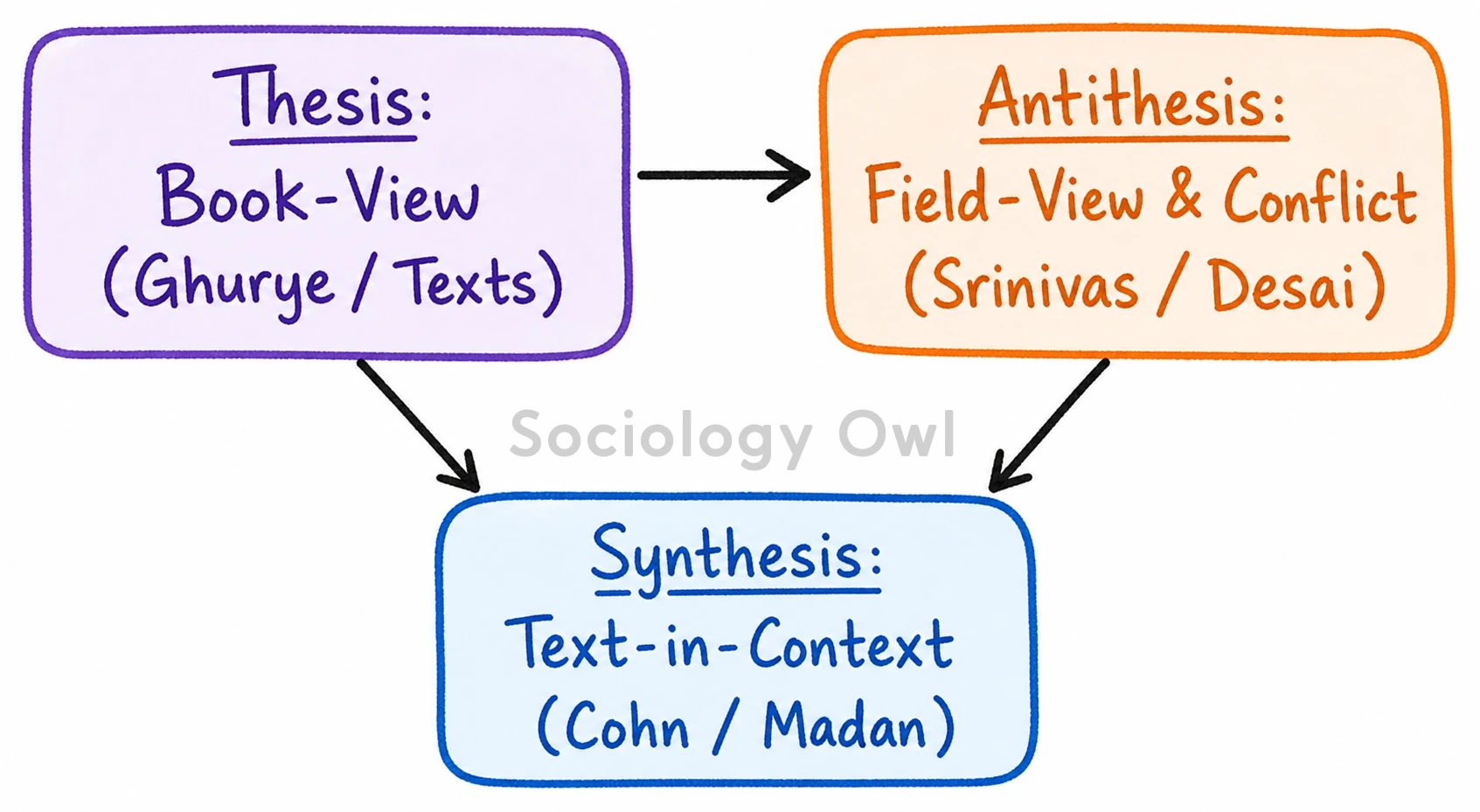
G.S. Ghurye’s Indological approach relies on historical antiquity and classical Sanskrit literature to study Indian society, representing a “Book-View”. Influenced by the Diffusionist approach of W.H.R. Rivers, Ghurye utilized ancient texts to trace the civilizational continuity and evolution of Indian social institutions.

Application of Indology

Ghurye argued that Indian society’s underlying unity stems from Brahminical traditions.

  • Caste System: In Caste and Race in India (1932), he utilized classical texts to outline the six structural characteristics of caste, tracing its Indo-Aryan origins and principles like gotra exogamy.
  • Civilizational Unity: In Indian Sadhus, he analyzed textual depictions of asceticism as a unifying, pan-Indian civilizational force connecting diverse regions.

Sociological Critiques of the Indological Approach

  • Structural-Functionalist Critique: M.N. Srinivas rejected Ghurye’s static “Book-View”, advocating for an empirical “Field-View”. Fieldwork revealed fluid hierarchies, demonstrated by dynamic realities like Sanskritization and the Dominant Caste.
  • Marxist Critique: A.R. Desai argued that Indology romanticizes the past, masking the underlying economic substructure, material realities, and class conflicts prevalent in ancient India.
  • Subaltern and Feminist Critiques: Scholars like B.R. Ambedkar and Uma Chakravarti noted that classical Shastras represent a hegemonic, patriarchal worldview that justifies the systemic exploitation of Dalits and women.
  • Hindu Nationalist Bias: Contemporary sociologists like Sujata Patel criticized Ghurye for equating “Indian culture” almost exclusively with “Hindu culture,” marginalizing minority contributions, a bias evident in Social Tensions in India.

Indological Approach

While pure Indology is largely outdated, sociologists like Bernard Cohn and T.N. Madan successfully synthesized textual knowledge with empirical fieldwork. Today, textual analysis remains vital for contextualizing the cultural roots of modern debates, such as the Uniform Civil Code and the resurgence of Ayurvedic practices.

Despite its methodological flaws, G.S. Ghurye is rightly regarded as the “Institutional Father of Indian Sociology.” His Indological approach established a distinctly indigenous sociological tradition, successfully breaking away from Western, Eurocentric models of society.

Critically examine GS Ghurye’s Indological approach to the understanding of Indian society. Read More »

Discuss the problem of religious minorities in India and suggest measures to solve them.

Model Answers

Q: Discuss the problem of religious minorities in India and suggest measures to solve them.

Question asked in UPSC Sociology 2022 Paper 2. Download our app for last 20 year question with model answers.

Model Answer:

Religious Minorities in India: Challenges and Solutions

India’s religious diversity, as noted by T.N. Madan, presents both opportunities and challenges in maintaining social harmony. While the constitution guarantees secular principles, the reality for religious minorities is complex.

Problems faced by religious minorities:

1. Discrimination: Religious minorities frequently face discrimination in various aspects of life. For example:
– Employment: A 2019 study by Oxfam India found that Muslim job applicants were 35.3% less likely to be called for interviews compared to equally qualified Hindu candidates.
– Housing: The phenomenon of “housing apartheid” is observed in many urban areas, where minorities struggle to rent or buy properties in certain neighborhoods.

2. Communal violence: India has witnessed several instances of communal riots, such as:
– The 1984 anti-Sikh riots following Indira Gandhi’s assassination
– The 2002 Gujarat riots primarily affecting the Muslim community
– The 2008 Kandhamal riots targeting Christians in Odisha
These events not only result in loss of life and property but also create lasting fear and insecurity among minority communities.

3. Forced conversions: While illegal, instances of forced conversions still occur. For example:
– The alleged “Love Jihad” phenomenon, where Muslim men are accused of converting Hindu women through marriage
– Reports of tribal communities being coerced into converting to Christianity or Hinduism in exchange for economic benefits

4. Hate speech and intolerance: The rise of social media has amplified hate speech against minorities. For instance:
– Inflammatory speeches by political leaders during election campaigns
– Circulation of fake news and misinformation targeting specific religious groups

5. Legal issues: Conflicts between religious personal laws and secular laws create challenges. For example:
– The debate over the Uniform Civil Code and its potential impact on minority personal laws
– Issues related to religious conversion laws in various states

Measures to solve the problems faced by religious minorities:

1. Strengthening secularism:
– Implement the recommendations of the Sachar Committee Report (2006) to improve the socio-economic conditions of Muslims
– Ensure equal representation of all religions in government bodies and decision-making processes

2. Promoting interfaith dialogue:
– Establish interfaith councils at national and state levels
– Organize annual interfaith festivals celebrating the diversity of Indian religions

3. Education and awareness:
– Introduce comparative religion studies in school curricula
– Launch public awareness campaigns highlighting the contributions of different religious communities to Indian culture and history

4. Legal reforms:
– Review and amend discriminatory laws and policies
– Strengthen the National Commission for Minorities to effectively address grievances

5. Strict action against hate speech and violence:
– Implement the recommendations of the Bezbaruah Committee (2014) on combating racial discrimination
– Establish fast-track courts to deal with cases of communal violence

6. Empowerment of religious minorities:
– Increase reservation quotas for minorities in education and employment
– Provide skill development programs and financial assistance for minority-owned businesses

In conclusion, addressing the challenges faced by religious minorities in India requires a multifaceted approach. By implementing these measures and fostering a culture of inclusivity and respect, India can work towards realizing its constitutional ideal of unity in diversity.

Discuss the problem of religious minorities in India and suggest measures to solve them. Read More »

Examine whether rural bondage still continues to be a social reality. Give your argument .

Model Answers

Q: Examine whether rural bondage still continues to be a social reality. Give your argument .

Question asked in UPSC Sociology 2022 Paper 2. Download our app for last 20 year question with model answers.

Model Answer:

Rural Bondage in India

Rural bondage continues to be a social reality in India, despite the various legal and constitutional measures taken to eradicate it. The persistence of rural bondage can be attributed to a combination of socio-economic factors, such as caste-based discrimination, poverty, and lack of access to education and employment opportunities. In this context, it is important to examine the various dimensions of rural bondage and the reasons for its continued existence.

Caste-based Discrimination

The caste system in India has been a significant factor in perpetuating rural bondage. Historically, the lower castes, particularly the Dalits and Adivasis, have been subjected to various forms of exploitation and discrimination, including bonded labor. Despite the legal abolition of untouchability and bonded labor, caste-based discrimination continues to exist in rural areas, with the lower castes often being forced to work for the upper castes in exploitative conditions.

Poverty

Poverty is another major factor contributing to rural bondage in India. Many poor families in rural areas are forced to take loans from moneylenders or landlords to meet their basic needs. In return, they are often required to work for the lender as bonded laborers to repay the debt. The lack of access to formal credit and banking facilities further exacerbates the problem, as it leaves the poor with no choice but to rely on informal sources of credit.

Lack of Access to Education and Employment Opportunities

The lack of access to quality education and employment opportunities in rural areas is another reason for the persistence of rural bondage. Illiteracy and lack of skills make it difficult for the rural poor to find alternative sources of livelihood, leaving them vulnerable to exploitation by landlords and moneylenders. Moreover, the absence of adequate social security measures and government support further pushes the rural poor into the vicious cycle of debt and bondage.

Weak Implementation of Laws and Policies

While the Indian Constitution and various laws, such as the Bonded Labour System (Abolition) Act, 1976, prohibit bonded labor and other forms of exploitation, the implementation of these laws remains weak. Corruption, lack of awareness, and the absence of effective monitoring mechanisms have allowed rural bondage to persist in many parts of the country.

Social Norms and Traditions

In many rural areas, bonded labor and other forms of exploitation are deeply entrenched in social norms and traditions. For instance, the practice of ‘Hali’ in Gujarat or ‘Kamaiya’ in Nepal involves the inter-generational transfer of debt and bondage, making it difficult for the victims to break free from the shackles of exploitation.

In conclusion, rural bondage continues to be a social reality in India due to a combination of factors such as caste-based discrimination, poverty, lack of access to education and employment opportunities, weak implementation of laws, and deeply entrenched social norms and traditions. To effectively address this issue, it is essential to adopt a multi-pronged approach that includes legal reforms, awareness campaigns, social and economic empowerment of the vulnerable sections, and the creation of alternative livelihood opportunities.

Examine whether rural bondage still continues to be a social reality. Give your argument . Read More »

Discuss the changing nature of industrial working class.

Model Answers

Q: Discuss the changing nature of industrial working class.

Question asked in UPSC Sociology 2022 Paper 2. Download our app for last 20 year question with model answers.

Model Answer:

Changing Nature of the Industrial Working Class

The industrial working class in India has undergone significant changes in recent years, primarily due to factors such as globalization, technological advancements, and economic liberalization. These changes have had a profound impact on the nature of work, the workforce, and the overall social structure of the industrial working class in India.

1. Shift from manufacturing to services: With the liberalization of the Indian economy in the 1990s, there has been a shift from manufacturing-based industries to service-based industries. This has led to a decline in traditional industrial jobs and an increase in jobs in the service sector, such as IT, finance, and retail. This shift has also led to a change in the skill set required for the working class, with a greater emphasis on education and technical skills.

2. Informalization of labor: A significant trend in the Indian industrial working class has been the growth of informal employment, which refers to jobs that are not regulated by labor laws and do not provide social security benefits. Informal workers often face job insecurity, low wages, and poor working conditions. This trend has been attributed to factors such as the decline of public sector employment, subcontracting, and the growth of small-scale industries.

3. Migration and urbanization: The changing nature of the industrial working class in India has been marked by increased migration from rural to urban areas in search of better employment opportunities. This has led to the growth of urban slums and informal settlements, as well as increased competition for jobs and resources in cities. Migrant workers often face challenges such as discrimination, exploitation, and a lack of access to social services.

4. Caste and gender dynamics: The industrial working class in India has historically been dominated by lower caste groups and men. However, recent years have seen an increase in the participation of women and upper caste individuals in the industrial workforce. This has led to changing social dynamics within the working class, with the potential for both increased social mobility and increased tensions between different caste and gender groups.

5. Labor unions and collective bargaining: The power of labor unions in India has declined in recent years, due to factors such as the growth of informal employment, the fragmentation of the working class, and the increasing influence of multinational corporations. This has led to a weakening of collective bargaining power for workers and a decline in the ability of unions to advocate for better wages and working conditions.

6. Technological advancements: The introduction of new technologies in the industrial sector has led to increased automation and the displacement of some manual labor jobs. This has created a need for workers to adapt to new skills and job requirements, as well as contributing to job insecurity for those unable to adapt.

In conclusion, the changing nature of the industrial working class in India has been shaped by a complex interplay of economic, social, and political factors. These changes have led to both new opportunities and new challenges for the working class, with implications for social mobility, labor rights, and the overall structure of Indian society.

Discuss the changing nature of industrial working class. Read More »

Discuss Law as an important instrument for women’s empowerment.

Model Answers

Q: Discuss Law as an important instrument for women’s empowerment.

Question asked in UPSC Sociology 2022 Paper 2. Download our app for last 20 year question with model answers.

Model Answer:

Role of Law in Women’s Empowerment

Law plays a crucial role in women’s empowerment in India, as it provides a framework for addressing gender inequalities and promoting women’s rights. The Indian Constitution guarantees equality before the law and prohibits discrimination on the grounds of sex. Over the years, various laws have been enacted to address specific issues related to women’s rights, such as dowry, domestic violence, sexual harassment, and equal pay. These legal provisions have been instrumental in empowering women by providing them with the necessary tools to fight against discrimination and violence.

1. Legal provisions for women’s rights

The Indian Constitution and various laws provide for the protection and promotion of women’s rights. For instance, the Constitution guarantees equality before the law (Article 14) and prohibits discrimination on the grounds of sex (Article 15). The Equal Remuneration Act (1976) mandates equal pay for equal work for both men and women. The Dowry Prohibition Act (1961) criminalizes the giving and taking of dowry, while the Protection of Women from Domestic Violence Act (2005) provides legal protection to women from domestic abuse.

2. Awareness and access to legal remedies

Laws related to women’s rights have helped raise awareness about gender-based discrimination and violence. This increased awareness has led to more women seeking legal remedies to protect their rights. For instance, the number of cases filed under the Protection of Women from Domestic Violence Act has been steadily increasing since its enactment, indicating that more women are now aware of their rights and are willing to take legal action against their abusers.

3. Legal reforms and policy changes

Laws related to women’s rights have also led to policy changes and reforms that aim to promote gender equality and women’s empowerment. For example, the Criminal Law (Amendment) Act (2013) was enacted in response to the brutal gang rape of a young woman in Delhi in 2012. This law introduced stricter penalties for sexual assault and harassment and expanded the definition of rape to include non-penetrative acts. Additionally, the Sexual Harassment of Women at Workplace (Prevention, Prohibition and Redressal) Act (2013) mandates the establishment of internal complaint committees in organizations to address workplace sexual harassment.

4. Changing social norms and attitudes

Legal provisions related to women’s rights have contributed to changing social norms and attitudes towards gender equality. As more women become aware of their rights and seek legal remedies, society is gradually becoming more accepting of the idea of women’s empowerment. This change in attitude is evident in the increasing number of women participating in the workforce, pursuing higher education, and taking on leadership roles in various sectors.

5. Challenges and limitations

Despite the progress made through legal provisions, there are still significant challenges to women’s empowerment in India. Many women continue to face discrimination, violence, and limited access to resources and opportunities. The implementation and enforcement of laws related to women’s rights remain weak, and there is a need for greater awareness and sensitization among law enforcement agencies, the judiciary, and society at large.

In conclusion, law plays a vital role in women’s empowerment in India by providing a legal framework to address gender inequalities and promote women’s rights. However, for these legal provisions to be truly effective, there is a need for better implementation, enforcement, and awareness. Additionally, societal attitudes and norms must continue to evolve to create an environment where women can fully exercise their rights and achieve their full potential.

Discuss Law as an important instrument for women’s empowerment. Read More »

Explain how land reforms brought about desired agrarian transformation.

Model Answers

Q: Explain how land reforms brought about desired agrarian transformation.

Question asked in UPSC Sociology 2022 Paper 2. Download our app for last 20 year question with model answers.

Model Answer:

Impact of Land Reforms in India

Land reforms have played a crucial role in bringing about the desired agrarian transformation in India. These reforms aimed at addressing the issues of land ownership, tenancy, and land distribution to ensure social justice, economic growth, and sustainable development in the rural areas. The main objectives of land reforms in India were to abolish intermediaries, secure land ownership rights, redistribute land to the landless and marginal farmers, and promote cooperative farming.

1. Abolition of intermediaries

One of the major steps taken during the land reforms was the abolition of intermediaries like zamindars, jagirdars, and inamdars who used to collect land revenue from the cultivators on behalf of the government. The abolition of intermediaries not only reduced the exploitation of the cultivators but also helped in establishing a direct relationship between the state and the cultivators. This led to a more equitable distribution of land and resources, and cultivators were able to enjoy the benefits of their labor.

2. Tenancy reforms

Tenancy reforms were introduced to provide security of tenure, fair rent, and ownership rights to the tenants. The reforms aimed at regulating the rent, preventing illegal eviction of tenants, and giving them the right to purchase the land they cultivated. As a result, the tenants were no longer at the mercy of the landowners and could invest in improving the land’s productivity without fear of losing their rights.

3. Land ceiling and redistribution

Land ceiling laws were enacted to fix the maximum limit of land that an individual or family could possess. The surplus land acquired from the landowners was redistributed among the landless and marginal farmers. This not only helped in reducing the concentration of land in the hands of a few but also provided an opportunity for the landless and marginal farmers to become self-reliant and improve their socio-economic status.

4. Consolidation of landholdings

Fragmentation of landholdings was a major problem in Indian agriculture, which affected the productivity and efficiency of the farming sector. Land consolidation aimed at bringing scattered and fragmented landholdings together to form a compact and viable unit. This helped in better utilization of resources, adoption of modern agricultural practices, and increased productivity.

5. Promotion of cooperative farming

Cooperative farming was encouraged to pool the resources of small and marginal farmers and enable them to enjoy the benefits of large-scale farming. This not only helped in increasing agricultural productivity but also provided better access to credit, technology, and marketing facilities to the farmers.

The land reforms in India brought about significant changes in the agrarian structure and contributed to the desired agrarian transformation. The reforms helped in breaking the feudal land relations, empowering the small and marginal farmers, and promoting a more equitable distribution of land and resources. However, the implementation of land reforms has been uneven across the country, and many challenges still persist, such as landlessness, inadequate land records, and the persistence of tenancy. To achieve a comprehensive agrarian transformation, there is a need for continuous efforts to address these challenges and ensure that the benefits of land reforms reach the most marginalized sections of society.

Explain how land reforms brought about desired agrarian transformation. Read More »

Explain the different forms of untouchability in India.

Model Answers

Q: Explain the different forms of untouchability in India.

Question asked in UPSC Sociology 2022 Paper 2. Download our app for last 20 year question with model answers.

Model Answer:

Forms of Untouchability in India

Untouchability in India is a complex social issue that has its roots in the caste system, which has been prevalent in the country for centuries. The caste system is a hierarchical social order that divides people into different groups or castes based on their birth, occupation, and social status. Untouchability refers to the social practice of ostracizing a particular group of people, who are considered to be at the lowest rung of the caste hierarchy, and are deemed “untouchable” by the higher castes.

Untouchability in India manifests in various forms, which can be summarized as follows:

  1. Occupational untouchability: This form of untouchability is based on the traditional occupations of the lower castes, which are considered to be impure or polluting. These occupations include manual scavenging, cleaning sewers, disposing of dead animals, and leatherwork. People engaged in these occupations are often treated as untouchables and face discrimination and exclusion from the rest of society.
  2. Social untouchability: This form of untouchability is based on the social status of the lower castes, who are considered to be inferior and are subjected to various forms of discrimination. They are often denied access to public spaces, such as temples, schools, and water sources, and are forced to live in segregated areas. They are also subjected to various forms of social exclusion, such as not being allowed to participate in community events, marriages, and other social gatherings.
  3. Economic untouchability: This form of untouchability is related to the economic exploitation of the lower castes by the higher castes. They are often forced to work in low-paying, menial jobs and are denied access to better employment opportunities. They are also subjected to various forms of economic discrimination, such as being charged higher prices for goods and services, and being denied access to credit and other financial services.
  4. Educational untouchability: This form of untouchability is related to the denial of educational opportunities to the lower castes. They are often denied admission to schools and colleges, and face discrimination and harassment from teachers and fellow students. This leads to high dropout rates and low levels of literacy and educational attainment among the lower castes.
  5. Political untouchability: This form of untouchability is related to the exclusion of the lower castes from the political process. They are often denied the right to vote, and face discrimination and violence during elections. They are also underrepresented in political institutions and decision-making bodies, which further marginalizes them and perpetuates their social and economic exclusion.
  6. Religious untouchability: This form of untouchability is related to the religious beliefs and practices that perpetuate the caste system and untouchability. The lower castes are often considered to be impure and are denied access to religious institutions and rituals. They are also subjected to various forms of religious discrimination, such as being denied entry to temples and other places of worship, and being excluded from religious ceremonies and festivals.

Despite the legal abolition of untouchability in India through the Constitution and various laws, these different forms of untouchability continue to persist in various parts of the country. The persistence of untouchability is a major obstacle to social and economic development, and efforts to address this issue require a multi-pronged approach that includes legal, social, and economic interventions.

Explain the different forms of untouchability in India. Read More »

Sociology Optional 2022 Paper 2 Solution

2022 Paper 2

Sociology Optional 2022 Paper 2 Model Answers

Our UPSC Sociology Optional 2022 Paper 2 webpage provides a comprehensive collection of model answers to questions from this examination. This resource is designed to help aspirants understand the depth and breadth of responses expected in the UPSC Sociology Optional Paper 2. 

Download 2022 Sociology Optional Paper 2 PDF

Click on Question to see Model Answer
Section A

Q.1 Write short answers, with a sociological perspective, on the following questions in about 150 words each:
a) Elaborate on M.N. Srinivas’s structural functionalist approach to the study of Indian society.
b) Do you agree that the agrarian class structure in India is changing ?Justify your answer with illustrations.
c) Elucidate the challenges of integration for tribal communities in india.
d) In the context of changing Indian society, how do you view Andre Beteille’s conceptions of harmonic and disharmonic social structures ?
e) Explain Leela Dube’s concept of “Seed and Earth”.

Q.2 a) Critically examine GS Ghurye’s Indological approach to the understanding of Indian society.
b) Elaborate on changing nature of caste system with suitable illustrations.
c) Discuss the problem of religious minorities in India and suggest measures to solve them.

Q.3 a) Critically examine Yogendra Singh’s thesis on ‘Modernization of Indian Tradition’.
b) Discuss the material basis of patriarchy as an ideological system.
c) Explain the different forms of untouchability in India.

Q.4 a) Examine the social background of growth of indian nationalism.
b) Explain how land reforms brought about desired agrarian transformation.
c) Discuss the challenges during village studies in India.

Section B

Q.5 Write short answers, with a sociological perspective, on the following questions in about 150 words each:
a) Discuss Law as an important instrument for women’s empowerment.
b) Examine different understandings of secularization in india?
c) How do you view the growth of informal sector in india ?
d) Discuss the role of pressure groups in strengthening democracy.
e) What role do co-operatives plays in poverty alleviation in rural India ?

Q.6 a) Examine whether rural bondage still continues to be a social reality. Give your argument .
b) Define ethnicity . Discuss the factors responsible for the growth of ethnic movements in India.
c) Discuss the changing nature of structure of political elites.

Q.7 a) “Instead of promoting equality in society , the present system of education itself has contributed to increased socio economic disparities” Comment .
b) Discuss recent trends in the structure of migration .
c) Discuss different forms of deprivation associated with slums.

Q.8 a) Bring out the various issues involved in Dalit movements in India.
b) Critically examine the dialectics between ‘development and environment’.
c) Discuss the changing nature of industrial working class.

Sociology Optional Paper 2 2022

Sociology Optional 2022 Paper 2 Solution Read More »