Model Answer

Critically examine the concept of Sanskritization with suitable illustrations.

Model Answers

Q: Critically examine the concept of Sanskritization with suitable illustrations.

Question asked in UPSC Sociology 2023 Paper 2. Download our app for last 20 year question with model answers. 

Model Answer:

M.N. Srinivas introduced Sanskritization in Religion and Society among the Coorgs of South India (1952) to describe lower castes emulating upper-caste rituals for upward mobility. Yogendra Singh rightly characterizes this as merely a “positional change, not structural change” within the caste hierarchy.

Illustrations of Sanskritization

Robert Hardgrave: Studied upward mobility among Nadars of Tamil Nadu via adopting vegetarianism and Brahminical practices.

David Hardiman: Documented Adivasi purification attempts through the Devi movement in Gujarat.

Critical Examination

Subaltern Critique: Kancha Ilaiah views it as cultural hegemony (“Brahmanization”) that forces lower castes to abandon egalitarian practices for patriarchal, hierarchical upper-caste norms.

Marxist Critique: A.R. Desai argues that genuine upward mobility stems from shifts in the political economy and land ownership, not cultural emulation.

Counter-Processes: D.N. Majumdar highlighted De-Sanskritization, where upper castes abandon orthodox rituals for Western secular lifestyles.

Today, social mobility relies more on politicization, Constitutional reservations, and Dalit assertion. However, Neo-Sanskritization persists, visible in subaltern classes adopting dowry-heavy weddings or leading upper-caste religious processions (Kanwar Yatra).

Conclusion

While Sanskritization remains a foundational heuristic for understanding historical social mobility, contemporary Indian society is increasingly transformed by democratic secular-political empowerment rather than ritualistic cultural emulation.

Critically examine the concept of Sanskritization with suitable illustrations. Read More »

How does a researcher achieve objectivity in interpretative research?

Model Answers

Q: How does a researcher achieve objectivity in interpretative research?

Question asked in UPSC Sociology 2022 Paper 1. Download our app for last 20 year question with model answers.

Model Answer:

Objectivity in Interpretative Research

Interpretative research, rooted in Max Weber’s Verstehen (empathetic understanding), rejects absolute positivist detachment. Instead, it aims for “intersubjective reliability” and Value-Neutrality (Wertfreiheit) while analyzing subjective meanings.

Achieving Objectivity

Researchers utilize several key strategies to maintain rigor:

  • Weberian Tools: Researchers use Ideal Types as analytical benchmarks to objectively measure deviations in subjective social action.
  • Reflexivity: Drawing from Alvin Gouldner’s Reflexive Sociology, researchers critically examine their own positionality and biases as objects of sociological inquiry.
  • “Thick Description”: Clifford Geertz emphasized deep, transparent contextualization, allowing readers to independently validate the researcher’s subjective interpretations.
  • Intersubjective Validation: Employing methodological triangulation and member-checking explicitly cross-verifies qualitative data.

In Gang Leader for a Day, Sudhir Venkatesh navigated interpretative biases through intense reflexivity and member-checking with Chicago gang members, ensuring his observations objectively reflected their reality.

Conclusion

Gunnar Myrdal argued that absolute objectivity is an illusion and values must be stated openly. Ultimately, while total scientific detachment is impossible, these methodological safeguards ensure high validity in interpretative sociology.

How does a researcher achieve objectivity in interpretative research? Read More »

Q. Do you think ‘objectivity’ is an over-hyped idea in sociological research? Discuss the merits and demerits of non-positivist methods.

Q. Do you think ‘objectivity’ is an over-hyped idea in sociological research? Discuss the merits and demerits of non-positivist methods.

UPSC Sociology 2024 Paper 1

Model Answer:

Objectivity in sociology implies studying phenomena without letting personal biases, prejudices, or values influence the research (Robert Bierstedt). Rooted in the Positivist tradition of Comte and Durkheim, it sought to model sociology on the natural sciences. However, treating pure objectivity as an absolute ideal is increasingly considered over-hyped.

The Myth of Absolute Objectivity

Inherent Value-Bias: Gunnar Myrdal argued that researchers’ values inevitably dictate topic selection. Similarly, Alvin Gouldner, in his essay Anti-Minotaur: The Myth of a Value-Free Sociology, dismissed absolute objectivity as an impossible illusion.

Masking Subjectivity: Feminist Standpoint Theory (Dorothy Smith) asserts that classical “objectivity” is frequently just male subjectivity disguised as universal truth.

Constructed “Facts”: While Durkheim championed statistical objectivity in Le Suicide, phenomenologists like J.D. Douglas demonstrated that suicide statistics are actually social constructs shaped by coroners’ interpretations, proving that purely objective data is often a mirage.

Merits and Demerits of Non-Positivist Methods

Recognizing these limitations, non-positivist paradigms (Interpretivism, Phenomenology) emerged to capture subjective realities.

Merits: They provide deep, contextualized insights through Max Weber’s Verstehen (interpretative understanding) and Clifford Geertz’s Thick Description. Instead of feigning absolute neutrality, they actively manage bias through Pierre Bourdieu’s “Reflexive Sociology”.

Demerits: These methods suffer from a Lack of Reliability, as deep qualitative data is difficult to standardize and replicate. Furthermore, heavy immersion risks the Hawthorne Effect, where the researcher’s presence alters the subjects’ natural behavior.

When studying gig economy workers, purely objective positivist data (e.g., algorithmic income statistics) fails to capture their complete reality. Non-positivist ethnography is required to uncover the lived experiences, meaning, and alienation associated with precarious labor.

Conclusion

While pure objectivity is unattainable, methodological rigor remains vital. Following Max Weber, sociologists distinguish between Value-Relevance (values guiding topic selection) and Value-Neutrality (impartial data collection). Ultimately, contemporary research balances these paradigms through Methodological Pluralism and Triangulation (Alan Bryman) to capture complete sociological truths.

Q. Do you think ‘objectivity’ is an over-hyped idea in sociological research? Discuss the merits and demerits of non-positivist methods. Read More »

Q. How do you view and assess the increasing trend of digital ethnography and use of visual culture in sociological research?

Q. How do you view and assess the increasing trend of digital ethnography and use of visual culture in sociological research?

UPSC Sociology 2024 Paper 1

Model Answer:

Digital Ethnography and Visual Culture in Modern Sociology

Traditional ethnography emphasized physical immersion, or “being there,” as championed by Bronisław Malinowski. Today, sociologists utilize Digital Ethnography (or Netnography) and visual culture, marking an epistemological shift toward “being with” subjects in mediated cyber-spaces to decode modern digital interactions.

Epistemological Opportunities in Digital Ethnography

Netnography & Virtual Worlds: Coined by Robert Kozinets, this methodology studies online cultures. Tom Boellstorff, in Coming of Age in Second Life, demonstrated that virtual environments are rich, legitimate sites of cultural inquiry.

Hyperreality: Through a postmodern lens, Jean Baudrillard’s concepts of Simulacra and Hyperreality explain how digital spaces allow sociologists to research artificially constructed, yet socially impactful, virtual realities.

Integrating Visual Culture

Visual Ethnography: Pioneered by Sarah Pink, sensory methodologies use visual materials to capture nuanced cultural norms and power dynamics missed by textual data.

Semiotics & Dramaturgy: Roland Barthes used Semiotics to decode visual culture. In the digital age, Erving Goffman’s Dramaturgical Analysis is critical for decoding highly curated “front-stage” visual performances on platforms like Instagram.

Methodological Limitations

Surveillance Risks: Applying Michel Foucault’s Panopticon, the extraction of digital data risks blurring the line between sociological research and corporate/state surveillance.

Crisis of Representation: Methodological validity is threatened by deepfakes and algorithmic biases. The Hawthorne Effect persists in digital spaces; subjects hyper-curate their identities, knowing they are constantly perceived.

Sociologists increasingly employ “Hashtag Ethnography” to study the visual framing of modern social movements like #BlackLivesMatter or the Farmers’ Protest. Additionally, marginalized indigenous tribes use participatory video to document ecological destruction, linking visual culture directly to Action Sociology.

Conclusion

As the boundary between physical and virtual realities blurs into a “phygital” world, relying solely on traditional observation is insufficient. Researchers must embrace Methodological Pluralism—combining digital, visual, and classical qualitative methods—to capture the holistic reality of modern human society while rigorously navigating emerging ethical complexities.

Q. How do you view and assess the increasing trend of digital ethnography and use of visual culture in sociological research? Read More »

What is the Marxist concept of ‘fetishism of commodities’?

Model Answers

Q: What is the Marxist concept of ‘fetishism of commodities’?

Question asked in UPSC Sociology 2019 Paper 1. Download our app for last 20 year question with model answers.

Model Answer:

Commodity Fetishism and Its Evolution

In Das Kapital, Karl Marx defines Commodity Fetishism as the phenomenon where Exchange-Value (market price) entirely overshadows Use-Value (utility). In capitalism, “a definite social relation between men assumes the fantastic form of a relation between things.”

Mechanism and Extensions

Obscured Relations: Commodities appear to possess intrinsic, “magical” power, masking the exploitative human labor that produced them.

Georg Lukács: Expanded this into Reification, where abstract social relations appear as natural, unchangeable objects.

Jean Baudrillard: Argued that modern fetishism is driven by Sign-Value (prestige and status), evolving beyond mere economic exchange.

Critique

Max Weber: Argued that modern alienation is driven by bureaucratic Rationalization, which would persist even in non-capitalist societies.

Interactionist View: Consumers are not merely passive victims of false consciousness; they actively use commodities to construct identity and meaning.

Society fetishizes smartphones for their sleek design and brand status (Sign-Value), remaining entirely blind to the exploitative labor (e.g., sweatshops, cobalt mining) driving their production.

Conclusion

Despite critiques, commodity fetishism remains a vital sociological tool to decode Alienation, hyper-consumerism, and the hidden exploitation embedded within modern global supply chains.

What is the Marxist concept of ‘fetishism of commodities’? Read More »

With suitable examples, explain how conformity and deviance coexist in a society as propounded by R.K. Merton.

Model Answers

Q: With suitable examples, explain how conformity and deviance coexist in a society as propounded by R.K. Merton.

Question asked in UPSC Sociology 2021 Paper 1. Download our app for last 20 year question with model answers.

Model Answer:

Strain Theory – Conformity and Deviance

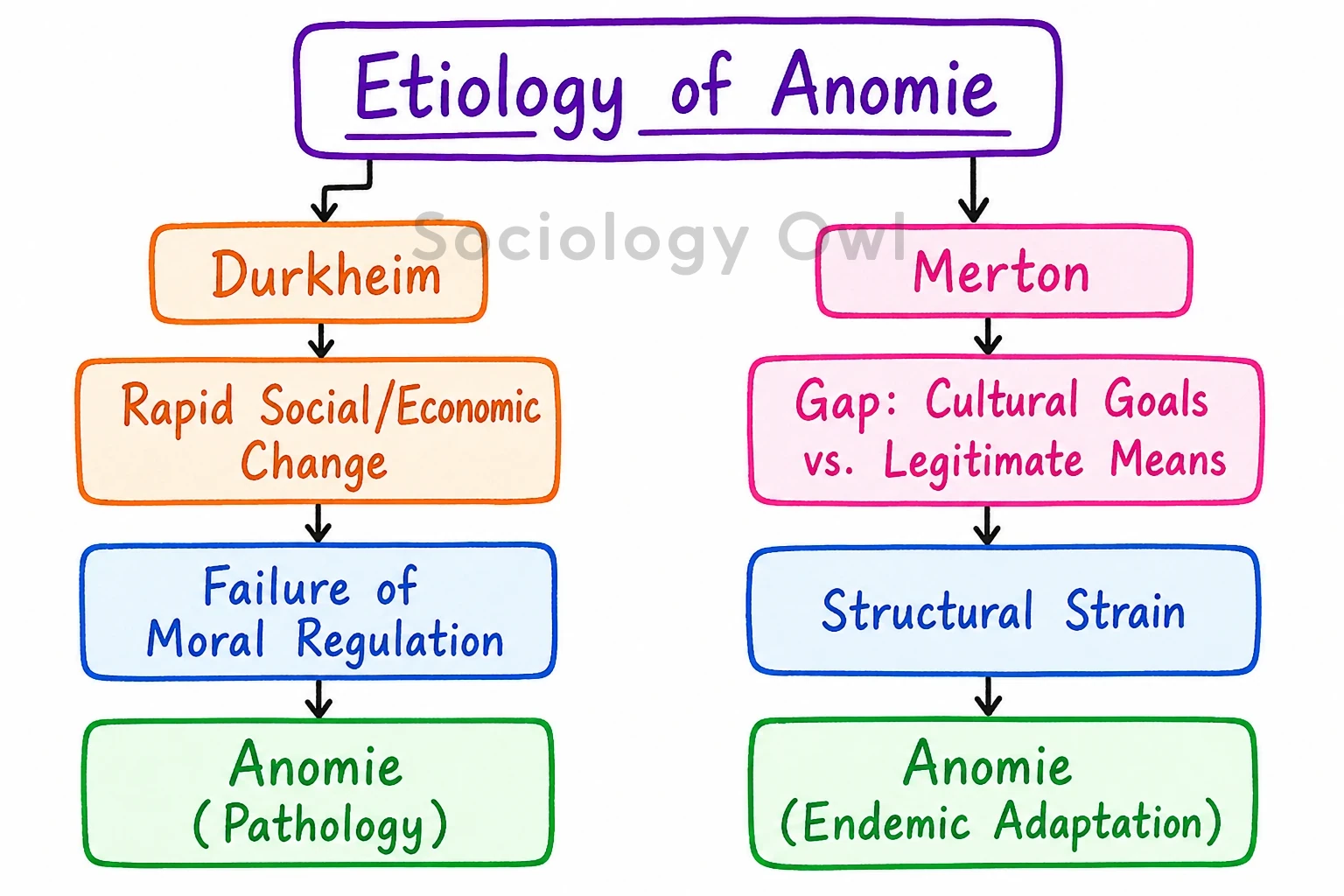
In Social Structure and Anomie, Robert K. Merton shifted deviance from biological pathology to a Structural-Functionalist view. Conformity and deviance coexist not as opposites, but as continuum points adapting to the exact same social structure.

Coexistence occurs because society promotes universal Cultural Goals (e.g., wealth) but unevenly distributes legitimate Institutional Means across classes. This mismatch creates Anomie (strain), generating varied adaptations:

anomie

Adaptation Types

  • Conformity (+Goals, +Means): Pursuing legitimate careers.
  • Innovation (+Goals, -Means): Achieving wealth illegally (e.g., Jamtara cyber-crimes).
  • Ritualism (-Goals, +Means): Goal Displacement (e.g., bureaucratic red-tapism).
  • Retreatism (-Goals, -Means): Escapism (e.g., youth drug epidemics).
  • Rebellion (±Goals, ±Means): Seeking structural overhaul (e.g., Naxalism).
  • Critique: Cloward & Ohlin add that Merton ignores that deviants also face unequal access to Illegitimate Opportunity Structures.

In modern aspirational societies, hyper-consumerism amid unemployment continuously breeds both conforming tech-entrepreneurs and “innovative” deviants (e.g., the Vyapam scam) side-by-side.

Conclusion

Merton established that deviance is not a breakdown of society but an integral reflection of its structural inequalities. Reducing deviance therefore requires equitable structural opportunities, not merely punitive laws.

With suitable examples, explain how conformity and deviance coexist in a society as propounded by R.K. Merton. Read More »

How does the dramaturgical perspective enable our understanding of everyday life?

Model Answers

Q: How does the dramaturgical perspective enable our understanding of everyday life?

Question asked in UPSC Sociology 2023 Paper 1. Download our app for last 20 year question with model answers. 

Model Answer:

Dramaturgical Perspective

Introduced by Erving Goffman in The Presentation of Self in Everyday Life, the dramaturgical perspective is a micro-sociological approach rooted in Symbolic Interactionism. It decodes everyday social life as a theatrical performance.

Decoding Everyday Interactions

Impression Management

Individuals act to control how others perceive them utilizing sign vehicles (language, clothing) and props (e.g., a doctor’s stethoscope).

Front Stage vs. Back Stage

The Front Stage is for performing expected societal roles, while the Back Stage allows individuals to drop their roles outside the audience’s gaze.

Workplace Performances

Arlie Hochschild applied dramaturgy to modern workplaces, revealing how service workers perform Emotional Labor on the front stage.

Critique

Alvin Gouldner criticized Goffman for portraying humans as amoral manipulators. Structuralists argue dramaturgy ignores macro-forces (class, power) dictating who writes these social “scripts”.

Today, social media functions as a global “virtual front stage” where users engage in curated identity construction to manage public impressions.

Conclusion

Despite ignoring macro-structural inequalities, the dramaturgical approach remains a highly relevant theoretical lens for analyzing micro-level identity negotiations in our hyper-visible digital society.

How does the dramaturgical perspective enable our understanding of everyday life? Read More »

Q. ‘Textual perspective is important in understanding of Indian Social System.’ Discuss.

Q. ‘Textual perspective is important in understanding of Indian Social System.’ Discuss.

UPSC Sociology 2025 Paper 2

Model Answer:

The Indological Approach and Textual Perspective

The Indological approach utilizes classical texts to decipher the normative and ideological foundations of the Indian social system.

Significance of Textual Perspective

Ideological Framework: Louis Dumont in Homo Hierarchicus used texts to derive the purity and pollution binary structuring caste.

Institutional Antiquity: G.S. Ghurye utilized Sanskrit literature to trace the evolution of Gotra and kinship.

Civilizational Continuity: Irawati Karve in Yuganta applied textual analysis (The Mahabharata) to understand ancient kinship norms.

Critiques of the Textual Approach

“Book View” vs. “Field View”: M.N. Srinivas argued texts present a static, idealized reality, ignoring dynamic lived realities.

Brahmanical Hegemony: B.R. Ambedkar criticized texts like Manusmriti as active instruments of structural violence against Dalits and women.

Marxist Critique: A.R. Desai argued textual views mask underlying material class conflicts.

Textual analysis remains vital in Indian jurisprudence, evident in Supreme Court referencing ancient texts during the Sabarimala verdict and debates around the Uniform Civil Code (UCC).

Conclusion

While texts provide the ideological grammar of Indian society, they must be synthesized with empirical reality. A historical-sociological approach (e.g., Bernard Cohn), blending the “field view” and “book view,” is vital to capture India’s dynamic reality.

Q. ‘Textual perspective is important in understanding of Indian Social System.’ Discuss. Read More »

Q. Can Merton’s reference group theory be relevant in understanding ‘identity making’ in digital world? Explain.

Q. Can Merton’s reference group theory be relevant in understanding ‘identity making’ in digital world? Explain.

UPSC Sociology 2025 Paper 1

Model Answer:

Merton’s Reference Group Theory and Digital Identity Formation

Coined by Herbert Hyman and developed by Robert K. Merton, Reference Group Theory explains self-concept evaluation. Today, digital identity-making is a fluid negotiation against online reference groups.

Comparative Function & Relative Deprivation

Users compare themselves to curated influencer lifestyles, breeding status anxiety (Relative Deprivation) and shaping the digital looking-glass self (Charles Cooley).

Normative & Negative Groups

Online subcultures dictate behavioral norms. Conversely, Negative Reference Groups solidify identity through active opposition, visible in digital “cancel culture.”

Anticipatory Socialization

Users adopt the language of desired groups, like mirroring industry leaders on LinkedIn, utilizing “front stage” impression management (Erving Goffman).

Merton assumed individuals choose their reference groups. Today, algorithms dictate these groups, creating “echo chambers.” Furthermore, digital identities remain transient, reflecting Zygmunt Bauman’s Liquid Modernity, often built on superficial parasocial relationships rather than substantive community ties.

Conclusion

Despite its pre-digital origins, Merton’s structural framework successfully decodes the complex pathways of aspiration, validation, and comparison that drive modern digital identity construction.

Q. Can Merton’s reference group theory be relevant in understanding ‘identity making’ in digital world? Explain. Read More »

What does Dr. B. R. Ambedkar mean by the concept of “Annihilation of caste” ?

Model Answers

Q: What does Dr. B. R. Ambedkar mean by the concept of “Annihilation of caste" ?

Question asked in UPSC Sociology 2021 Paper 2. Download our app for last 20 year question with model answers.

Model Answer:

Ambedkar’s Concept -> Annihilation of Caste

In his 1936 text, Annihilation of Caste, B.R. Ambedkar presented a radical Subaltern Perspective demanding the complete destruction of the caste system’s ideological and structural foundations, explicitly rejecting mere reform.

Core Dimensions of Annihilation

Destruction of Shastras

Arguing that caste represents “Graded Inequality” rather than a simple division of labour, Ambedkar advocated “dynamiting” the Shastras and Smritis that grant divine legitimacy to exploitation.

Eradicating Endogamy

Identifying Endogamy as the core mechanism reproducing caste boundaries, he argued that mere interdining is insufficient; the ultimate antidote is the “fusion of blood” through intermarriage.

Ambedkar vs. Gandhi Debate

Unlike M.K. Gandhi, who sought to remove untouchability while preserving an idealized Varna system, Ambedkar asserted caste is inherently pathological. As sociologist Gail Omvedt notes, Ambedkar’s vision demanded a total social revolution, not just behavioral reform.

dsfsdfinequality

The persistence of honour killings and the rise of “Digital Endogamy” through caste-based matrimonial websites validate Ambedkar’s thesis that without ideological destruction, caste simply adapts to modernity.

Conclusion

Despite robust constitutional safeguards and political empowerment, Ambedkar’s radical vision of a truly casteless society remains an unfinished social revolution in contemporary India.

What does Dr. B. R. Ambedkar mean by the concept of “Annihilation of caste” ? Read More »