Model Answer

Critically examine Weber‘s theory of Protestant Ethic and Spirit of Capitalism.

Model Answers

Q: Critically examine Weber‘s theory of Protestant Ethic and Spirit of Capitalism.

Question asked in UPSC Sociology 2002 Paper 1. Download our app for last 20 year question with model answers.

Model Answer:

Max Weber, in his magnum opus “The Protestant Ethic and the Spirit of Capitalism” (1905), sought to explain the unique emergence of rational, modern capitalism in Western Europe. Methodologically, Weber used Ideal Types and the Historical Comparative Method to study world religions. Unlike Karl Marx, who viewed religion as the “opium of the masses” and a product of the economic base, Weber argued for an Elective Affinity (a mutual attraction and reinforcement) between the religious ideas of the Protestant Reformation and the ethos of modern capitalism.

The Core of the Weberian Thesis

Weber argued that modern capitalism is not merely about the greed for wealth, but is a rational, systematic pursuit of profit. This “spirit” was unintentionally fostered by the tenets of Calvinism (a branch of Protestantism):

  • Doctrine of Predestination: Calvinists believed that God had already chosen the “elect” for salvation, and nothing could change this decree. This created unprecedented salvation anxiety among believers.
  • The Calling (Beruf): To cope with this anxiety, Calvinists interpreted worldly success in one’s occupation as a “sign” of being chosen by God. Work became a religious duty.
  • This-Worldly Asceticism: Calvinism demanded strict discipline, hard work, and frugality. Believers were forbidden from wasting money on luxury or idle leisure.
  • Capital Accumulation: The combination of relentless work (generating wealth) and asceticism (preventing consumption) inevitably led to the constant reinvestment of profits, which is the very engine of capitalism.

Comparative Perspective: Weber vs. Marx on the Rise of Capitalism

ParameterKarl Marx (Historical Materialism)Max Weber (Social Action / Ideas)
Primary DriverChanges in the Mode of Production (Material Base).Changes in human consciousness and Religious Ideas.
View of ReligionReligion is part of the superstructure; it justifies exploitation.Religion can be an independent, revolutionary force causing social change.
Rise of CapitalismEmerged from the contradictions and class struggles of Feudalism.Emerged due to the unintended consequences of Calvinist ethics.

Critical Examination of the Thesis

While Weber’s thesis is a foundational text in sociology, it has been heavily critiqued by various scholars:

  • R.H. Tawney in Religion and the Rise of Capitalism argued that the causal direction was reversed: early capitalism in Italian city-states (like Venice and Florence, which were Catholic) created the conditions for Protestantism, not the other way around.
  • Werner Sombart criticized Weber for ignoring the contribution of Judaism, arguing that Jewish merchants played a far more crucial role in developing early capitalist institutions like credit and banking.
  • Robert Bellah demonstrated that the “spirit of capitalism” existed in non-Protestant societies. He highlighted the Samurai Ethic (Bushido) and the Tokugawa religion in Japan, which fostered similar values of loyalty, discipline, and rational capitalism.
  • Marxist Critique: Scholars argue that Weber underplays colonial exploitation, technological advancements, and the primitive accumulation of capital, placing undue emphasis on subjective religious motives.

The Indian Context: Weber’s View and Counter-Critiques

Weber extended his comparative study to India in “The Religion of India”. He argued that despite having the material prerequisites, capitalism did not develop indigenously in India due to Hinduism’s “Other-Worldly Asceticism.” He claimed that the doctrines of Karma and Dharma (within the caste system) promoted fatalism and ritual conformity rather than rational economic innovation.

However, Indian sociologists and modern anthropologists have robustly challenged Weber’s ethnocentric view:

  • Milton Singer, in his study of Madras industrialists, found that Hindu businessmen used a psychological mechanism of Compartmentalization. They separated their traditional religious life at home from their rational, modern capitalist behavior in the factory, proving Hinduism is not antithetical to capitalism.
  • Dipankar Gupta and Thomas Timberg have highlighted the role of the Marwaris, Jains, and Parsis. The traditional Vaishya ethic in India bears a strong resemblance to the Protestant ethic, emphasizing frugality, bookkeeping, and reinvestment.
  • A.R. Desai, from a Marxist perspective, argued that the lack of capitalist development in India was not due to Hindu theology, but was a direct result of British colonialism, which de-industrialized India and drained its wealth.

Contemporary Relevance

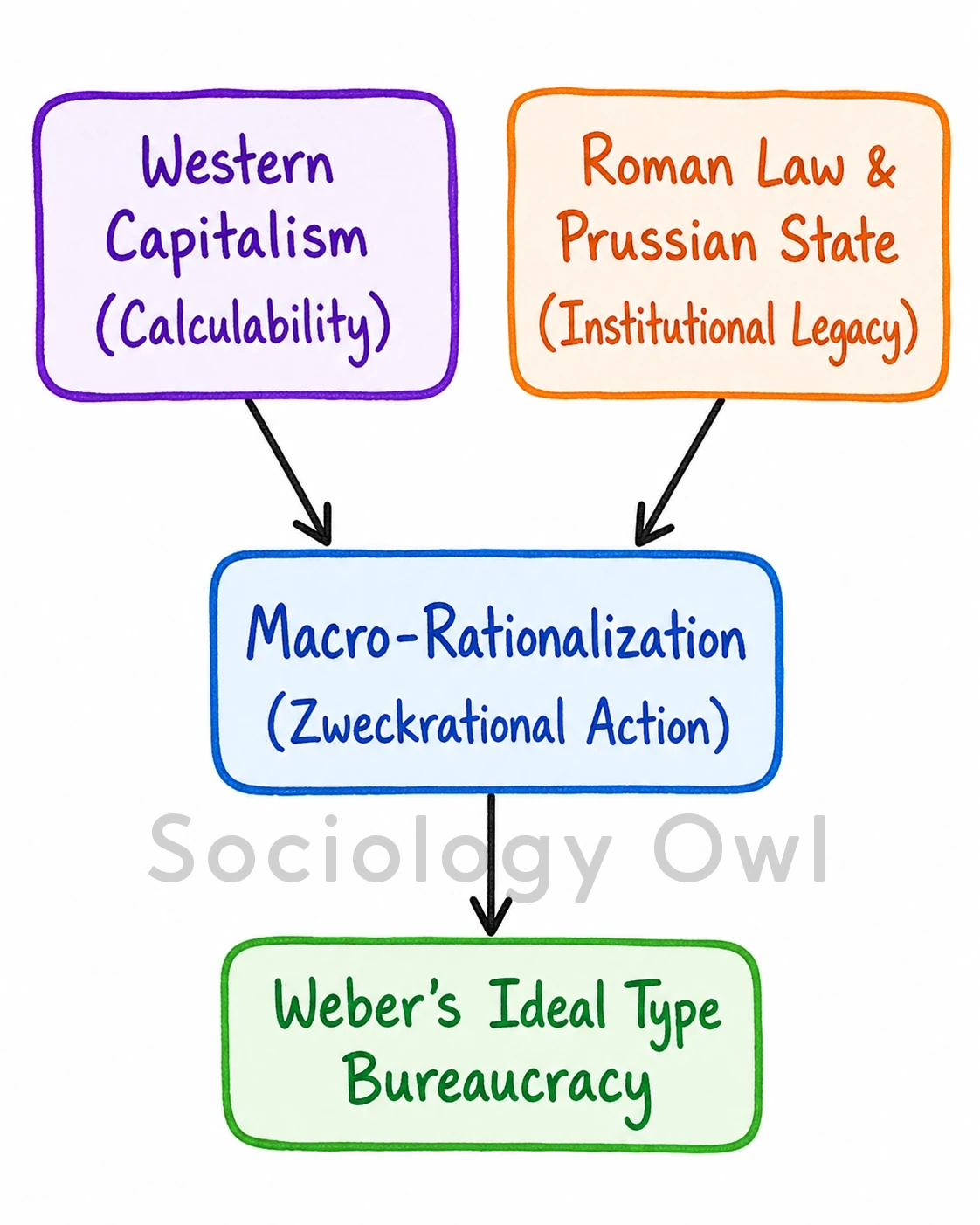
In the modern, globalized era, the religious roots of capitalism have withered away, but the “spirit” remains embedded in secular culture. Today’s “hustle culture,” the gig economy, and the relentless pursuit of productivity are secularized forms of the Protestant ethic. Furthermore, George Ritzer’s concept of McDonaldization shows how the Weberian principles of formal rationality, efficiency, and calculability continue to dominate contemporary global institutions, albeit stripped of their original spiritual meaning.

Conclusion

Max Weber’s thesis remains a masterclass in demonstrating how deeply held cultural and religious ideas can unintentionally alter the trajectory of global economic history. While his specific historical claims regarding Calvinism and Hinduism have been highly debated, his broader methodological contribution—that ideas matter in social change—is undisputed. As Weber himself poignantly concluded, the religious zeal of early capitalism has faded, leaving modern man trapped in an “Iron Cage” (Stahlhartes Gehäuse) of bureaucratic rationality and materialistic compulsion, a diagnosis that remains remarkably accurate for contemporary society.

Critically examine Weber‘s theory of Protestant Ethic and Spirit of Capitalism. Read More »

Elaborate on M.N. Srinivas’s structural functionalist approach to the study of Indian society.

Model Answers

Q: Elaborate on M.N. Srinivas’s structural functionalist approach to the study of Indian society.

Question asked in UPSC Sociology 2022 Paper 2. Download our app for last 20 year question with model answers.

Model Answer:

Functional Integration and Critiques of M.N. Srinivas’s Sociology

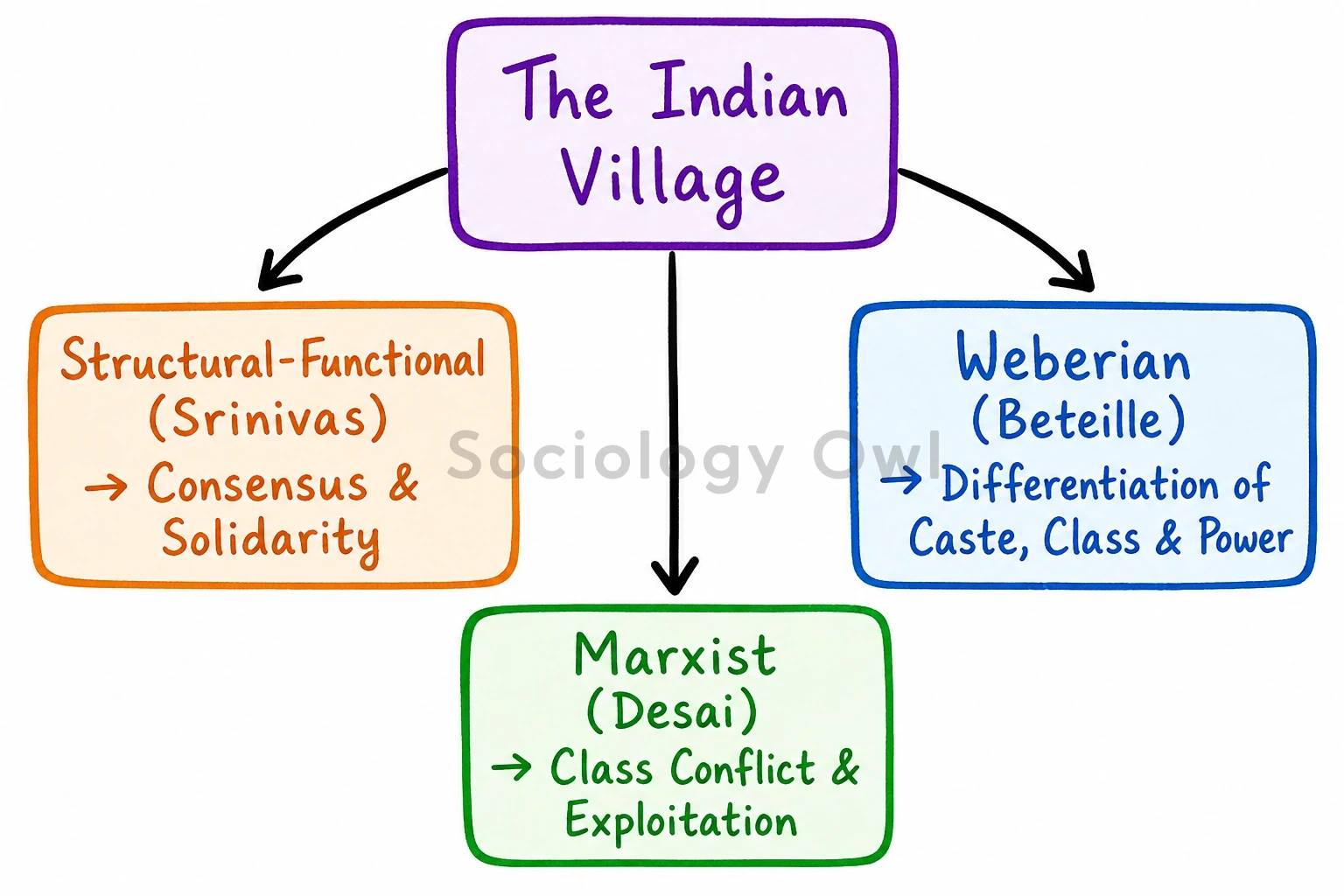
M.N. Srinivas pioneered the structural-functional approach, rejecting the textual “Book-View” for an empirical “Field-View”. Influenced by A.R. Radcliffe-Brown, he analyzed society as an integrated whole where traditional institutions maintain equilibrium.

Functional Integration of Indian Society

Vertical Solidarity: In The Remembered Village, he showed how interdependent castes cooperate via the Jajmani system, ensuring economic and social harmony.

Ritual Cohesion: In Religion and Society Among the Coorgs, he demonstrated how religious rituals reinforce structural unity across the society.

Systemic Equilibrium: Sanskritization acts as a “safety valve,” allowing cultural mobility for lower castes without dismantling the overarching caste framework.

Stability Anchor: The Dominant Caste serves as a local patron, settling disputes and upholding functional social order.

social equilibrium

Critiques

Marxist Critique: A.R. Desai criticized his romanticization of village harmony, which overlooked deep-rooted economic exploitation and class conflicts.

Subaltern Critique: Critics highlight an upper-caste bias, arguing that emphasizing “equilibrium” downplays systemic Dalit oppression.

Srinivas’s functional framework helps analyze modern structural disruptions, such as the contemporary political demands for reservation by erstwhile Dominant Castes (e.g., Marathas and Patidars).

Conclusion

Despite critiques, Srinivas’s rigorous ethnography remains foundational, successfully transitioning Indian sociology towards the empirical study of dynamic, lived structural realities.

Elaborate on M.N. Srinivas’s structural functionalist approach to the study of Indian society. Read More »

From the viewpoint of growing importance of multidisciplinarity, how do you relate sociology to other social sciences ?

Model Answers

Q: From the viewpoint of growing importance of multidisciplinarity, how do you relate sociology to other social sciences ?

Question asked in UPSC Sociology 2021 Paper 1. Download our app for last 20 year question with model answers.

Model Answer:

Sociology as an Interconnected Bridge Discipline

Historically, Auguste Comte envisioned sociology as the hierarchical “Queen of Sciences,” while Emile Durkheim conceptualized Social Facts to establish strict disciplinary boundaries against psychology and philosophy. However, modern globalization and post-modernity demand multidisciplinarity. Today, sociology acts as an interconnected “bridge discipline,” synthesizing diverse fields to analyze complex, multi-causal realities.

Emergence of Hybrid Disciplines and Synthesis

Rather than remaining in isolated silos, modern sociology synthesizes with other sciences to form dynamic, problem-solving sub-fields:
sociology and others
Socio-Economics

Critiquing the isolated, rational models of classical economics, Karl Polanyi’s concept of the “Embedded Economy” and Pierre Bourdieu’s Cultural Capital demonstrate how market behaviors are deeply rooted in social structures.

Political Sociology

Moving beyond formal governance, C. Wright Mills in The Power Elite and Michel Foucault through Bio-power bridge sociology and political science to expose hidden, informal power dynamics.

Social Psychology

George Herbert Mead’s Symbolic Interactionism merges sociological macro-structures with psychological micro-motives, explaining how the “Self” emerges through social interaction.

Contemporary sociological paradigms inherently reject strict borders. Structural theories like Marxism and Feminism seamlessly blend history, economics, and sociology. Furthermore, Ulrich Beck’s Risk Society thesis illustrates that understanding modern crises requires the simultaneous integration of sociology, ecology, and technology.

Modern global challenges mandate a multidisciplinary approach. Analyzing the COVID-19 pandemic required Epidemiology alongside Medical Sociology (to map structural health inequalities), Behavioral Economics (to understand vaccine hesitancy), and Political Science (to analyze lockdown governance). Similarly, the advent of Computational Sociology bridges computer science and sociology to decode algorithmic biases and echo chambers.

Conclusion

While multidisciplinarity is vital for holistic analysis, it triggers an Identity Crisis within the discipline. Sociology must resist methodological imperialism—such as biological determinism from Sociobiology or economic reductionism via Rational Choice Theory—ensuring it acts as a grand synthesizer without abandoning its core focus on social structures and power inequalities.

From the viewpoint of growing importance of multidisciplinarity, how do you relate sociology to other social sciences ? Read More »

Q. Differentiate between ‘Western’ and ‘Indological’ perspectives on the study of Indian society. Bring out the major aspects of G. S. Ghurye’s contribution to ‘Indological’ approach.

Q. Differentiate between ‘Western’ and ‘Indological’ perspectives on the study of Indian society. Bring out the major aspects of G. S. Ghurye’s contribution to ‘Indological’ approach.

UPSC Sociology 2024 Paper 2

Model Answer:

Differentiating Western and Indological Perspectives

The sociological study of Indian society is characterized by a dialectic between the empirical “Field View” derived from Western perspectives and the textual “Book View” of the Indological perspective.

Epistemology and Methodology

Early Western perspectives (like colonial ethnography or Marxist models) applied universalistic frameworks to India. Conversely, Indology stresses the cultural uniqueness and historical continuity of Indian civilization.

Western sociology emphasizes empirical field studies and participant observation, a “Field View” later championed by Indian sociologists like M.N. Srinivas. Indology relies on the textual analysis of scriptures like Vedas and Dharmashastras (the “Book View”). Notably, Louis Dumont synthesized both in Homo Hierarchicus, using French structuralism to analyze Hindu texts.

Focus

Western approaches prioritize material reality, structural differentiation, and modernization, whereas Indology examines traditional ideologies, values, and normative structures.

indian sociology

G.S. Ghurye’s Contribution and Critique

G.S. Ghurye utilized Indology with a nationalist undertone to counter colonial narratives, establishing India’s underlying socio-cultural unity:

Diffusionism and Integration

He applied a diffusionist approach to trace how Indo-Aryan Brahmanical culture spread from the Gangetic plains, binding the subcontinent together.

In The Aborigines – So-called – And Their Future, he famously termed tribes as “Backward Hindus,” actively challenging the colonial isolationist policies of Verrier Elwin.

Synthesis of Text and Science

In Caste and Race in India, he combined ancient textual evidence with empirical anthropometric data to analyze social stratification.

Ghurye’s Indology faces severe criticism from Marxist (A.R. Desai) and Subaltern scholars for its Brahmanical and elitist bias, which often marginalized the lived realities of Dalits and women. Today, the tension between Indological cultural assimilation and empirical ground realities remains highly relevant in debates surrounding the Uniform Civil Code (UCC) and tribal assertion against Sanskritization.

Conclusion

While Ghurye’s Indological approach laid the bedrock for Indian sociology by establishing India’s cultural unity, the subsequent shift towards empirical studies proved that an authentic understanding requires a dynamic synthesis of both the historical text and the modern context.

Q. Differentiate between ‘Western’ and ‘Indological’ perspectives on the study of Indian society. Bring out the major aspects of G. S. Ghurye’s contribution to ‘Indological’ approach. Read More »

Explain Durkheim’s basic arguments on suicide. Can you analyse high suicide rates of contemporary Indian society with Durkheim’s theory?

Model Answers

Q: Explain Durkheim's basic arguments on suicide. Can you analyse high suicide rates of contemporary Indian society with Durkheim's theory?

Question asked in UPSC Sociology 2018 Paper 1. Download our app for last 20 year question with model answers.

Model Answer:

Durkheim’s Suicide Theory and Arguments

In Le Suicide (1897), Emile Durkheim sought to establish sociology as a positivist science by proving that a highly individualistic act is caused by “Social Facts” (suicidogenic currents). He defined suicide sociologically as death resulting from a direct or indirect act of the victim, knowing the outcome. Using “Concomitant Variation” on European data, he demonstrated the supremacy of society over the individual.

Durkheim argued suicide rates depend on two macro-sociological forces:

Social Integration

Egoistic: Low integration (detachment, isolation).

Altruistic: High integration (over-identification with group norms).

Moral Regulation

Anomic: Low regulation (normlessness, sudden economic shocks).

Fatalistic: High regulation (oppressive discipline, hopelessness).

moral regulation

Analyzing Contemporary Indian Society

Durkheim’s framework powerfully decodes India’s high suicide rates, reflecting NCRB data trends:

Egoistic Suicide

Hyper-individualism and the breakdown of traditional family support lead to extreme isolation, visible in the tragic Kota student suicides.

Altruistic Suicide

Over-integration into rigid family or sectarian beliefs, tragically exemplified by the Burari mass suicide or fasts-unto-death by political zealots.

Anomic Suicide

Globalization and market-driven agriculture create sudden economic shocks and normlessness, driving Farmer Suicides in regions like Vidarbha.

Fatalistic Suicide

Inescapable structural oppression, such as caste-based marginalization (e.g., the Rohith Vemula case) or women trapped in patriarchal domestic abuse.

Critics reject Durkheim’s macro-positivism. Phenomenologist J.D. Douglas argues official statistics are mere social constructions by coroners, while Ethnomethodologist J.M. Atkinson emphasizes the subjective “meaning” of the act. Globally, Indian youth suicides mirror suicidogenic currents in hyper-competitive societies like South Korea or Japan (Hikikomori).

Conclusion

While modern psychiatry favors a biopsychosocial model, Durkheim’s structural perspective remains indispensable. As India navigates the turbulent transition from mechanical to organic solidarity, viewing suicide through the lens of integration and regulation is vital for formulating systemic public policies, rather than merely treating it as individual psychiatric failure.

Explain Durkheim’s basic arguments on suicide. Can you analyse high suicide rates of contemporary Indian society with Durkheim’s theory? Read More »

The difference between information and data in social science is subtle. Comment.

Model Answers

Q: The difference between information and data in social science is subtle. Comment.

Question asked in UPSC Sociology 2022 Paper 1. Download our app for last 20 year question with model answers.

Model Answer:

Data comprises raw, unprocessed facts, whereas information is interpreted data yielding meaning. In sociology, this distinction is subtle because social actions inherently carry subjective human context, unlike matter in natural sciences.

Positivism

The distinction is clear in positivism. For Émile Durkheim in Suicide, raw police statistics were data; correlating them to social integration generated sociological information.

Phenomenology

Alfred Schutz explains the subtlety, arguing that human “raw data” already possesses meaning assigned by actors (first-order constructs). Sociological “information” is merely a second-order construct, blurring the boundary.

Methodological Nuance

Quantitative surveys mechanically separate data collection from information processing. Conversely, qualitative methods merge them simultaneously, transforming observations directly into insights via Max Weber’s Verstehen.

data & information

Today, raw digital footprints constitute Big Data. Through algorithmic processing, this is transformed into predictive behavioral information, driving what Shoshana Zuboff terms Surveillance Capitalism.

Conclusion

Converting data to information is fundamentally epistemological. As Alvin Gouldner notes, it requires stringent reflexivity to prevent a researcher’s theoretical biases from distorting objective reality during interpretation.

The difference between information and data in social science is subtle. Comment. Read More »

How do qualitative and quantitative methods supplement each other in sociological enquiry?

Model Answers

Q: How do qualitative and quantitative methods supplement each other in sociological enquiry?

Question asked in UPSC Sociology 2021 Paper 1. Download our app for last 20 year question with model answers.

Model Answer:

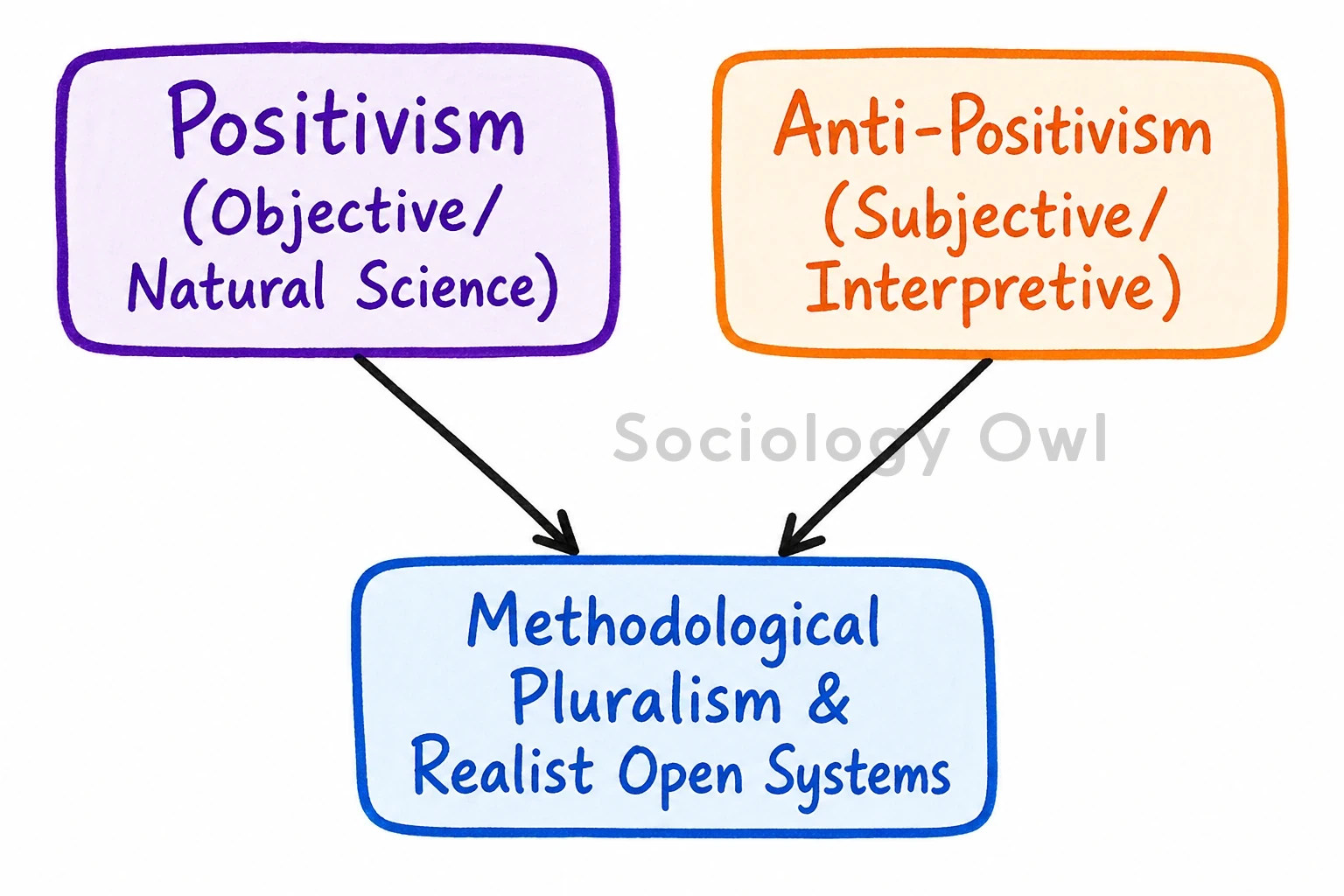
Historically, sociology experienced a divide between Positivists using quantitative methods to uncover objective social facts, and Interpretivists favoring qualitative methods to grasp subjective meanings. Modern sociology transcends this dichotomy through Methodological Pluralism, integrating both to capture the total complexity of social reality.

Epistemological and Methodological Supplementation

Qualitative and quantitative methods compensate for each other’s inherent limitations:

  • Causal and Meaningful Adequacy: Max Weber argued for combining quantitative statistical correlations (causal adequacy) with the qualitative understanding of human motives (Verstehen or meaningful adequacy).
  • Validity vs. Reliability: Qualitative approaches ensure high validity through idiographic (context-specific) depth, whereas quantitative methods provide reliability through nomothetic (generalizable) breadth.
  • Inductive-Deductive Loop: Qualitative research inductively uncovers unexpected themes (e.g., Grounded Theory), generating hypotheses that quantitative surveys deductively test across larger populations.

Triangulation in Sociological Research

Norman Denzin advocates for methodological Triangulation to cross-verify findings and build robust theories.

  • Bridging Structure and Agency: Echoing Anthony Giddens’ Structuration Theory, quantitative data maps macro-level “Structure,” while qualitative data captures micro-level “Agency.”
  • Empirical Integration: Pierre Bourdieu’s Distinction utilized vast statistical surveys alongside in-depth interviews to analyze cultural capital. Similarly, Eileen Barker’s The Making of a Moonie combined participant observation with rigorous questionnaires to demystify religious cult conversions.

In today’s era of Big Data and AI, quantitative data is hyper-abundant. Consequently, qualitative methods are increasingly vital to provide the missing “human context” and mitigate algorithmic biases. However, Alan Bryman highlights an ongoing epistemological debate: while methods supplement each other technically, reconciling their conflicting worldviews (objective vs. constructed reality) remains theoretically challenging.

Conclusion

Sociology has largely moved past methodological “paradigm wars.” By pragmatically integrating both methods, researchers balance depth with breadth, effectively bridging the gap between macro-structural forces and lived human experiences to produce holistic, empirically sound sociological insights.

How do qualitative and quantitative methods supplement each other in sociological enquiry? Read More »

What are the characteristics of scientific method? Do you think that scientific method in conducting sociological research is foolproof? Elaborate.

Model Answers

Q: What are the characteristics of scientific method? Do you think that scientific method in conducting sociological research is foolproof? Elaborate.

Question asked in UPSC Sociology 2023 Paper 1. Download our app for last 20 year question with model answers. 

Model Answer:

The Scientific Method uses systematic observation and empiricism to generate causal, nomothetic (generalizing) knowledge. Championed in sociology by Positivism (Auguste Comte, Emile Durkheim), it aimed to uncover objective “social laws” mirroring the natural sciences.

Characteristics of the Scientific Method

  • Empiricism: Relying on observable evidence. Emile Durkheim advocated treating “social facts as things” to study society objectively, as seen in his statistical work Suicide.
  • Value Neutrality: Max Weber emphasized Wertfreiheit, requiring researchers to strictly separate their personal values from empirical facts.
  • Falsifiability: Karl Popper asserted that for any theory to be truly scientific, it must be empirically testable and disprovable.
  • Systematic Logic: It relies on structured inductive or deductive reasoning and requires high replicability.

Critique: Is the Scientific Method Foolproof?

The method is heavily debated and not considered foolproof in sociology:

  • Philosophy of Science Critique: Thomas Kuhn argued that science is not purely objective but governed by socially constructed Paradigm Shifts. Paul Feyerabend rejected a singular method entirely, proposing “epistemological anarchism.”
  • Interpretivist Critique: Symbolic Interactionists like G.H. Mead argue humans possess consciousness and attach “meaning” to actions, which strict natural science methods fail to capture. Ethnomethodology (Harold Garfinkel) argues that “objective” social facts are merely continuous social accomplishments.
  • Feminist & Critical Views: The Frankfurt School argued positivism reduces humans to mere numbers, serving capitalist domination. Feminists like Ann Oakley critique the “objective” method as historically androcentric (male-biased).

The illusion of foolproof objectivity is evident in modern Big Data and AI algorithms. While appearing purely scientific, tools like predictive policing software often replicate historic racial biases, proving that scientific parameters are always constrained by subjective human researchers.

scientific method

Conclusion

Acknowledging these limitations, Post-Positivism rejects absolute objectivity. Thinkers like Alvin Gouldner advocate for Reflexivity, while modern sociology relies on Methodological Pluralism and Triangulation (Norman Denzin)—combining both quantitative and qualitative methods to rigorously approximate complex social realities.

What are the characteristics of scientific method? Do you think that scientific method in conducting sociological research is foolproof? Elaborate. Read More »

Q. What is common sense? How are common knowledge and sociology related to each other? Explain.

Q. What is common sense? How are common knowledge and sociology related to each other? Explain.

UPSC Sociology 2025 Paper 1

Model Answer:

Common sense is the routine, “taken-for-granted reality” navigating daily life. Antonio Gramsci viewed it as fragmented wisdom often reflecting ruling-class ideological hegemony.

Sociology Transcending Common Sense

Positivist and critical traditions argue sociology systematically debunks uncritical everyday knowledge:

  • Emile Durkheim challenged individualistic common-sense views in Suicide, proving its structural, social roots.
  • C. Wright Mills utilized the Sociological Imagination to elevate isolated “personal troubles” into structural “public issues.”

Sociology Relying on Common Sense

Interpretivists treat everyday knowledge not as an error, but as essential subject matter:

  • Alfred Schutz argued individuals use “first-order constructs” (common sense), which sociologists systematically organize into “second-order constructs.”
  • Harold Garfinkel‘s Ethnomethodology studies the practical methods people use to actively construct and maintain everyday common sense.

While common sense often labels gig-economy drivers as “flexible independent freelancers,” sociological analysis reveals hidden structures of algorithmic control and economic precarity.

common sense

Conclusion

The relationship is dialectical. Through Anthony Giddens‘ concept of the Double Hermeneutic, sociological discoveries (e.g., “patriarchy” or “introversion”) continuously filter back into society, evolving into tomorrow’s common sense.

Q. What is common sense? How are common knowledge and sociology related to each other? Explain. Read More »

Critically examine the relevance of Vilfredo Pareto’s theory of Circulation of Elites in the present scenario

Model Answers

Q: Critically examine the relevance of Vilfredo Pareto's theory of Circulation of Elites in the present scenario.

Question asked in UPSC Sociology 2021 Paper 1. Download our app for last 20 year question with model answers.

Model Answer:

In Mind and Society, Vilfredo Pareto calls history a “graveyard of aristocracies”. Driven by psychological “Residues”, power inevitably circulates between cunning “Foxes” (Instinct of Combinations) and forceful “Lions” (Persistence of Aggregates).

Elites and Democracies

The Power Elite: C. Wright Mills validates Pareto, demonstrating how modern political, military, and corporate elites continuously circulate.

Democratic Inevitability: Robert Michels’ “Iron Law of Oligarchy” confirms that elite domination remains inevitable even within modern democratic organizations.

Critical Examination of Pareto’s Theory

Theoretical Critiques

Marxist Critique: Karl Marx argued circulation is an illusion; the ruling class maintains power structurally via the means of production, not psychological instincts.

Pluralist Critique: Robert Dahl argues democratic power is diffused among competing pressure groups, rather than monopolized by closed elites.

Global tech-entrepreneurs act as modern “Foxes”, constantly displacing traditional industrial elites. Furthermore, Leslie Sklair’s “Transnational Capitalist Class” illustrates a newly globalized dimension of elite circulation.

Conclusion

Despite pluralist critiques of his psychological determinism, Pareto’s framework remains a vital sociological lens to decode modern power asymmetries and the persistent recycling of political dynasties today.

Critically examine the relevance of Vilfredo Pareto’s theory of Circulation of Elites in the present scenario Read More »