Q. Discuss the nature of Sociology. Highlight its relationship with Social Anthropology.
Q. Discuss the nature of Sociology. Highlight its relationship with Social Anthropology. Read More »
Model Answer:
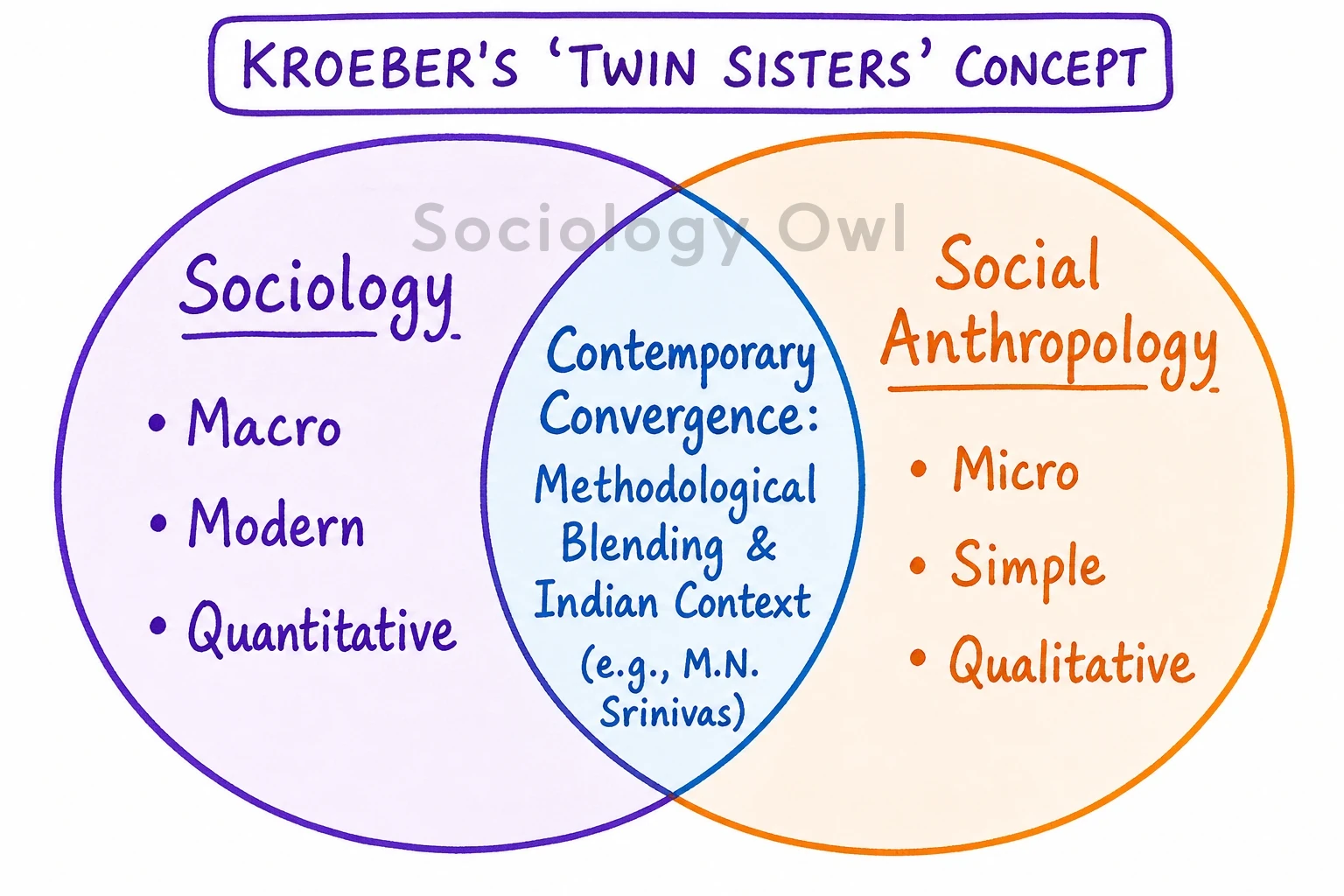
Sociology emerged from Modernity as the scientific study of society. Its nature centers on analyzing objective “Social Facts” (Emile Durkheim) and the “Interpretative Understanding” of social action (Max Weber) within complex, industrial societies.

Today, studying complex phenomena like urban slums (e.g., Dharavi) or tribal displacement requires blending sociological macro-analysis of state policies with anthropological micro-analysis of kinship and cultural trauma.
As Anthony Giddens argues, late-stage globalization has rendered the traditional “modern” versus “primitive” dichotomy obsolete, increasingly dissolving methodological boundaries and forging a unified, holistic sociological anthropology.
Q. Discuss the nature of Sociology. Highlight its relationship with Social Anthropology. Read More »
Model Answers
Question asked in UPSC Sociology 2023 Paper 1. Download our app for last 20 year question with model answers.
Model Answer:
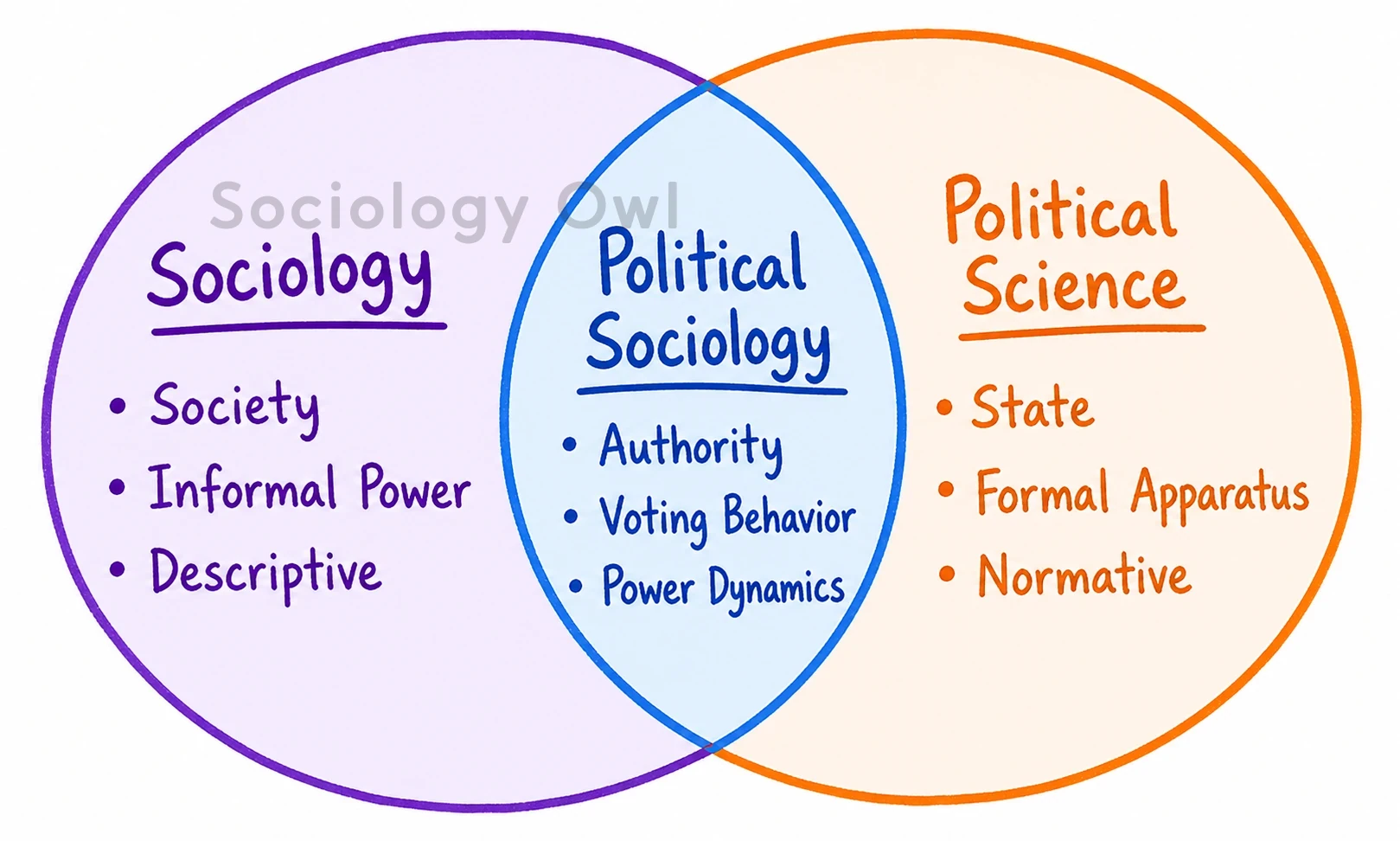
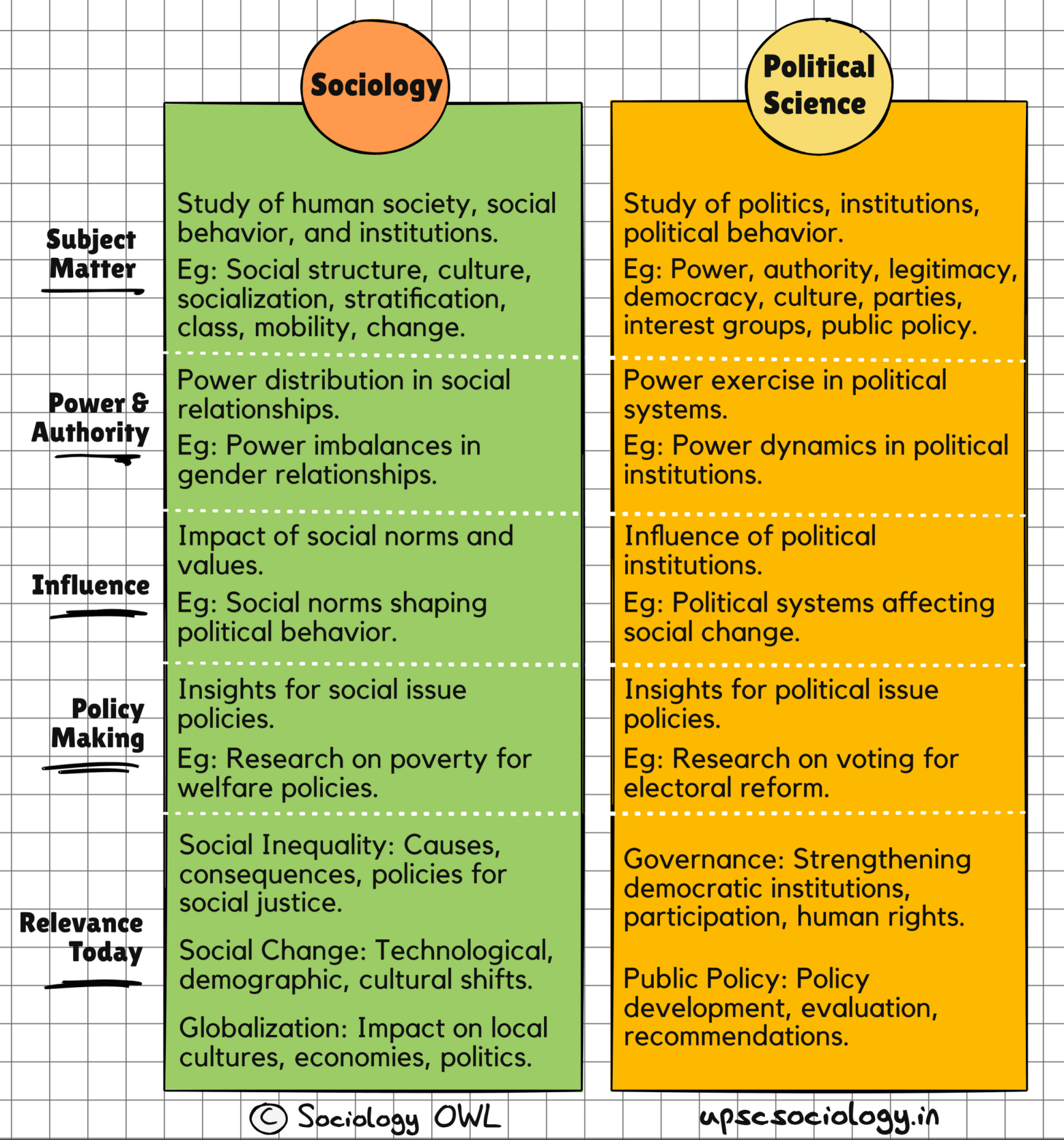
Sociology studies society holistically, while Political Science focuses on formal power apparatuses like the State. Highlighting their deep interdependence, George E.G. Catlin stated, “Political Science and Sociology are two faces or aspects of the same figure.”

Sociological frameworks are essential to decode modern political phenomena like Global Populism and Rajni Kothari’s analysis of Vote Bank Politics, which demonstrates how caste identities drive Indian electoral behavior.
A comprehensive understanding of the State remains impossible without analyzing the society that creates it. Today, sociological inquiry is an indispensable foundation for political science.
Download our app for UPSC Sociology Optional - Syllabus, NCERT Books, IGNOU Books, Past Paper with Model Answers, Topper Notes & Answer Sheet.
Discuss the relationship between sociology and political science. Read More »
Model Answers
Question asked in UPSC Sociology 2022 Paper 2. Download our app for last 20 year question with model answers.
Model Answer:
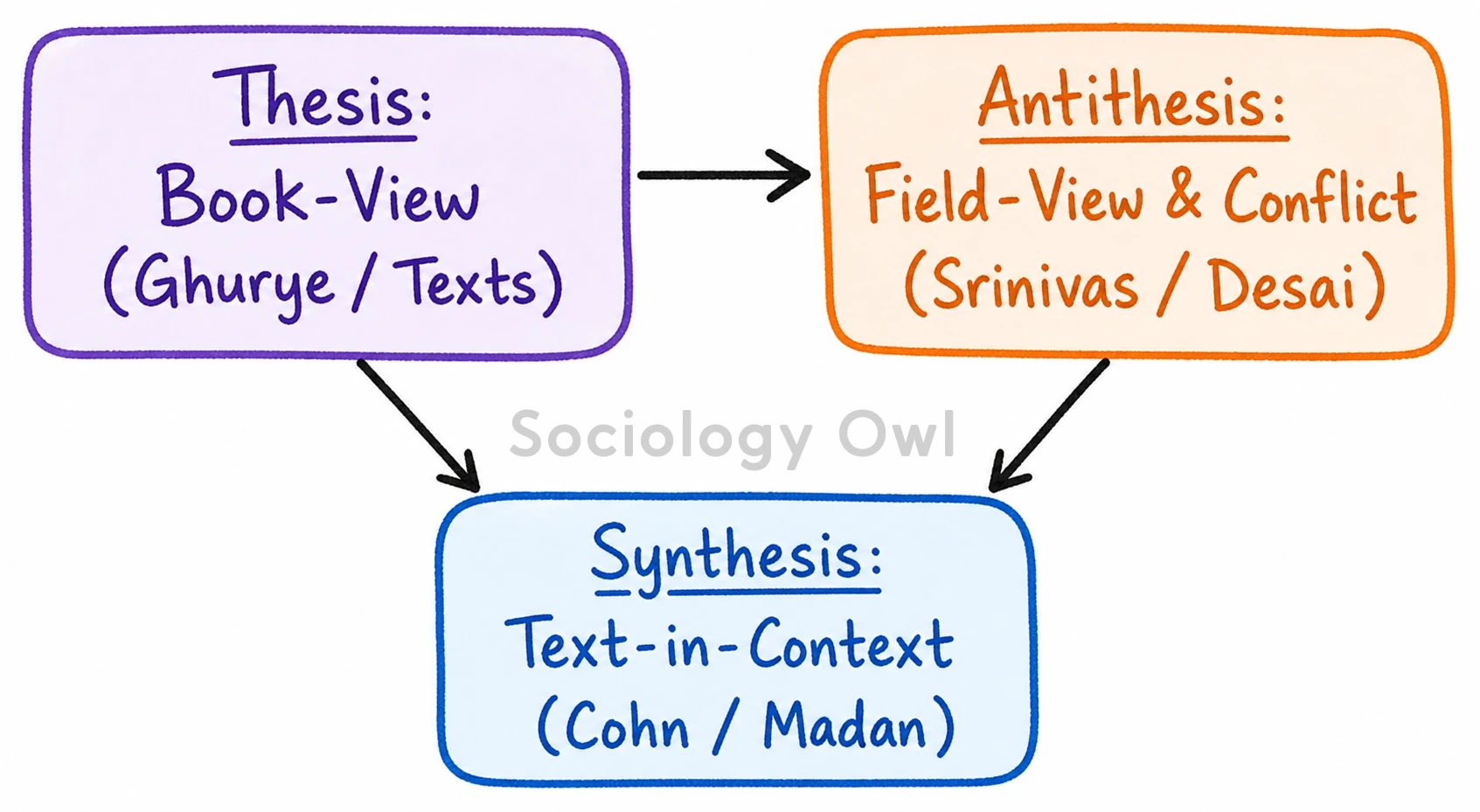
G.S. Ghurye’s Indological approach relies on historical antiquity and classical Sanskrit literature to study Indian society, representing a “Book-View”. Influenced by the Diffusionist approach of W.H.R. Rivers, Ghurye utilized ancient texts to trace the civilizational continuity and evolution of Indian social institutions.
Ghurye argued that Indian society’s underlying unity stems from Brahminical traditions.

While pure Indology is largely outdated, sociologists like Bernard Cohn and T.N. Madan successfully synthesized textual knowledge with empirical fieldwork. Today, textual analysis remains vital for contextualizing the cultural roots of modern debates, such as the Uniform Civil Code and the resurgence of Ayurvedic practices.
Despite its methodological flaws, G.S. Ghurye is rightly regarded as the “Institutional Father of Indian Sociology.” His Indological approach established a distinctly indigenous sociological tradition, successfully breaking away from Western, Eurocentric models of society.
Download our app for UPSC Sociology Optional - Syllabus, NCERT Books, IGNOU Books, Past Paper with Model Answers, Topper Notes & Answer Sheet.
Model Answers
Question asked in UPSC Sociology 2021 Paper 1. Download our app for last 20 year question with model answers.
Model Answer:
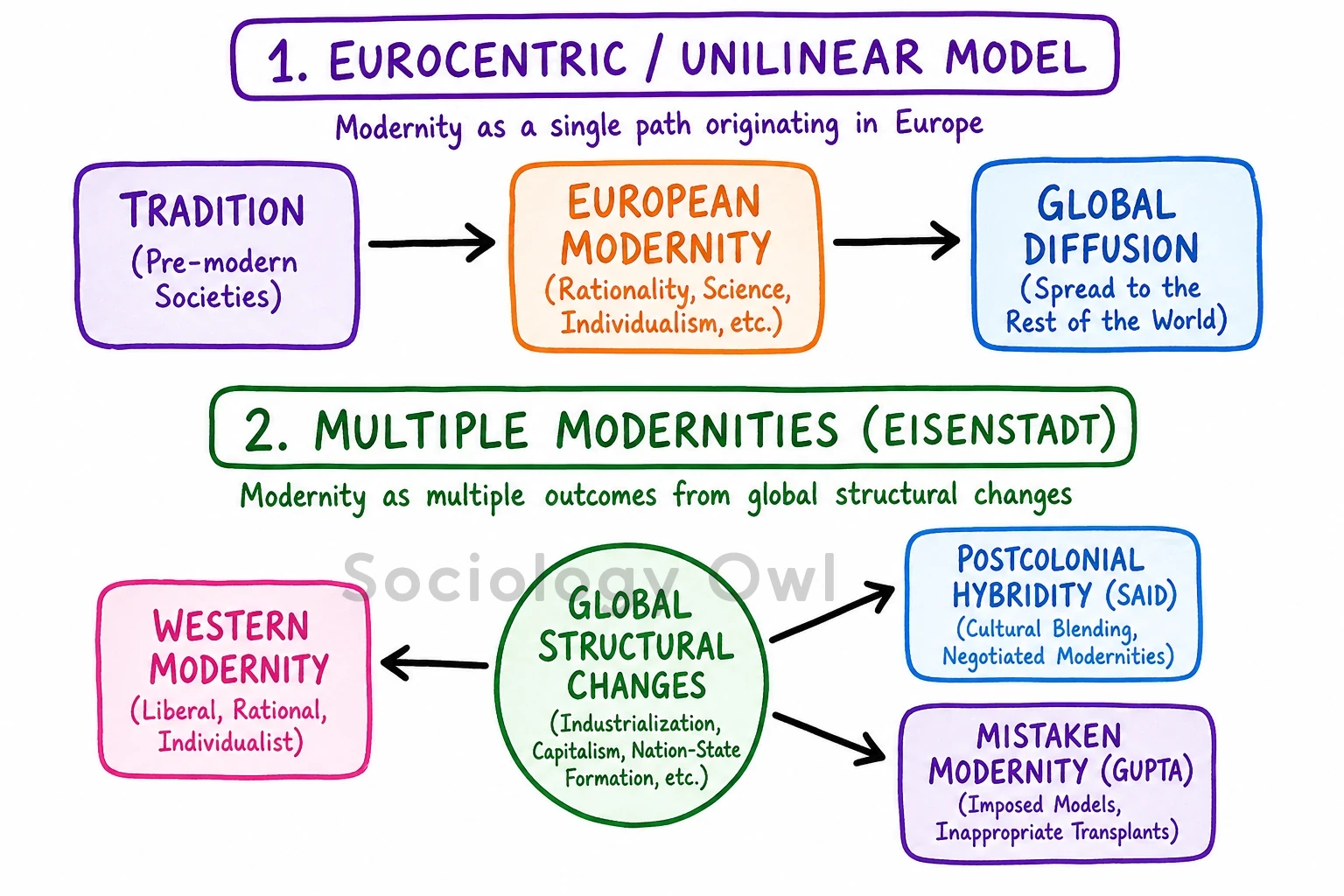
Classical sociology defined modernity as an epistemic rupture characterized by Max Weber’s “Rationalization” and Karl Marx’s “Capitalist Mode of Production”, viewing Europe as its undisputed birthplace following the twin revolutions.
Critiquing Europe as the “First” Place:
Critiquing Europe as the “Only” Place:
Gulf nations exemplify advanced economic modernity coexisting with traditional religion. Similarly, Dipankar Gupta’s concept of “Mistaken Modernity” illustrates India’s unique trajectory, where technological advancement coexists with deep-rooted caste and kinship structures.
Modernity is not a monolithic European export. Rather, it is a globally interconnected and highly pluralistic project, reflecting what Anthony Giddens terms the dynamic, institutional reflexivity of late modernity.
Download our app for UPSC Sociology Optional - Syllabus, NCERT Books, IGNOU Books, Past Paper with Model Answers, Topper Notes & Answer Sheet.
Europe was the first and the only place where modernity emerged. Comment. Read More »
Model Answers
Question asked in UPSC Sociology 2023 Paper 1. Download our app for last 20 year question with model answers.
Model Answer:
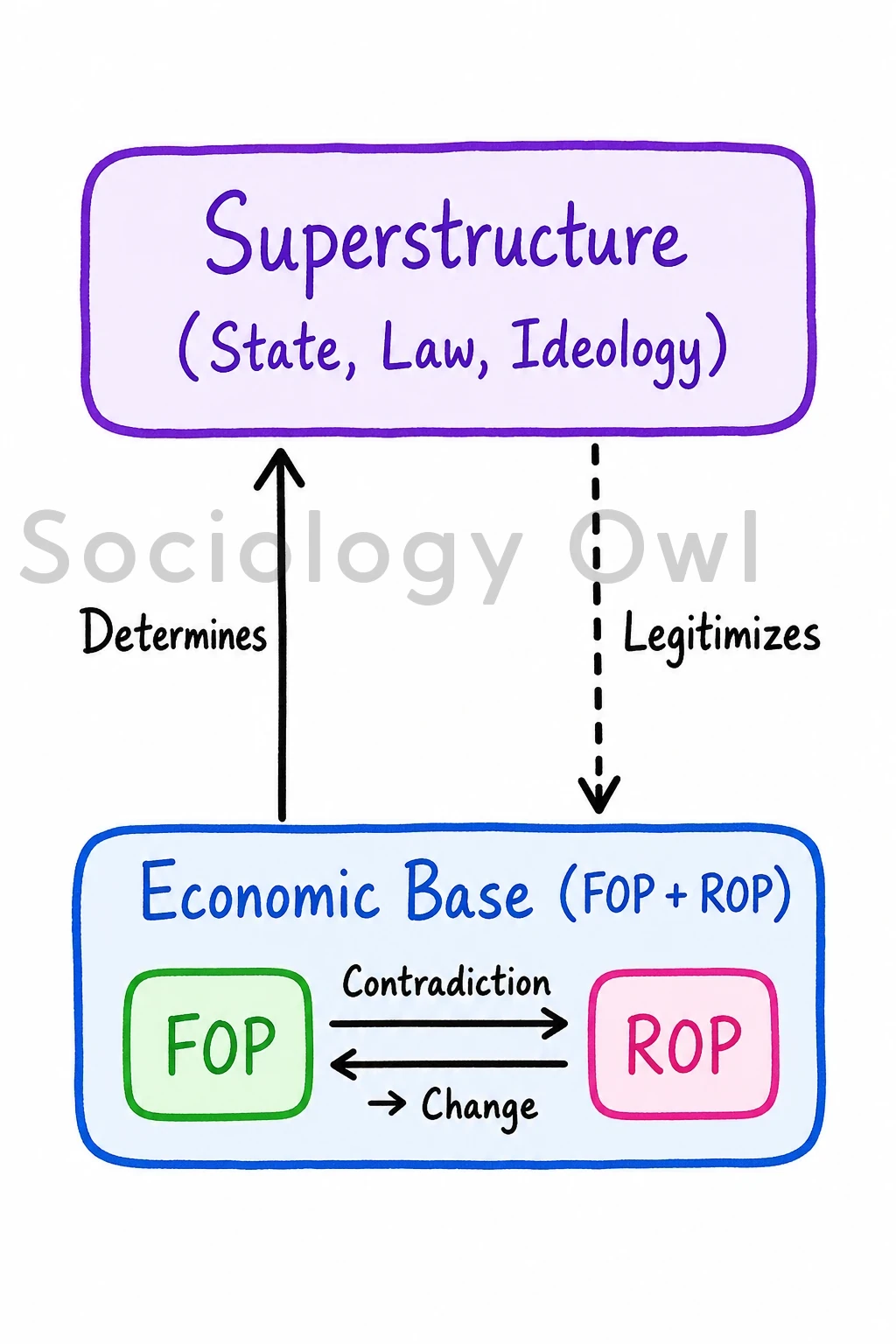
Karl Marx’s Historical Materialism constitutes an epistemological break from Hegel’s “Historical Idealism.” Marx asserted he “turned Hegel on his head” by arguing that material reality, not ideas, drives history. It posits that a society’s economic base determines its ideological superstructure (law, religion, state).

While classical economic determinism is outdated, historical materialism remains an indispensable analytical tool. As long as capitalism generates systemic inequalities and ecological crises, the Marxist lens—when integrated with post-modern and intersectional realities—remains highly potent for understanding social change.
Download our app for UPSC Sociology Optional - Syllabus, NCERT Books, IGNOU Books, Past Paper with Model Answers, Topper Notes & Answer Sheet.
Model Answers
Question asked in UPSC Sociology 2022 Paper 1. Download our app for last 20 year question with model answers.
Model Answer:
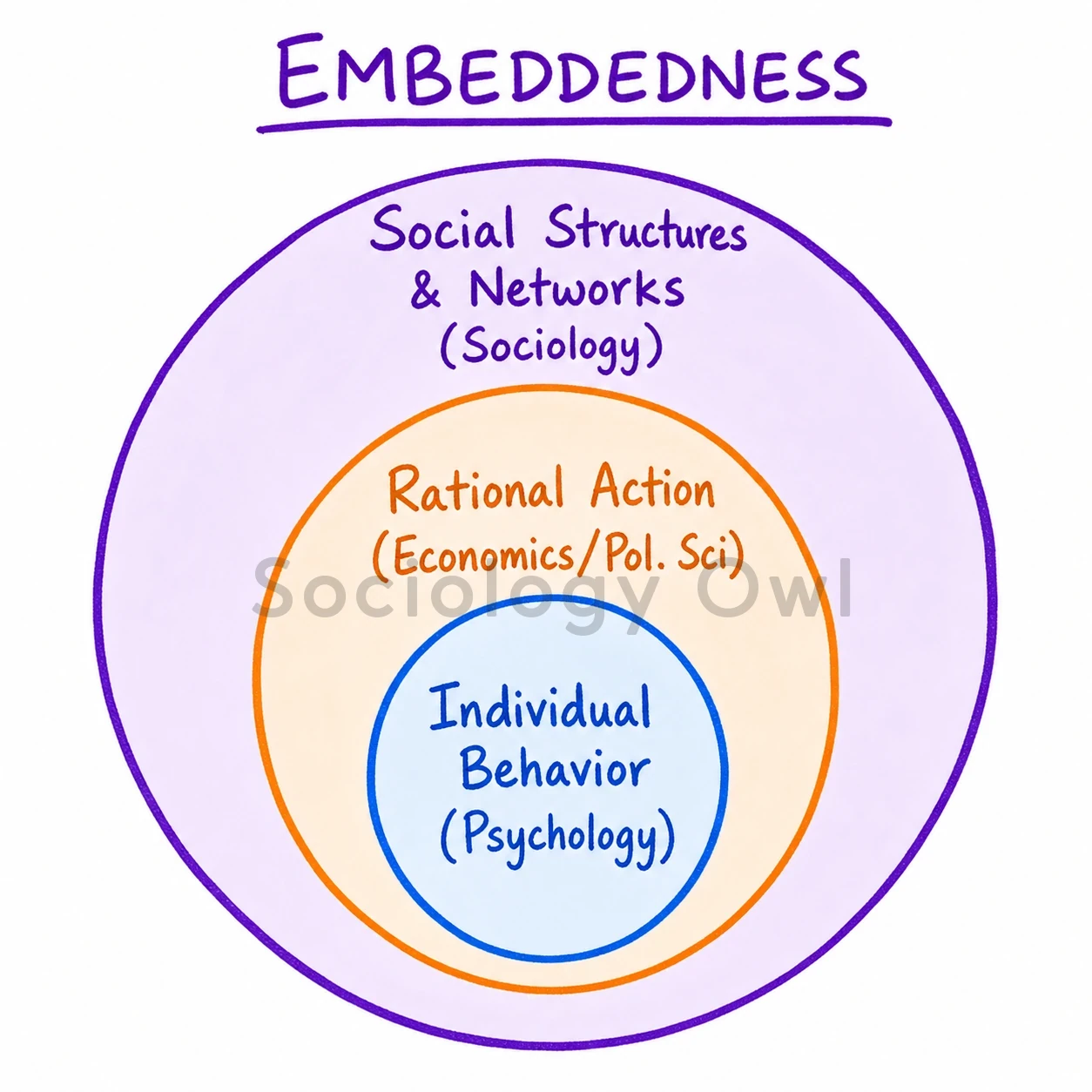
The scope of sociology is fundamentally debated between the Formalistic School (Georg Simmel), which limits it to specific forms of social relationships, and the Synthetic School (Emile Durkheim), which views it as a comprehensive, generalizing science. Despite overlaps, sociology maintains distinct analytical boundaries.

In studying the global Gig Economy, economics analyzes algorithmic wage structures, whereas sociology uniquely examines the resulting worker Alienation, social isolation, and shifting family dynamics.
While sociology possesses a distinct scope centered on systemic relationships and social structures, the complexities of modern society necessitate Interdisciplinarity. The rise of hybrid fields like Political Sociology demonstrates that rigid disciplinary boundaries are increasingly blurring.
Download our app for UPSC Sociology Optional - Syllabus, NCERT Books, IGNOU Books, Past Paper with Model Answers, Topper Notes & Answer Sheet.
Delimit the scope of sociology in relation to other social sciences Read More »
Model Answers
Question asked in UPSC Sociology 2022 Paper 1. Download our app for last 20 year question with model answers.
Model Answer:
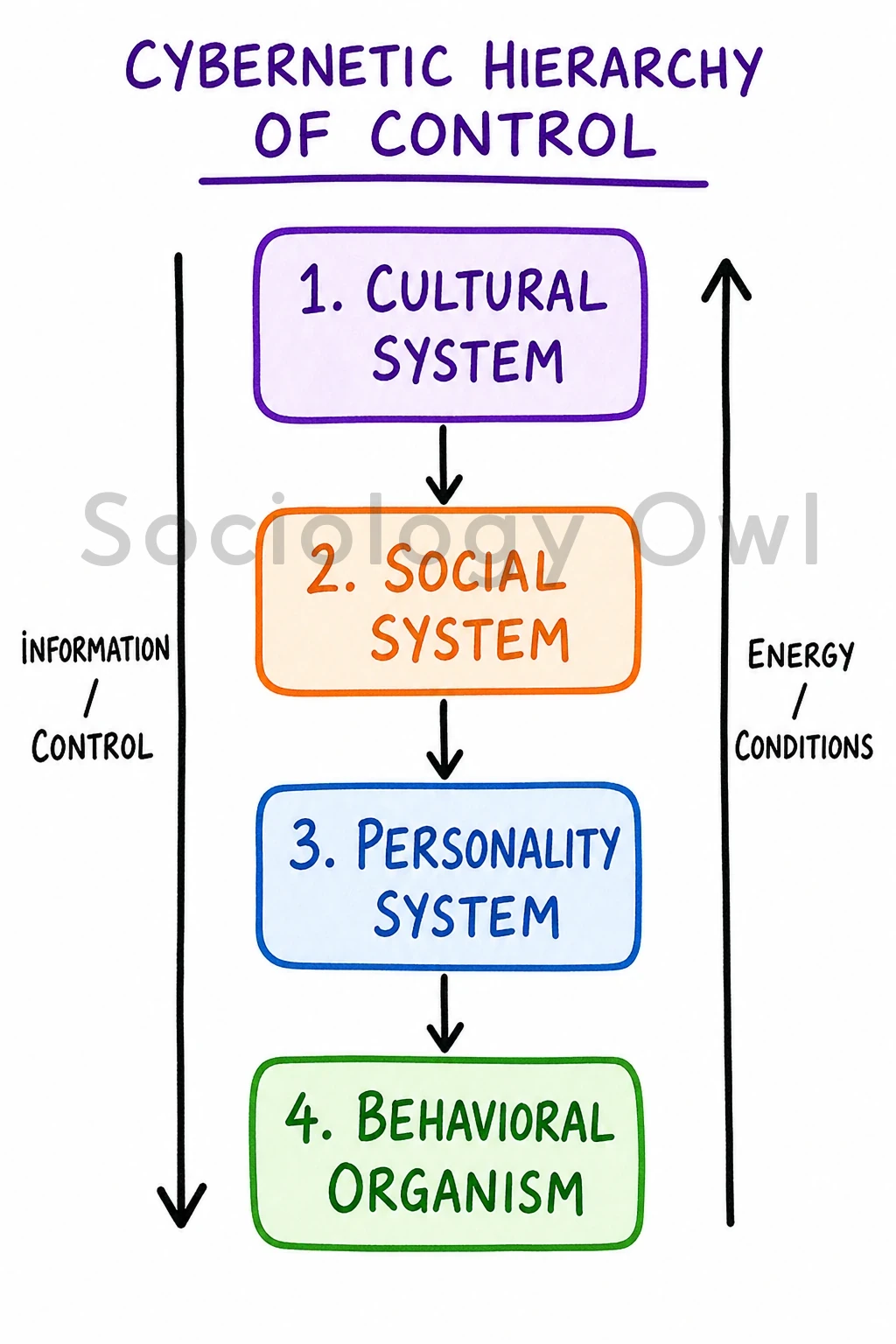
Talcott Parsons, in his seminal work The Social System, sought to resolve the “Hobbesian problem of order” by synthesizing Max Weber’s focus on social action with Emile Durkheim’s macro-social order. He defined a Social System as a plurality of interacting actors motivated by gratification optimization, whose relations are guided by a culturally structured system of shared symbols.

Parsons’ AGIL schema elegantly maps systemic responses to modern crises like the COVID-19 pandemic: societies had to Adapt (remote digital economy), set Goals (vaccine deployment by the State), ensure Integration (public health mandates), and rely on Latency (appealing to shared community values).
While classical Parsonian functionalism declined, its quest to understand society as an interconnected whole remains vital. It laid the foundation for Niklas Luhmann’s Systems Theory and Jeffrey Alexander’s Neo-functionalism, proving continuously relevant for analyzing complex, highly differentiated global societies.
Download our app for UPSC Sociology Optional - Syllabus, NCERT Books, IGNOU Books, Past Paper with Model Answers, Topper Notes & Answer Sheet.
Critically analyse Parsons views on society as a social system. Read More »
Model Answers
Question asked in UPSC Sociology 2022 Paper 1. Download our app for last 20 year question with model answers.
Model Answer:
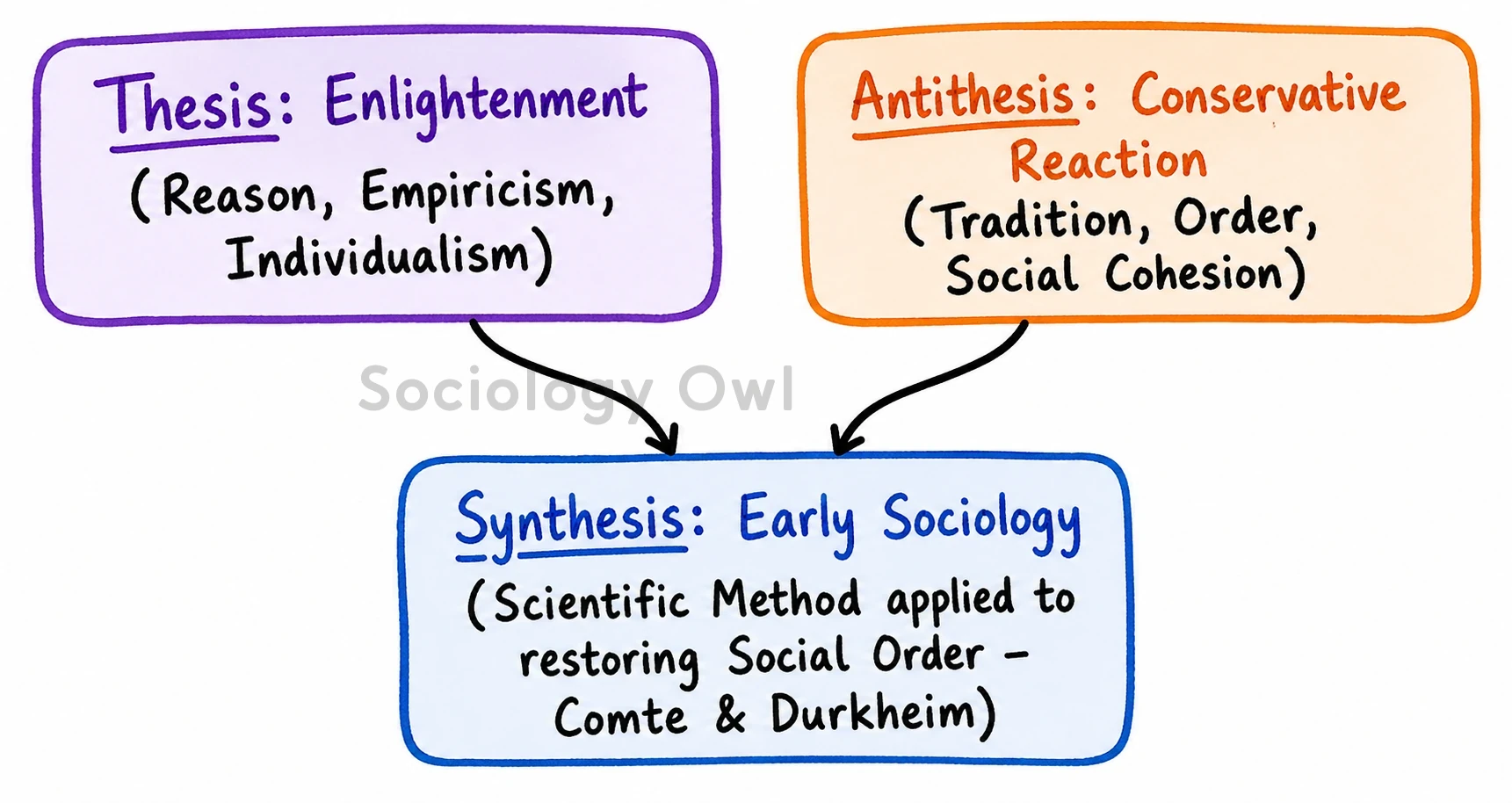
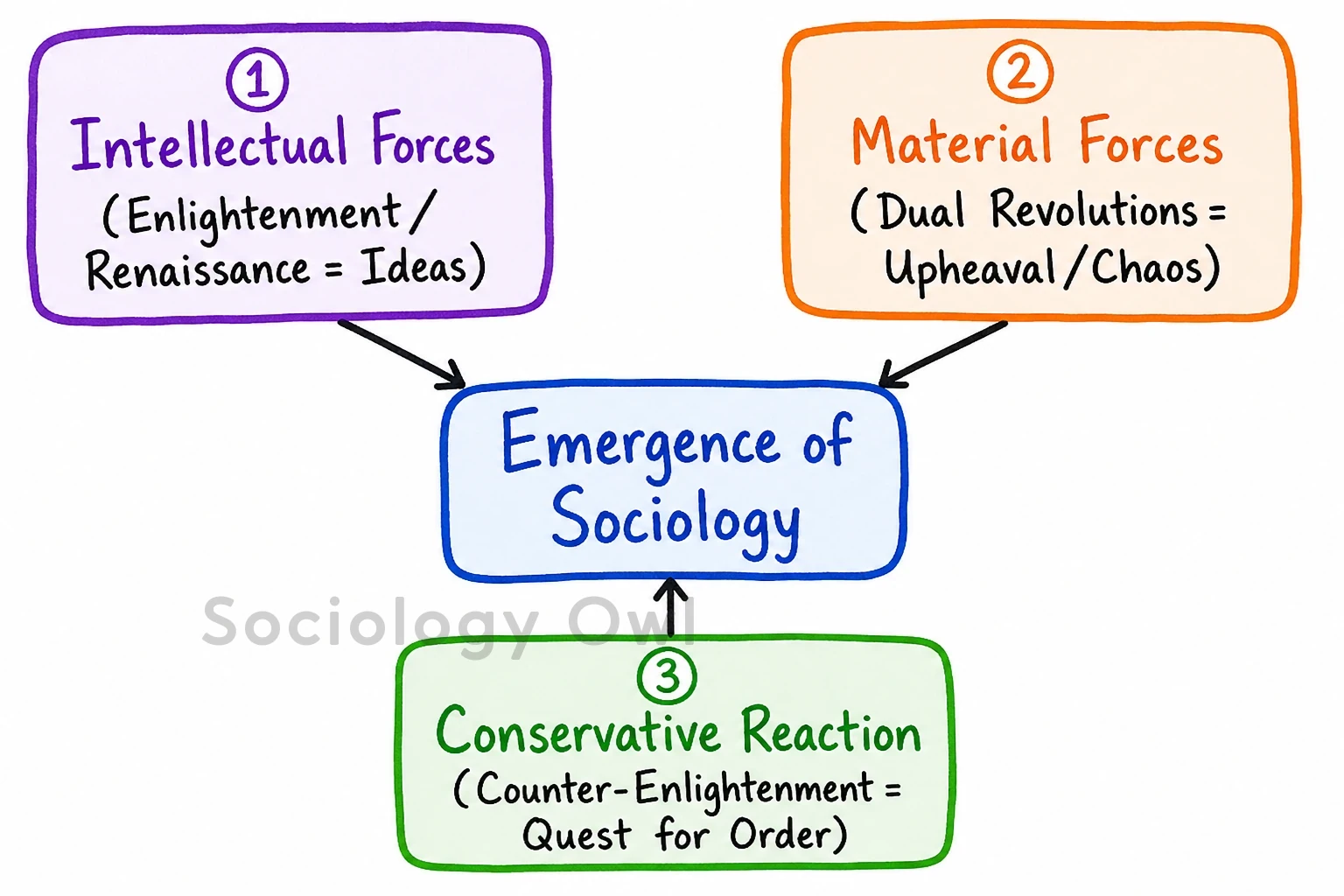
The Enlightenment (18th century) marked a radical shift from a theocentric (God-centered) medieval worldview to an anthropocentric (human-centered) “Age of Reason.” Alongside the material chaos of the French and Industrial Revolutions (the “Dual Revolution”), this intellectual awakening created the epistemological foundation for sociology.
Sociology emerged not just from a linear progression of Enlightenment ideals, but dialectically through a Conservative Reaction.

The Frankfurt School sociologists Theodor Adorno and Max Horkheimer, in Dialectic of Enlightenment, critiqued extreme instrumental rationality, arguing that it ultimately led to modern alienation and hyper-bureaucratized oppression, such as the Holocaust.
Today, sociology uses rational inquiry to study the limits of Enlightenment rationality, evident in the critical analysis of technologically driven algorithmic biases and the global ecological crises born from unchecked scientific “progress.”
Ultimately, sociology emerged as an intellectual response to the structural chaos of modernity. It was born from a unique dialectical synthesis—merging the Enlightenment’s empirical and rational methods with the Conservative desire for social solidarity and structural equilibrium.
Download our app for UPSC Sociology Optional - Syllabus, NCERT Books, IGNOU Books, Past Paper with Model Answers, Topper Notes & Answer Sheet.
Model Answer:
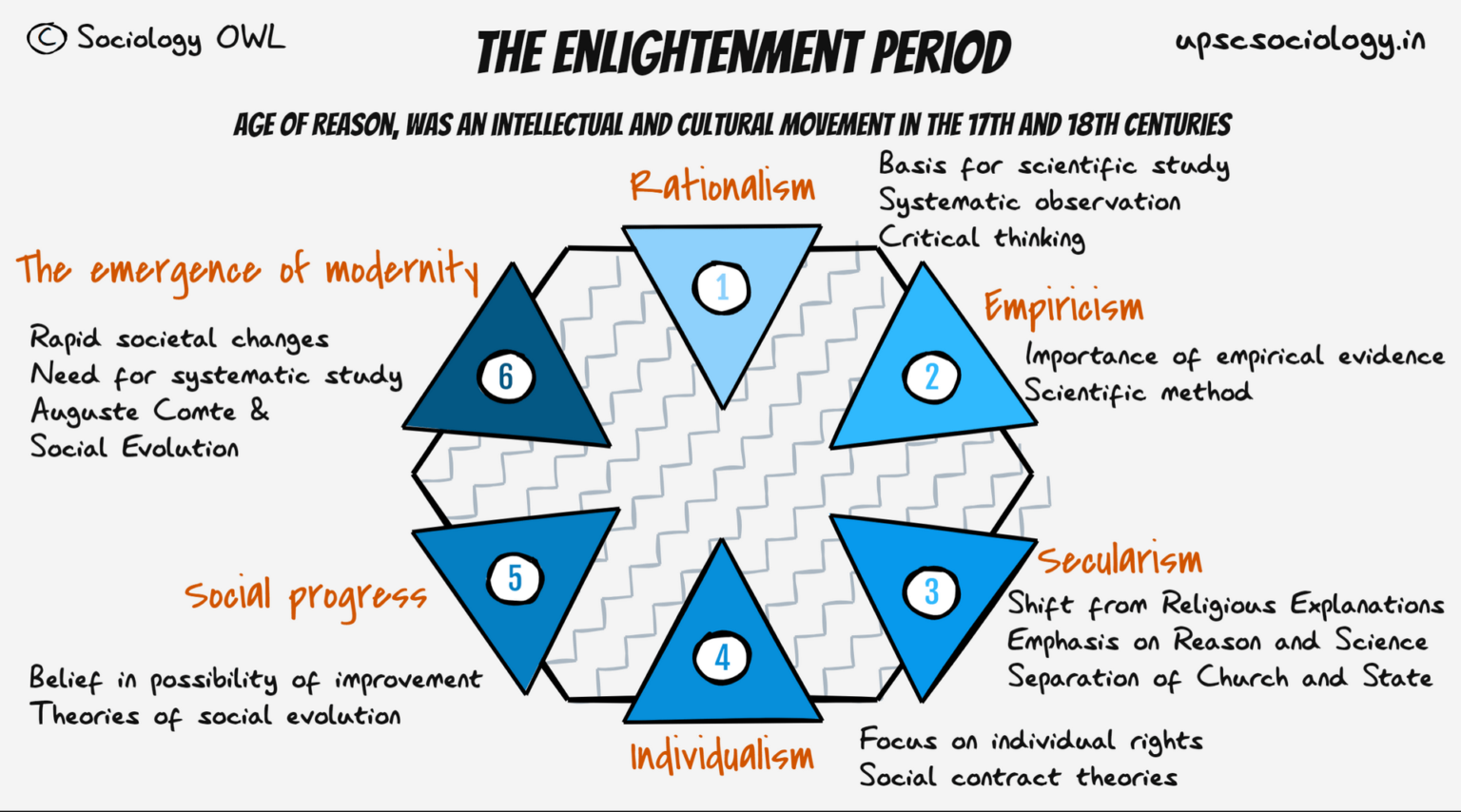
The emergence of sociology marked an epistemological shift from “Theodicy” (explaining society through divine will) to “Sociodicy” (rational understanding of society). The Renaissance birthed Humanism, while the Enlightenment introduced Reason and Positivism, providing the primary intellectual bedrock for the discipline.
Thinkers like Montesquieu (The Spirit of the Laws) pioneered comparative methods, while the Enlightenment belief that society is governed by discoverable laws inspired Auguste Comte’s Positivism.
The Renaissance shifted the analytical focus to human-centric studies, empowering Karl Marx’s historical materialism and critique of capitalism over religious dogmas.

The Counter-Enlightenment heavily shaped classical sociology. Thinkers like Louis de Bonald and Joseph de Maistre rejected extreme Enlightenment individualism. Emile Durkheim drew from this, scientifically studying the breakdown of community and diagnosing modernity’s “Anomie”.
Enlightenment provided the ideas, but the French Revolution and Industrial Revolution provided the chaos. Sociology emerged fundamentally as a quest for “Social Order” amid these upheavals.
Max Weber challenged the unbridled celebration of reason, warning of modernity’s “Iron Cage of Rationality” and the consequent “Disenchantment of the World”.
Raewyn Connell (Southern Theory) and Gurminder K. Bhambra argue classical sociology ignored how colonialism built “modernity.” Furthermore, Ibn Khaldun’s 14th-century work on “Asabiyyah” (social cohesion) significantly predates European sociology.
The ongoing global movement of “Decolonizing the Curriculum” actively challenges sociology’s Eurocentric origins. By integrating Indigenous, African (Ubuntu), and Asian epistemologies, modern universities are transforming sociology into a truly multipolar discipline.
While the Renaissance and Enlightenment supplied the crucial intellectual raw materials of reason and empiricism, sociology was fundamentally forged in the furnace of 19th-century socio-political crises. Today, the discipline continuously evolves past its European birth to critically analyze diverse global realities.
Model Answers
Question asked in UPSC Sociology 2021 Paper 2. Download our app for last 20 year question with model answers.
Model Answer:
Regionalism denotes political articulation of territorially based identities (linguistic, cultural, economic) seeking greater recognition or autonomy. Decentralization of power refers to constitutionally structured dispersal of authority from the Centre to states and below. In India, regionalism has been a major driver of federal restructuring, but its relationship with decentralization is complex, not automatic.
• Linguistic reorganisation of states (States Reorganisation Act, 1956) – As Paul Brass shows, linguistic regionalism led to creation of states like Andhra Pradesh, Maharashtra, Gujarat, which brought administration closer to vernacular publics and deepened “territorial democracy”.
• Strengthening federalism – Myron Weiner argued that accommodating regional demands through state formation (e.g., Haryana, Himachal Pradesh, later Uttarakhand, Jharkhand, Chhattisgarh, Telangana) has integrated peripheral regions and improved representation of historically neglected areas, a functional decentralization of political power.
• Rise of regional parties – Rajni Kothari and later Yogendra Yadav note that parties like DMK, TDP, Akali Dal, BJD, TRS converted regional grievances into bargaining power within coalition politics, shifting India from one‑party dominance to a multi-centric federal political system.
• Sub‑regional and tribal regionalism – Demands of Jharkhand, Bodoland, Gorkhaland, and North‑Eastern autonomy compelled greater recognition of ethnic and sub‑regional diversities and fed into reforms like the 73rd and 74th Amendments, pushing power downwards to local bodies.
• Elite capture of regions – Brass points out that regionalism is often mobilized by dominant elites. Once in power, these elites can centralize authority within the state (e.g., highly centralized leadership patterns in some Dravidian or North Indian parties), substituting central domination with regional domination.
• Centralised responses to regionalism – Secessionist or militant regionalism (Punjab’s Khalistan movement, Naga and Kashmiri movements) invited heavy central intervention, AFSPA, and President’s Rule, leading to re-centralization rather than decentralization.
• Fiscal and administrative centralisation – Economic regionalism (demands for special packages, backward-region status) can intensify vertical dependence on the Centre through grants, planning and regulatory controls, as noted by Rudolph and Rudolph in their analysis of “overdeveloped” central bureaucracy.
Thus, regionalism has often acted as a vehicle for democratizing and decentralizing Indian federalism, but its outcomes depend on state response and internal class power within regions.
Download our app for UPSC Sociology Optional - Syllabus, NCERT Books, IGNOU Books, Past Paper with Model Answers, Topper Notes & Answer Sheet.